8B - Dividing a line in a ratio
How can you locate a point one-third of the way along a sloping segment without measuring the diagram? You will find midpoints, divide segments in a stated ratio and work backwards to find a missing endpoint or ratio.
Midpoints
Where is the halfway point between and ? It must be halfway through both coordinate changes.
The total horizontal change is and the vertical change is . Starting at , half those changes take you to .
Midpoint
The midpoint of a segment is the point on the segment at equal distances from its endpoints.
For one coordinate, starting at and adding half the change gives . The same reasoning applies to the other coordinate.
Midpoint coordinates
The midpoint of and is
Not on the formulae sheet: learn it as the equal-ratio case of the division formula.
Average the two -coordinates together and the two -coordinates together. Do not mix a horizontal coordinate with a vertical one.
Worked example 1: halfway through each change
Question. Find the midpoint of and .
Plan. Average the coordinates in matching pairs.
Answer. .
Check. From to the changes are , and from to they are also . Thus both half-segments have length .
Now change one endpoint so that both coordinate sums are odd. A midpoint need not have integer coordinates.
Worked example 2: fractional midpoint coordinates
Question. Find the midpoint of and .
Plan. Use the same averages and retain exact fractions.
Answer. .
Check. Each half of the segment has horizontal change and vertical change , so the two lengths agree.
The formula also works for horizontal and vertical segments: averaging a coordinate that stays constant gives that same constant.
Internal division in a given ratio
A ratio tells you what fraction of the entire segment to travel from the first endpoint.
If , the whole segment contains equal parts, so is of the way from to . It is nearer , because is the shorter sublength.
[DIAGRAM: asset_name: One part and two parts along a segment; asset_slug: internal-ratio; caption: AP to PB is 1 to 2, so P is one-third of the way from A to B; description: Equal-scale axes show A at 1 comma 2, P at 5 comma 4 and B at 13 comma 8 on one line. Three equal steps along AB are indicated. The first step AP is pale blue and the two-step PB is pale peach.]
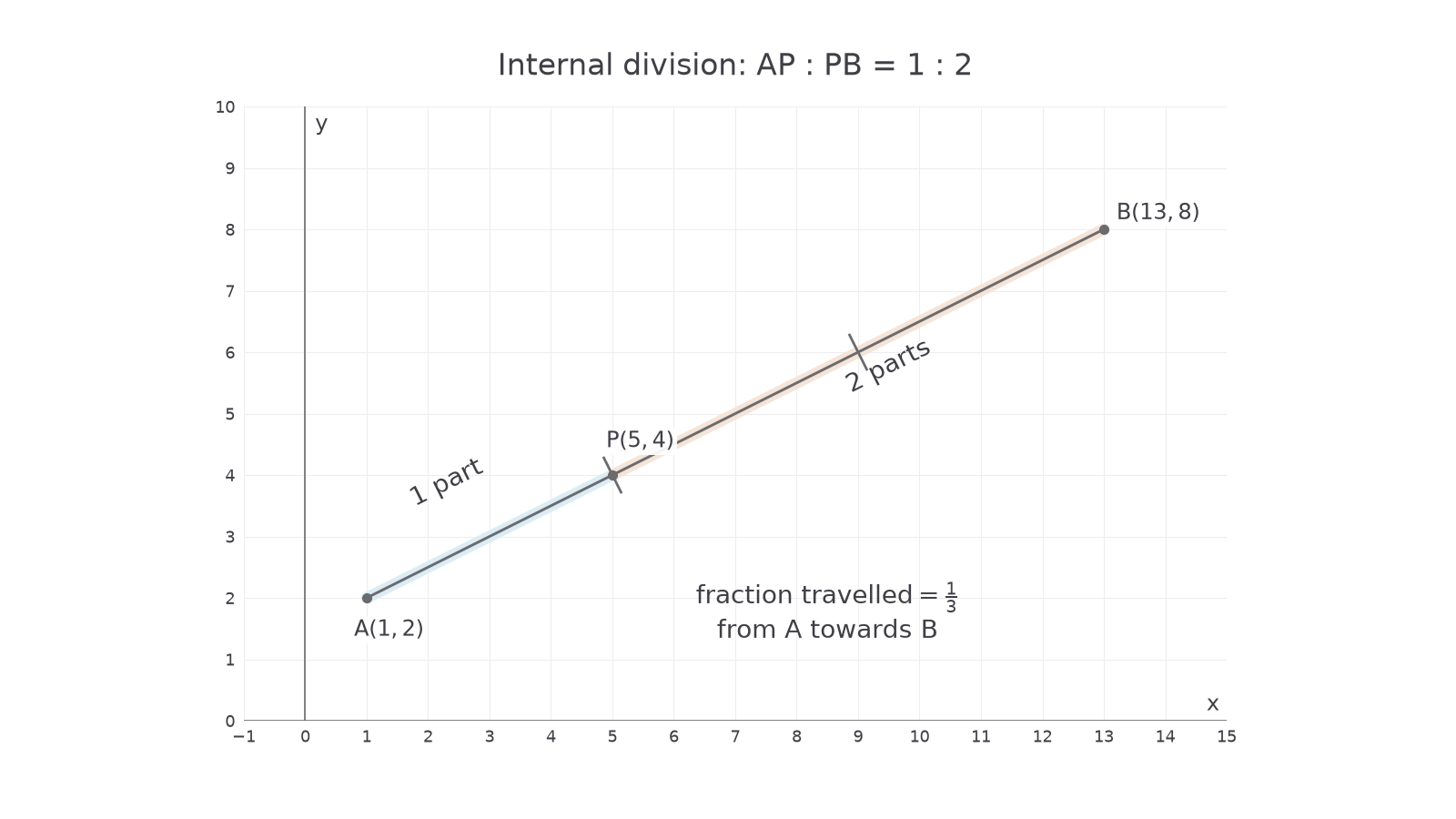
For , with , travel the fraction of each coordinate change. For example,
The weights look reversed because the starting coordinate contributes to both the starting position and the change.
Internal division coordinates
If the endpoints and are distinct and , where , then
This is internal division: lies strictly between and .
Not on the formulae sheet: learn it.
State the order before substituting. The coefficient of 's coordinates is , the numerator of the fraction travelled from .
Worked example 3: one-third of a segment
Question. and are joined by a segment. Find when .
Plan. Travel of each change from .
Answer. .
Check. The changes from to are ; those from to are . The second length is twice the first, as required.
Continue this lesson.
You’re previewing NovaLearn without an account. Create a free account to read the rest.
Create free account