2A - Completing the square
How small can a quadratic expression become? You will rewrite quadratics as a multiple of one square plus a constant, making their minimum or maximum visible without plotting lots of points.
Making a perfect square
How small can become as varies over all real numbers?
At it is ; at it is ; at it is again. Those values suggest a lowest point near , but checking a few values cannot prove a minimum. We need a form that tells us about every real .
Expand one square:
It has the right first two terms but the constant is too large. Subtracting gives
A square cannot be negative, so this expression is at least , with equality when .
Completing the square
Completing the square means rewriting a quadratic as a single squared linear expression, possibly multiplied by a constant, plus a remaining constant. The new expression must be equal to the original for every value of the variable.
The coefficient of in is twice . That is why we halve the middle coefficient.
Completing a monic square
For real constants ,
Halve , square that half, then compensate for the constant introduced.
Not on the formulae sheet: learn it.
Use the identity as a reason for the steps, rather than as a long formula to substitute into mechanically.
Worked example 1: an even middle coefficient
Question. Express in completed-square form.
Plan. Use , then correct its constant term.
Answer. .
Check. Expansion gives .
Change only the middle coefficient from to . Its half is a fraction; the method is unchanged.
Worked example 2: an odd middle coefficient
Question. Express in the form .
Plan. Halve and subtract the square of that half before adding the original constant.
Answer. , , giving .
Check. The constant after expansion is , and the middle term is .
The square of a bracket contains a cross term.
Watch out
: the expansion is . Also subtract the square of the half-coefficient, not the half-coefficient itself.
Keep fractions exact in the next expression.
Other leading coefficients
A leading coefficient other than one must be taken out before you complete the square inside a bracket.
For , first write . The middle coefficient inside is now , not . Every constant introduced inside that bracket is multiplied by the outside .
For any , the first step is
You may instead take out of all three terms, provided you divide the constant by too. Leaving the constant outside often keeps the arithmetic simpler.
Worked example 3: a positive leading coefficient
Question. Express in the form .
Plan. Factor from the first two terms, complete the square inside, then multiply out the correction.
Answer. .
Check. Expansion gives .
Keep the middle and constant terms but change the leading coefficient from to . This tests both a negative outside factor and division by a fraction.
Worked example 4: a negative fractional coefficient
Question. Express in completed-square form.
Plan. Take out from the first two terms, so the bracket starts with .
Answer. .
Check. Expanding gives . In particular, gives in both forms.
The outside factor is part of the expression, so it affects the correction as well as the square.
Watch out
becomes , not . Distribute the outside coefficient to every term.
Apply that same distribution carefully with a negative fraction.
Reading the completed-square form
A completed square locates a quadratic graph's turning point because it shows where the squared quantity is zero.
In , putting makes the square zero and gives . Moving the same distance to either side gives the same : for instance, and both give . The graph is symmetric about .
Vertex
The vertex of a quadratic graph is its turning point: its lowest point when the leading coefficient is positive, or its highest point when that coefficient is negative. The vertical line through it is the axis of symmetry.
For , where , the square is zero at . The vertex is therefore and the symmetry axis is . If , multiplying a nonnegative square by keeps it nonnegative, so . If , the inequality reverses and . In either case the bound is attained at the vertex.
[DIAGRAM: asset_name: One vertex with a minimum or a maximum; asset_slug: completed-square-vertices; caption: Changing the sign of the squared term changes a minimum into a maximum at the same vertex; description: Two coordinate plots with the same scales compare y equals 3 times x minus 2 squared minus 5 and y equals minus 3 times x minus 2 squared minus 5. Both have vertex 2 comma minus 5 and symmetry line x equals 2. The first opens upward and has minimum minus 5; the second opens downward and has maximum minus 5. Equal-distance points on either side of x equals 2 are shown at x equals 1 and x equals 3.]
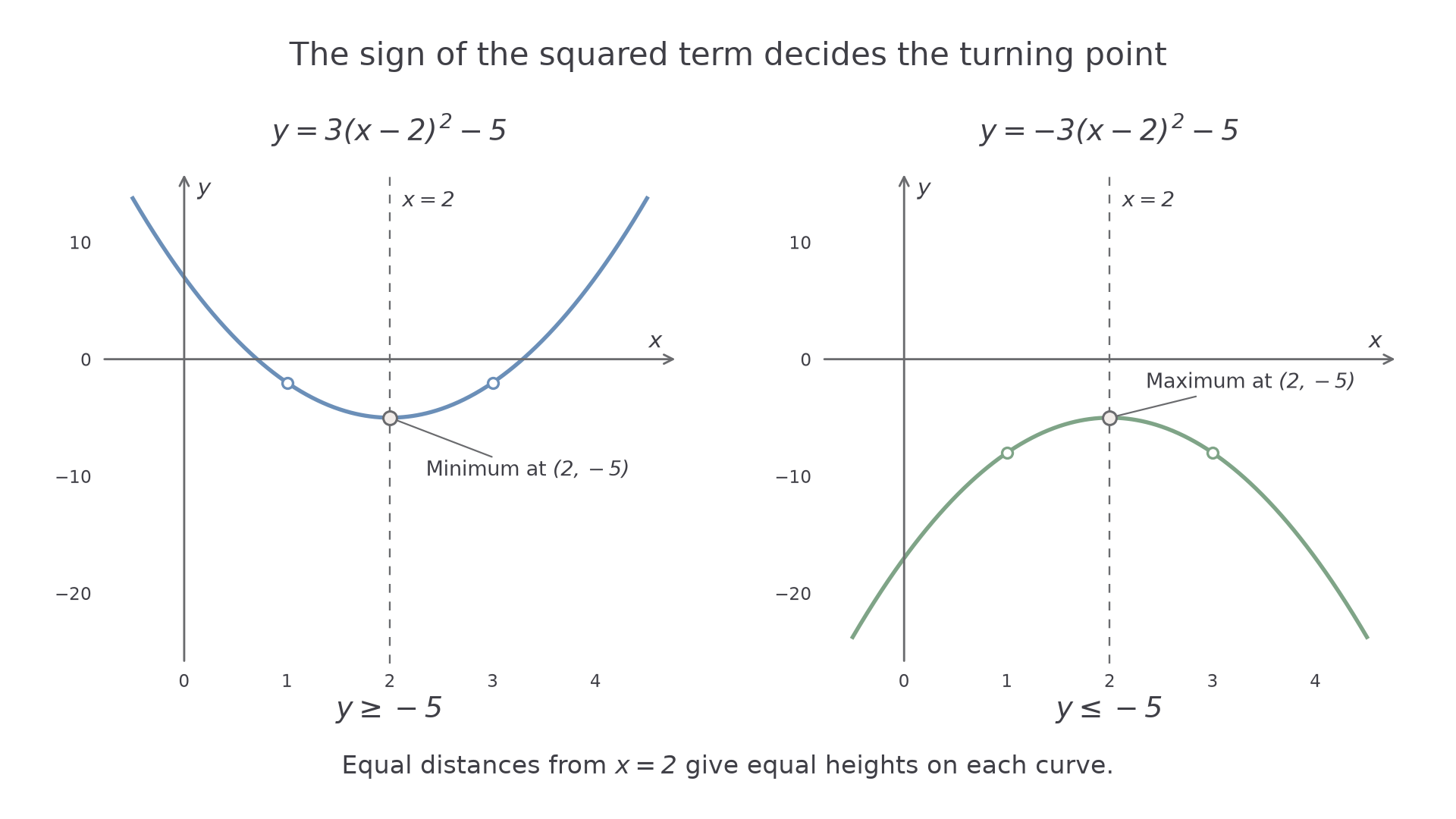
The completed-square form also describes graph transformations: shift the graph of horizontally by and vertically by . A negative reflects its opening downwards.
Worked example 5: a minimum
Question. For , find the vertex, axis of symmetry and minimum value.
Plan. Make the square zero and use the fact that a positive multiple of a square is nonnegative.
Answer. Vertex , axis , minimum value .
Check. At and , the value is , equally above the vertex. Expanding gives , so the leading coefficient is positive as expected.
Change only the multiplier of the square from to . The location where the square is zero stays fixed, but the bound becomes a maximum.
Worked example 6: a maximum
Question. For , find the vertex, axis of symmetry and maximum value.
Plan. Multiply the nonnegative square by the negative coefficient before interpreting the bound.
Equality occurs at .
Answer. Vertex , axis , maximum value .
Check. At and , , equally below the vertex. Expansion gives , with negative leading coefficient.
Read the sign inside the bracket by asking what value makes it zero.
Watch out
For , the vertex is , not . The minimum value is the -coordinate ; the value of where it occurs is .
This proves the opening expression has minimum , rather than merely suggesting it from a few plotted values.
Quick Recap
- Halve the middle coefficient inside a monic quadratic, then compensate for its square.
- For another leading coefficient, factor it out first and multiply the constant correction by it.
- The form has vertex and symmetry axis .
- Positive gives minimum ; negative gives maximum , for all real .
The opening expression is , so its minimum is exactly at .