10B - Trigonometric ratios beyond acute angles
Extend sine, cosine and tangent from right-angled triangles to rotations of any size. You will use coordinates to choose signs, derive the standard exact values and find related values in degrees or radians.
Angles of any magnitude
How can have a meaning when a right-angled triangle cannot contain an angle of ?
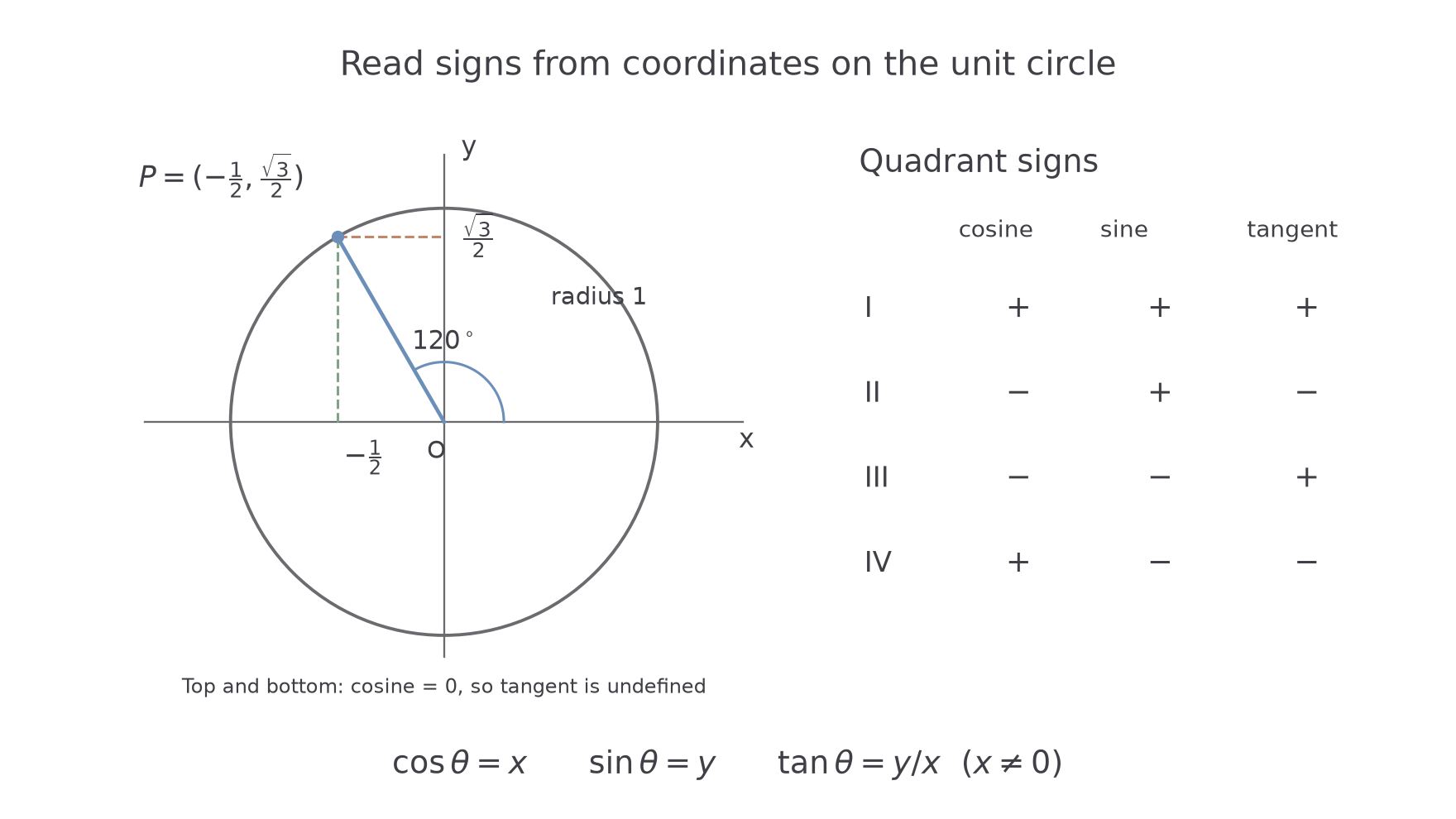
Start a radius on the positive horizontal axis and turn it anticlockwise. At , its endpoint is above and to the left of the centre. The vertical coordinate is still positive; the horizontal coordinate is now negative. Signed coordinates extend the familiar right-triangle ratios beyond acute angles.
[DIAGRAM: asset_name: Coordinates extend trigonometric ratios to every quadrant; asset_slug: unit-circle-signs; caption: Cosine is the horizontal coordinate and sine is the vertical coordinate on a unit circle; description: A unit circle shows a radius at 120 degrees, with endpoint minus one half, square root of three over two. Dashed horizontal and vertical projections connect the point to the axes. Each quadrant lists the signs of cosine, sine and tangent; tangent is undefined at the top and bottom of the circle.]
Unit circle
The unit circle has centre and radius . For an angle measured from the positive horizontal axis, its endpoint is
Positive angles turn anticlockwise; negative angles turn clockwise. On this circle, , provided .
For an acute angle the coordinates are the adjacent and opposite lengths with hypotenuse , so these definitions agree with the triangle ratios you already know. Sine and cosine are defined for every real angle and lie between and . Tangent is a quotient and need not lie in that range.
Number the quadrants anticlockwise, starting at the top right. Signs follow the coordinates, without a separate sign rule to guess:
| Quadrant | Horizontal coordinate: cosine | Vertical coordinate: sine | Tangent: sine divided by cosine |
|---|---|---|---|
| I | Positive | Positive | Positive |
| II | Negative | Positive | Negative |
| III | Negative | Negative | Positive |
| IV | Positive | Negative | Negative |
Points on the axes are not inside a quadrant. For example, at the endpoint is , so cosine is , sine is and tangent is undefined. At , the endpoint is , giving cosine , sine and tangent .
Worked example 1: ratios from coordinates
Question. The endpoint for angle on the unit circle is . State its quadrant and find the three trigonometric ratios.
Plan. Read cosine and sine from the coordinates, then divide to find tangent.
The negative horizontal coordinate and positive vertical coordinate place the point in quadrant II.
Answer. Quadrant II; , , .
Check. The corresponding right triangle has side lengths . Tangent has magnitude and is negative because its coordinates have opposite signs.
Reflect the point below the horizontal axis next. Both coordinates are negative, but their quotient becomes positive.
Worked example 2: two negative coordinates
Question. The endpoint for angle is . State its quadrant and find the three ratios.
Plan. Use the new vertical coordinate, retaining the original horizontal coordinate.
Both coordinates are negative, so the point is in quadrant III.
Answer. Quadrant III; , , .
Check. Reflecting across the horizontal axis leaves the horizontal coordinate unchanged and reverses the vertical coordinate, exactly as the cosine and sine values show.
A full turn returns to the same endpoint. Adding , or radians, therefore leaves all three ratios unchanged wherever tangent is defined.
Exact trigonometric values
Two special right triangles give exact values without a calculator.
An isosceles right triangle with legs and has hypotenuse by Pythagoras. Both acute angles are , so , and .
Next split an equilateral triangle of side into two equal right triangles. Each has hypotenuse , shorter leg and height . The angle opposite the shorter leg is ; the other is . Reading opposite, adjacent and hypotenuse gives the remaining values.
Standard exact values
| Angle in degrees | Angle in radians | Sine | Cosine | Tangent |
|---|---|---|---|---|
These values are not on the formulae sheet: learn them. The relation is provided on that sheet.
Continue this lesson.
You’re previewing NovaLearn without an account. Create a free account to read the rest.
Create free account