4A - Sketching polynomial graphs
How much of a curve can you predict before plotting any points? Factors reveal where a polynomial meets an axis, while the highest power tells you where its ends go. You will combine these clues to make a labelled sketch without finding exact turning points.
Intercepts and factors
The equation looks like an instruction to multiply three numbers. Can those same brackets tell you where its graph crosses the axes?
On the -axis, . A product is zero when at least one factor is zero, so , and are the three roots. On the -axis, , so the height is . These are exact points, even on a rough sketch.
Intercept
An intercept is a point where a graph meets a coordinate axis. An -intercept has coordinates , where is a real root of . The -intercept is .
Set the output to zero for -intercepts; set the input to zero for the -intercept. Keep the coordinates in that order.
Worked example 1: reading factors
Question. Find the intercepts of .
Plan. Set each factor equal to zero, then substitute .
Answer. , , and .
Check. Substitution of each stated root makes one bracket zero. Expanding gives , whose constant term independently confirms .
Now change only the multiplier in front. This changes the heights, but a nonzero multiplier cannot change which inputs make the product zero.
Worked example 2: a negative multiplier
Question. Find the intercepts of .
Plan. Keep the roots of the three brackets and recalculate the height at .
Answer. , , and .
Check. Every height in example 1 is multiplied by . In particular, becomes , and zero heights remain zero.
A root is an input, while an intercept is a point. Writing the point helps you avoid swapping the axes.
Crossing or touching an axis
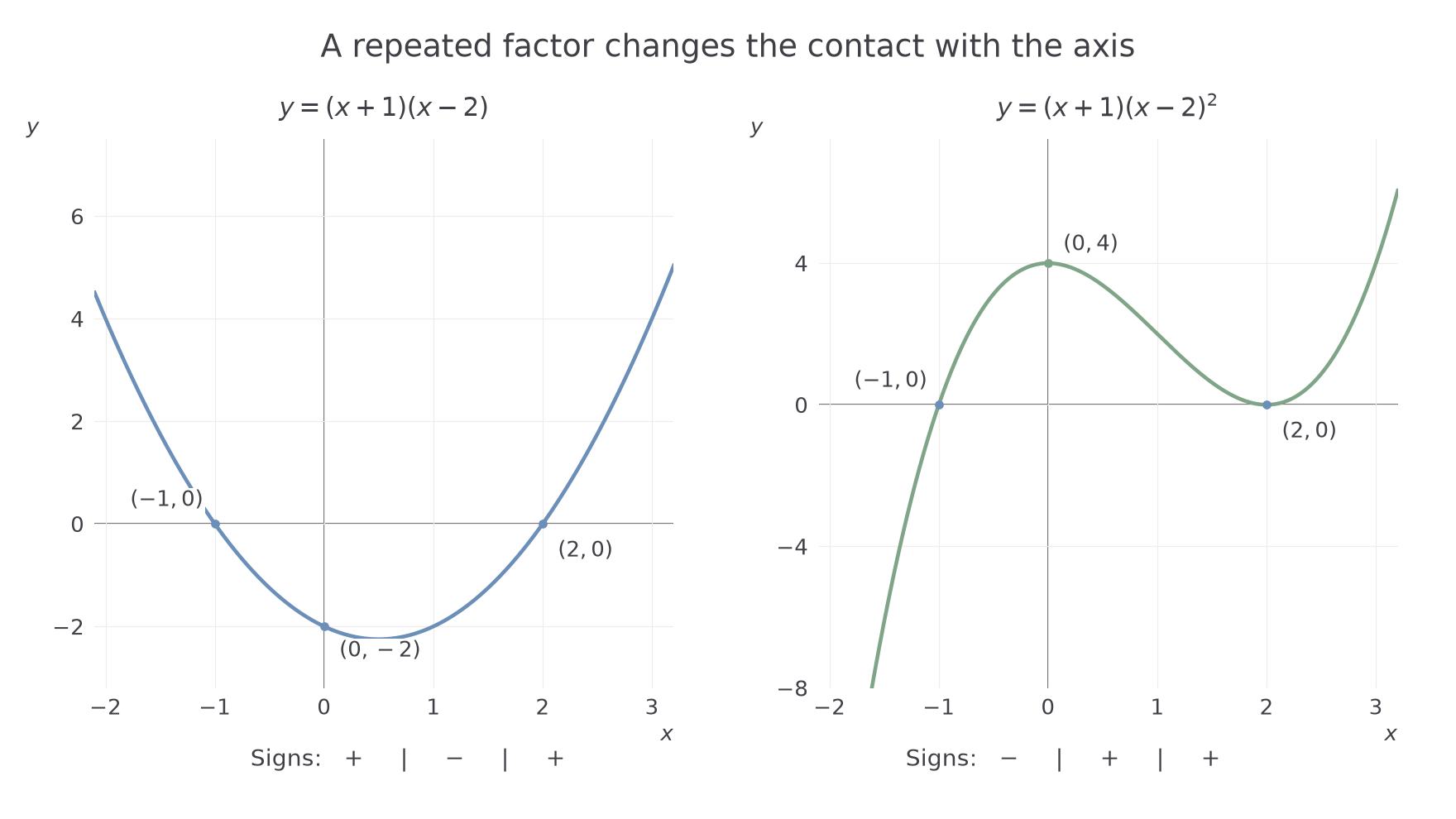
A root tells you where the graph reaches the -axis; its repeated factors tell you what happens there.
Compare with . Near , the first bracket is positive in both cases. The factor changes from negative to positive, but its square stays nonnegative. The first graph crosses the axis at ; the second touches it and returns to the same side.
[DIAGRAM: asset_name: A repeated factor changes crossing into touching; asset_slug: crossing-touching; caption: Squaring the factor x minus 2 makes the graph touch the axis at 2; description: Side-by-side coordinate graphs show y equals (x plus 1)(x minus 2), crossing at minus 1 and 2, and y equals (x plus 1)(x minus 2) squared, crossing at minus 1 but touching from above at 2. Intercepts are labelled and sign strips show plus minus plus for the first graph and minus plus plus for the second.]
Multiplicity
If , where , the root has multiplicity . An odd multiplicity makes the graph cross the -axis; an even multiplicity makes it touch without crossing.
Why does this work? Close enough to , keeps its sign. An odd power of changes sign across , whereas an even power does not. A root of multiplicity three still crosses, even though it can look flatter than a simple crossing.
Worked example 3: simple crossings
Question. Describe how meets the -axis.
Plan. Use one test input in each interval separated by the roots.
The sign changes at both and , so the curve passes through the axis at each root.
Answer. It crosses at and .
Check. Both factors occur once. Each therefore has odd multiplicity, agreeing with the two sign changes.
Change just one factor to a square. The test values now show exactly which crossing changes.
Worked example 4: a repeated root
Question. Describe how meets the -axis.
Plan. Find multiplicities, then verify the signs on the three intervals.
At the sign changes; at it stays positive. The squared factor is nonnegative, and near , so the contact is from above.
Answer. It crosses at and touches from above at .
Check. The multiplicities are and : odd then even, agreeing with the sign table.
Test values work because a polynomial is continuous and cannot change sign inside an interval without another root. A sketch must respect these signs.
Continue this lesson.
You’re previewing NovaLearn without an account. Create a free account to read the rest.
Create free account