8A - Distances between points
Coordinates describe position, but they also let you measure a length exactly. You will build the distance formula from a right-angled triangle, find missing coordinates from length conditions and use exact lengths to investigate geometric figures.
Distance from coordinate differences
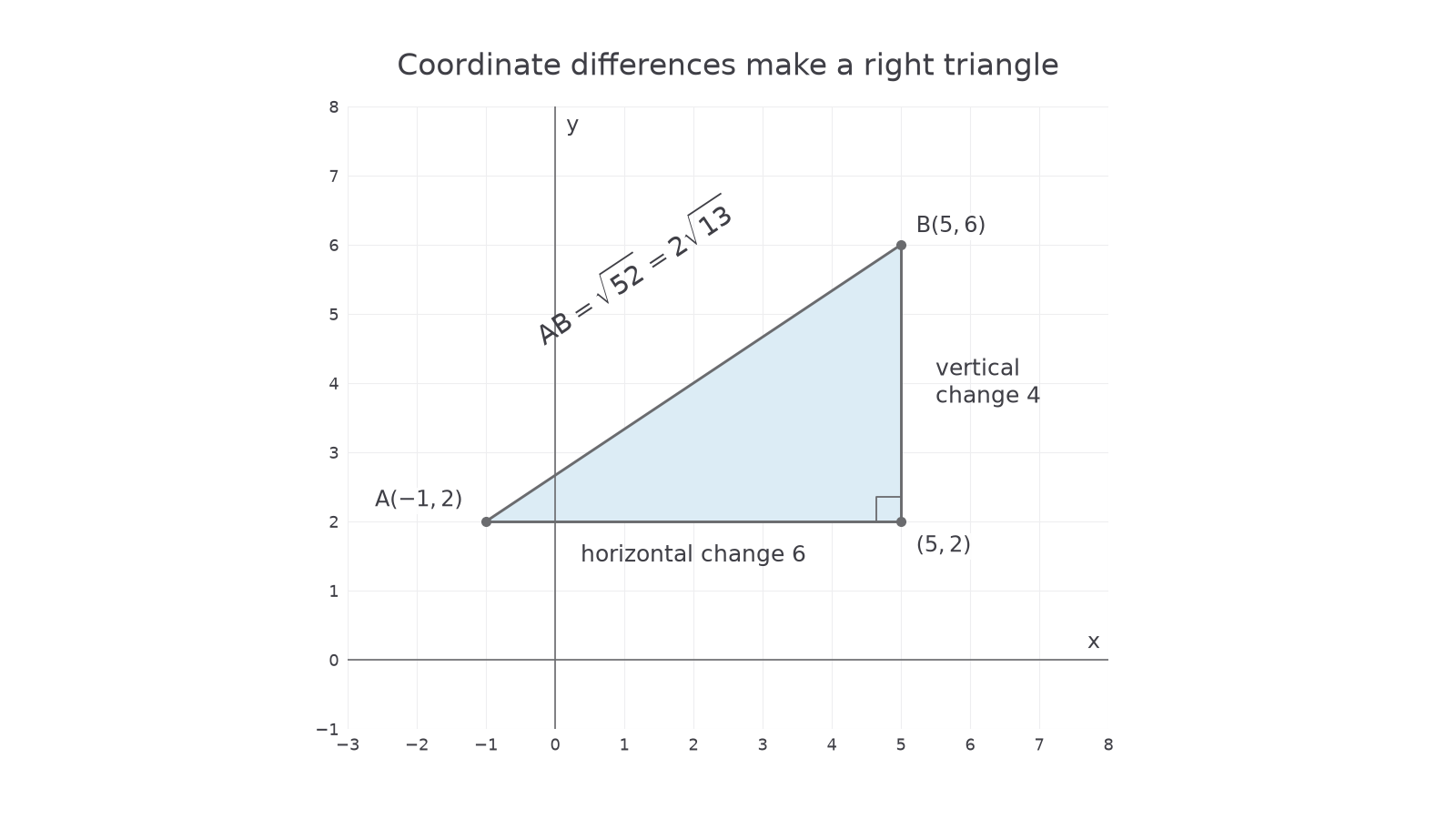
From to , you move units across and units up. Is the straight-line distance units?
That sum measures a journey along two sides of a right-angled triangle. The direct route is its hypotenuse, so Pythagoras gives its square as .
[DIAGRAM: asset_name: Coordinate differences form a right triangle; asset_slug: coordinate-distance; caption: The direct distance is the hypotenuse, with horizontal change 6 and vertical change 4; description: Equal-scale coordinate axes show A at minus 1 comma 2 and B at 5 comma 6, a right-angle corner at 5 comma 2, horizontal side 6, vertical side 4 and hypotenuse 2 square root 13.]
Distance between two points
For and ,
and hence
The distance is nonnegative. It is zero exactly when the points coincide.
Not on the formulae sheet: learn it.
A coordinate difference may be negative; its square supplies the squared side length. Reversing both differences leaves the distance unchanged.
Worked example 1: the direct route
Question. Find the exact distance from to .
Plan. Find the two coordinate changes, use Pythagoras and simplify the root.
Answer. units.
Check. , so the distance is between and , shorter than the two-stage route of .
Now let the horizontal change be negative. The sign changes the direction of travel, not the length.
Worked example 2: a negative coordinate change
Question. Find the exact distance from to .
Plan. Keep the negative difference inside brackets before squaring.
Answer. units.
Check. Reversing the direction gives changes and , whose squares still sum to .
The same formula includes horizontal and vertical segments. If the -coordinates agree, the distance is ; if the -coordinates agree, it is . For example, to has length , and to has length .
Watch out
, whereas . Put each complete coordinate difference in brackets. A negative final distance signals an error.
Use an exact root in the next calculation.
Equal-length conditions
When two lengths are equal, their squares are equal too, so you can often solve the condition without carrying square roots through the algebra.
For nonnegative lengths and , is equivalent to . This equivalence is why comparing squared distances loses no geometric information.
Worked example 3: equidistant from two points
Question. , and satisfy . Find .
Plan. Set the squared distances equal and expand; the quadratic terms will cancel.
Answer. .
Check. is units from each endpoint: both squared distances are .
Continue this lesson.
You’re previewing NovaLearn without an account. Create a free account to read the rest.
Create free account