9C - Areas bounded by curves
How can two regions with positive areas give an integral of zero? You will turn signed integrals into geometric areas, find the region between two curves, and choose between vertical and horizontal strips when one direction makes the calculation simpler.
Areas between a curve and an axis
An integral adds signed strip contributions, whereas a geometric area measures how much surface a region covers.
A thin vertical strip between a curve and the horizontal axis has width and height equal to the distance from the curve to the axis. Above the axis this height is ; below it the height is . First find the intercepts and decide the sign on each interval. A test value in each interval is enough for a continuous curve with all its zeros identified.
Area and the x-axis
For , if throughout the interval,
If throughout it,
If the sign changes, split at the zeros and add the positive areas. The area integral formulae must be learnt; they are not on the examination formulae sheet.
An area has square units. If coordinates measure centimetres, strip height times strip width gives square centimetres.
Worked example 1: a region above the axis
Question. Find the area bounded by and the -axis.
Plan. Find the intercepts, check the sign between them, then integrate.
Both factors are positive for , so the curve is above the axis there.
Answer. square units.
Check. The maximum height is at . The region fits inside a rectangle of area and contains the triangle joining the intercepts to the maximum, of area . The answer lies between these bounds.
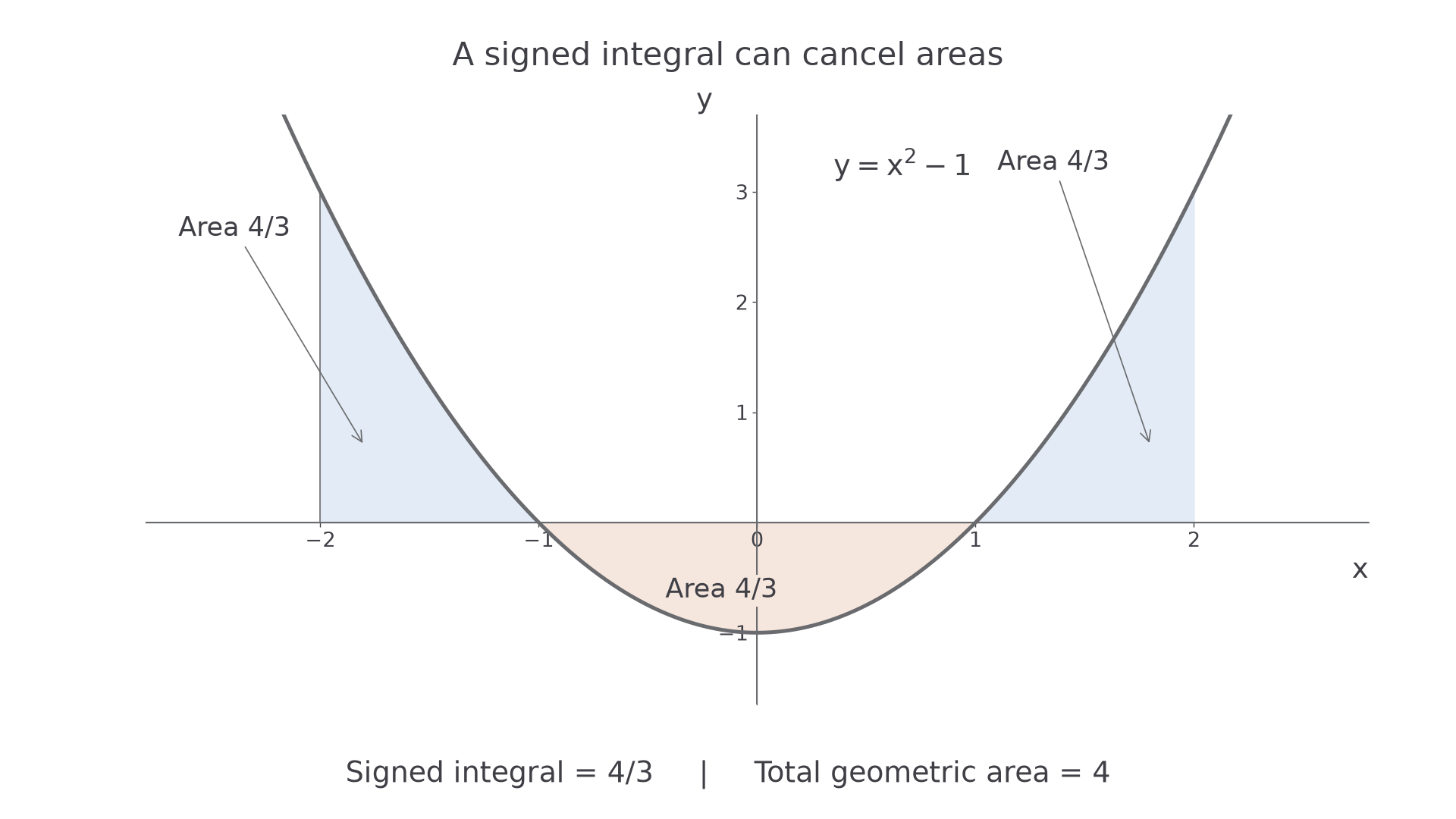
Now let the curve cross the axis inside the interval. Taking the absolute value of one integral over the whole interval can still lose area through cancellation.
[DIAGRAM: asset_name: Signed contributions and total area; asset_slug: signed-area; caption: The curve crosses the axis at minus 1 and 1, so its three regions must be treated separately; description: The graph y equals x squared minus 1 from x equals minus 2 to 2 has roots minus 1 and 1. The outer regions above the axis are shaded pale blue and the middle region below it pale clay. Each region has geometric area 4 over 3. Labels distinguish signed integral 4 over 3 from total geometric area 4.]
Worked example 2: a curve on both sides of the axis
Question. Find the total area between , the -axis and the lines , .
Plan. Split at , where . Reverse the sign of the integral for the middle region.
Let . Then
The middle integral is negative because the curve is below the axis.
Answer. square units.
Check. . The signed integral over the whole interval is . Adding twice the magnitude of the negative contribution gives , as required when that contribution changes from negative to positive.
Use the zeros to decide the pieces before evaluating the next integral.
Area between two curves
A vertical strip between two curves has height equal to its upper coordinate minus its lower coordinate.
Neither curve needs to be above the axis: the difference measures their separation. Solve the two equations simultaneously to find intersections. Use a sketch or a test value to identify which curve is higher on each interval. If they exchange order, split the area there.
Upper curve minus lower curve
If for ,
For a region enclosed by the curves alone, the limits come from their intersections.
Worked example 3: finding the boundaries
Question. Find the area enclosed by and .
Plan. Find the intersections and integrate the positive difference.
At , the quadratic gives and the line gives , so the quadratic is above the line between the intersections.
Answer. square units.
Check. The separation has maximum . The area is less than the enclosing rectangle , and differentiating the displayed antiderivative recovers that separation.
The next pair meets three times. One choice of “upper minus lower” will not work on both sides of the middle intersection.
Continue this lesson.
You’re previewing NovaLearn without an account. Create a free account to read the rest.
Create free account