8D - Equations of straight lines
A point fixes a position; a gradient fixes a direction. You will combine them to describe a whole line, recognise equivalent equation forms and find where lines meet by solving their equations together.
A point and a gradient
How can one point and one gradient determine every other point on a line?
Take a line through with gradient . Moving horizontally from to changes by , so the matching vertical change must be . The new vertical coordinate therefore satisfies .
Point-gradient form
A line of finite gradient through has equation
Every point on the line satisfies this relation, including the given point, where both changes are zero.
Not on the formulae sheet: learn it.
The equation compares coordinate changes. This explains why both brackets must refer to the same starting point.
Worked example 1: using a positive gradient
Question. Find the equation of the line through with gradient , in the form .
Plan. Substitute the point and gradient, then expand and isolate .
Answer. .
Check. At , the equation gives . Increasing by increases by , so the gradient is correct too.
Now use a negative fractional gradient and a negative starting coordinate. The method is unchanged, but both signs need care.
Worked example 2: a negative fractional gradient
Question. Find the equation through with gradient , in the form .
Plan. Write before expanding.
Answer. .
Check. Substituting gives . From to the point , the gradient is .
One coordinate alone cannot check a proposed equation: the given point and the gradient must both agree.
Watch out
Through , the bracket is , not . Substituting the given point into the completed equation is a quick way to catch this sign error.
Keep the fraction exact in the next equation.
Equivalent line forms
Rearranging a line's equation changes its appearance while keeping the same set of points.
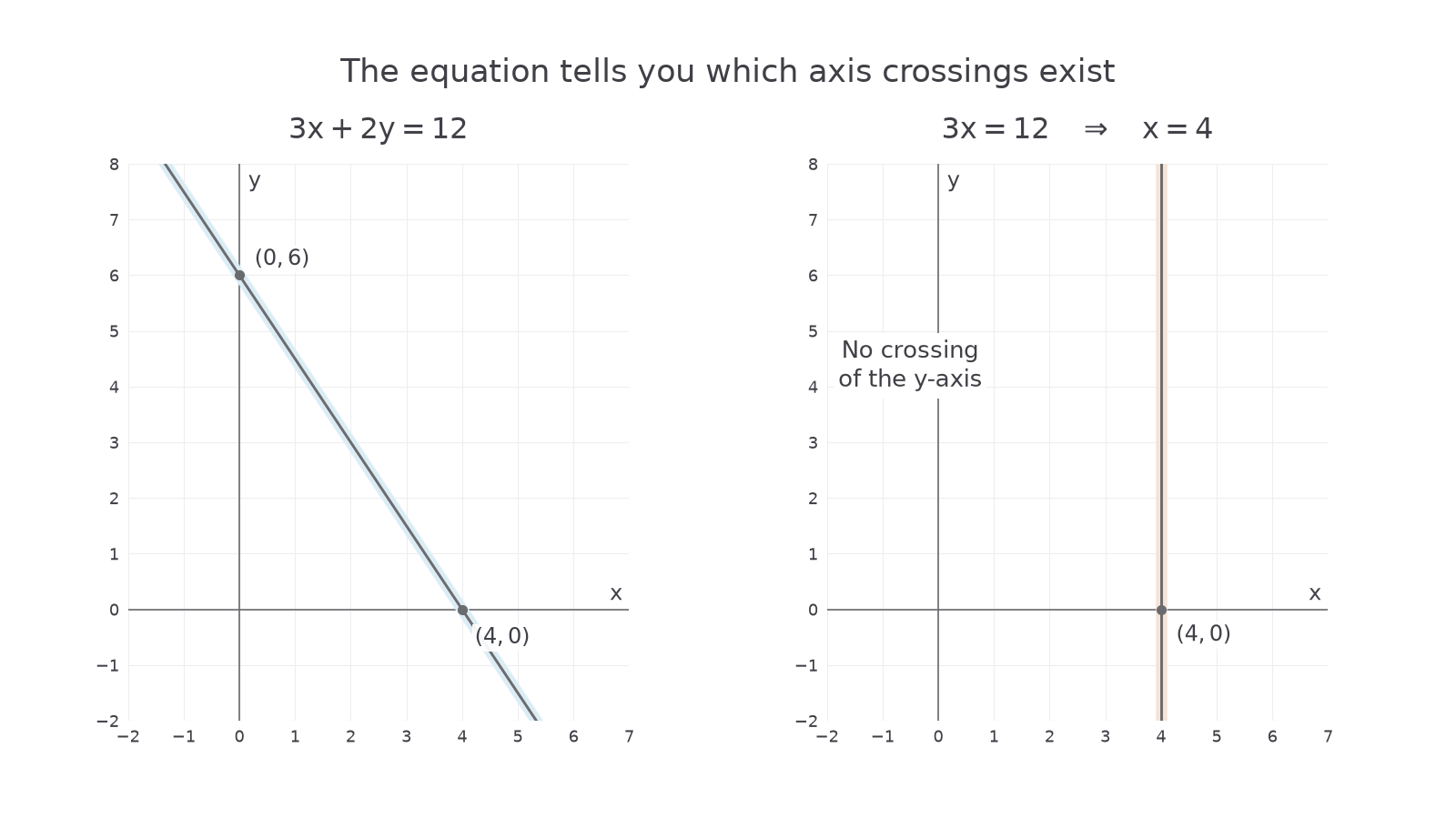
For a nonvertical line, displays its gradient and its -intercept . An intercept is a point where a line meets a coordinate axis. Set for an -intercept, and for a -intercept.
[DIAGRAM: asset_name: Intercepts and a vertical line; asset_slug: line-forms; caption: The line 3x plus 2y equals 12 has two axis intercepts, while x equals 4 is vertical; description: Two equal-scale panels show the line 3x plus 2y equals 12 through 0 comma 6 and 4 comma 0, and the vertical line x equals 4. The vertical line crosses the x-axis at 4 comma 0 and never crosses the y-axis.]
General straight-line form
describes a straight line when and are not both zero.
If , rearranging gives
If , then and the line is vertical: .
Not on the formulae sheet: learn these forms.
A horizontal line has equation . A vertical line has equation and cannot be written with a finite gradient in the form . The exceptional case would give either all points or no points, rather than a line.
Worked example 3: reading gradient and intercepts
Question. Find the gradient and both axis intercepts of .
Plan. Isolate for the gradient, then set one coordinate to zero for each intercept.
With , , so . With , , so .
Answer. Gradient ; intercepts and .
Check. Both intercepts satisfy the original equation, and their gradient is .
Continue this lesson.
You’re previewing NovaLearn without an account. Create a free account to read the rest.
Create free account