10E, 10F - Using trigonometric identities
Knowing one trigonometric ratio often lets you find the others without finding the angle. In 10E, you will connect sine and cosine through the unit circle; in 10F, you will write tangent as their quotient. Together, these identities let you calculate exact values and prove that different expressions are equal wherever they are defined.
The Pythagorean identity
If you know that , must be ? The size is determined, but its sign depends on where the angle ends.
For example, the point lies on the unit circle because . Its horizontal coordinate is negative and its vertical coordinate is positive, so it represents an angle in the second quadrant. Its cosine is , even though its sine is positive.
[DIAGRAM: asset_name: Sine and cosine on the unit circle; asset_slug: identity-unit-circle; caption: The radius is 1, so the squares of the horizontal and vertical coordinates add to 1; description: A unit circle centred at O has a radius to a point P in quadrant two, labelled P equals cos theta comma sin theta. A perpendicular from P to the horizontal axis makes a right triangle. The horizontal coordinate is negative and the vertical coordinate positive. A counterclockwise arc from the positive horizontal axis marks theta. Alongside, Pythagoras gives cos squared theta plus sin squared theta equals 1.]
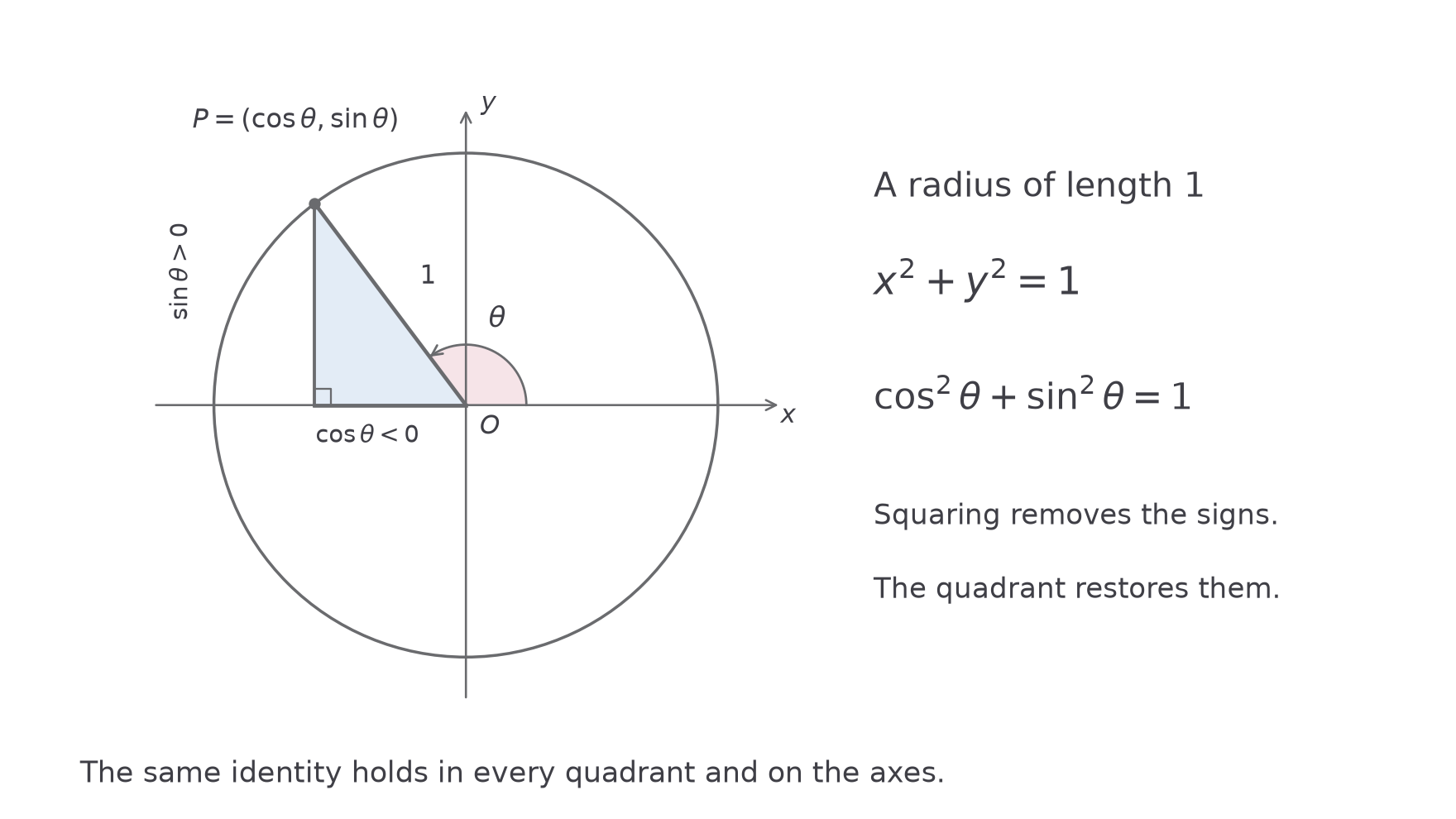
On a unit circle, the point at angle has coordinates . Pythagoras gives the same equation in every quadrant: squaring a negative coordinate makes it positive. It also holds on the axes, where one coordinate is zero.
Pythagorean identity
For every real angle , in degrees or radians,
Here means , not .
Not on the formulae sheet: learn it.
An identity is an equality that holds for every value in its stated domain. Use this one to find a missing squared ratio, then use the quadrant to choose its sign.
Worked example 1: an acute angle
Question. Given and , find the exact value of .
Plan. Find , then choose the positive root because the angle is acute.
Both roots have size . In the first quadrant cosine is positive.
Answer. .
Check. A right triangle with opposite side and hypotenuse has adjacent side , giving the same cosine.
Keep the same sine but move the angle to the second quadrant. Only the sign of cosine changes.
Worked example 2: the other possible sign
Question. Given and , find exactly.
Plan. Use the identity for the magnitude and the second quadrant for the sign.
The horizontal coordinate is negative in this quadrant, so take the negative root.
Answer. .
Check. Reflecting the first example's unit-circle point in the vertical axis preserves sine and reverses cosine. Also, .
The identity alone cannot choose between the two signs.
Watch out
From , writing automatically can lose the correct sign. Use the angle's quadrant; if no information fixes the quadrant, both signs may be possible.
Use the vertical coordinate's sign in the next calculation.
Writing tangent in sine and cosine
Tangent compares the vertical and horizontal coordinates, so its sign depends on both.
In a right triangle, dividing by cancels the hypotenuse. The quotient is . The same signed-coordinate ratio extends this relationship to other quadrants.
Tangent identity
In degrees, exclude ; in radians, exclude , where is any integer.
On the formulae sheet.
For instance, . At , the denominator is zero, so tangent is undefined. A zero numerator is allowed; a zero denominator is not.
Continue this lesson.
You’re previewing NovaLearn without an account. Create a free account to read the rest.
Create free account