10D - The sine rule and triangle area
Can the same two side lengths and angle describe two different triangles? You will use opposite side–angle pairs to find lengths, decide how many triangles are possible, and calculate area from two sides and their included angle.
Matching sides and opposite angles
A triangle has angles and , and the side opposite is . How can you find the side opposite without a right angle?
In a right triangle, a side divided by the sine of its opposite angle gives the hypotenuse. In any triangle, the corresponding ratios still agree with one another. The common value need not be one of the triangle's sides.
Label a triangle , with side opposite angle , opposite , and opposite . A side's opposite angle is the angle at the vertex the side does not touch.
Sine rule
For a non-degenerate triangle, with and ,
You may also use the reciprocal form, .
Not on the formulae sheet: learn it.
Why do these pairs match? Dropping a perpendicular height gives, for example, ; dividing gives the equal ratios. This short height argument explains the pairing. You do not need a general proof of the rule.
Use the sine rule when you have a complete opposite pair and another side or angle. If two angles are known, first use when necessary. Use degree mode for the examples below.
Worked example 1: an acute opposite angle
Question. In triangle , , and . Find exactly.
Plan. Match with and with , then make the subject.
Answer. .
Check. . Also, the larger angle has the longer opposite side.
Now keep the known side and angle, but change the other angle from acute to obtuse. The pairing and rearrangement stay the same.
Worked example 2: an obtuse opposite angle
Question. In triangle , , and . Find to three significant figures.
Plan. Use the same opposite pairs, evaluating the sine of the obtuse angle directly.
The formula applies because .
Answer. to three significant figures.
Check. The unrounded result gives . Angle is largest, and its opposite side is longer than and .
Write the side–angle matches before substituting; matching a side to an angle it touches gives a different calculation.
The ambiguous case
Two sides and a non-included angle can leave the triangle free to fold into two different shapes.
Suppose , and . Fix , and draw the ray from making with . Vertex must lie on this ray and be from . A circle centred at can meet the ray twice.
[DIAGRAM: asset_name: Two possible triangles from the same SSA data; asset_slug: sine-ambiguity; caption: A circle of radius 7 meets the 30 degree ray twice, giving one acute and one obtuse angle at B; description: Exact planar geometry with A at the origin, C at (10,0), and B on the ray at 30 degrees above AC. A circle of radius 7 centred at C meets the ray at B1 and B2. The two triangles share AC=10 and have CB1=CB2=7. A perpendicular from C to the ray has length 5. B1 is the nearer intersection and has an obtuse internal angle; B2 has an acute internal angle.]
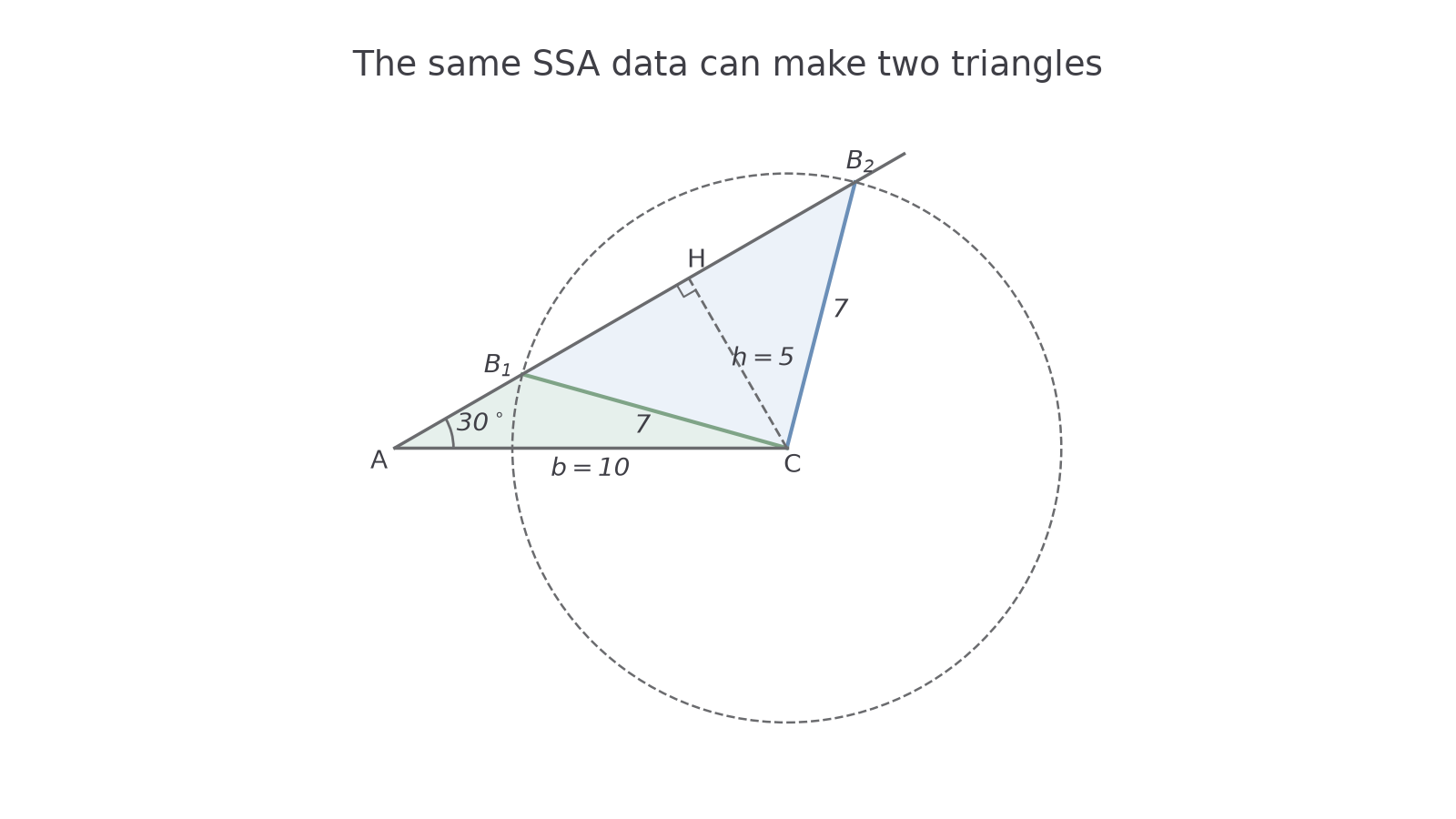
Ambiguous case
The ambiguous case occurs when two sides and an angle opposite one of them are given, and the data allow two different triangles. It is often called SSA: side, side, angle.
The calculator value , for , is acute. But both and have sine . Test each candidate: all three angles must be positive and add to . An explicitly acute or obtuse angle selects the matching candidate.
Worked example 3: two valid triangles
Question. In triangle , , and . Find all possible values of and , to one decimal place.
Plan. Find , consider both angles with that sine, then check the angle sum.
For , . For , . Both are positive.
Answer. or .
Check. The unrounded pairs each sum with to , and both candidate values of have sine . In each triangle , matching .
Continue this lesson.
You’re previewing NovaLearn without an account. Create a free account to read the rest.
Create free account