3E - Regions and linear optimisation
With two variables, an inequality describes a region of possible pairs rather than an interval of numbers. You will draw its boundaries, combine constraints into a feasible region and find the greatest or least value of a linear expression, including situations where the variables must be integers.
Straight-line boundaries
Which pairs satisfy ? If and count two kinds of kit, using two and three units of material respectively, this inequality keeps total material within the available units. A graph can show all permitted combinations together.
Start by replacing the inequality sign with equality. The resulting straight line separates the two sides of the plane. Its coordinates are the pairs at the limiting total.
Boundary line
The boundary line of a linear inequality is obtained by replacing its comparison sign with . Use a solid line when equality is allowed, and a dashed line when equality is excluded.
A straight line divides the plane into two half-planes, one on each side. The next step will decide which side satisfies the inequality.
You already know how to draw a straight line through two points. For , setting and often gives convenient intercepts; if both intercepts coincide at the origin, find a second point by substituting another value.
Worked example 1: an inclusive boundary
Question. Draw and label the boundary of .
Plan. Find two points on , then decide whether the boundary belongs to the solution.
The sign includes equality.
Answer. Draw a solid straight line through and , extending it across the graph. Label it , as in the left-hand picture.
Check. The midpoint also gives . Every point on the line satisfies the original inequality at equality, so the solid style is justified.
Change only the comparison sign. The same points determine the line, but they no longer belong to the solution.
Worked example 2: a strict boundary
Question. Draw and label the boundary of .
Plan. Keep the equation and its intercepts, but exclude all points at equality.
Answer. Draw the same line dashed, labelled , as in the right-hand picture. The line marks the boundary but is excluded from the solution.
Check. At , the left side is . Since is false, this boundary point must not be included.
[DIAGRAM: asset_name: Solid and dashed straight-line boundaries; asset_slug: region-boundaries; caption: The same boundary is included for a non-strict inequality and excluded for a strict inequality; description: Two equal-scale coordinate graphs show the line 2x plus y equals 8 through intercepts (0,8) and (4,0). The left line is solid for 2x plus y less than or equal to 8. The right line is dashed for 2x plus y less than 8. No half-plane is selected yet.]
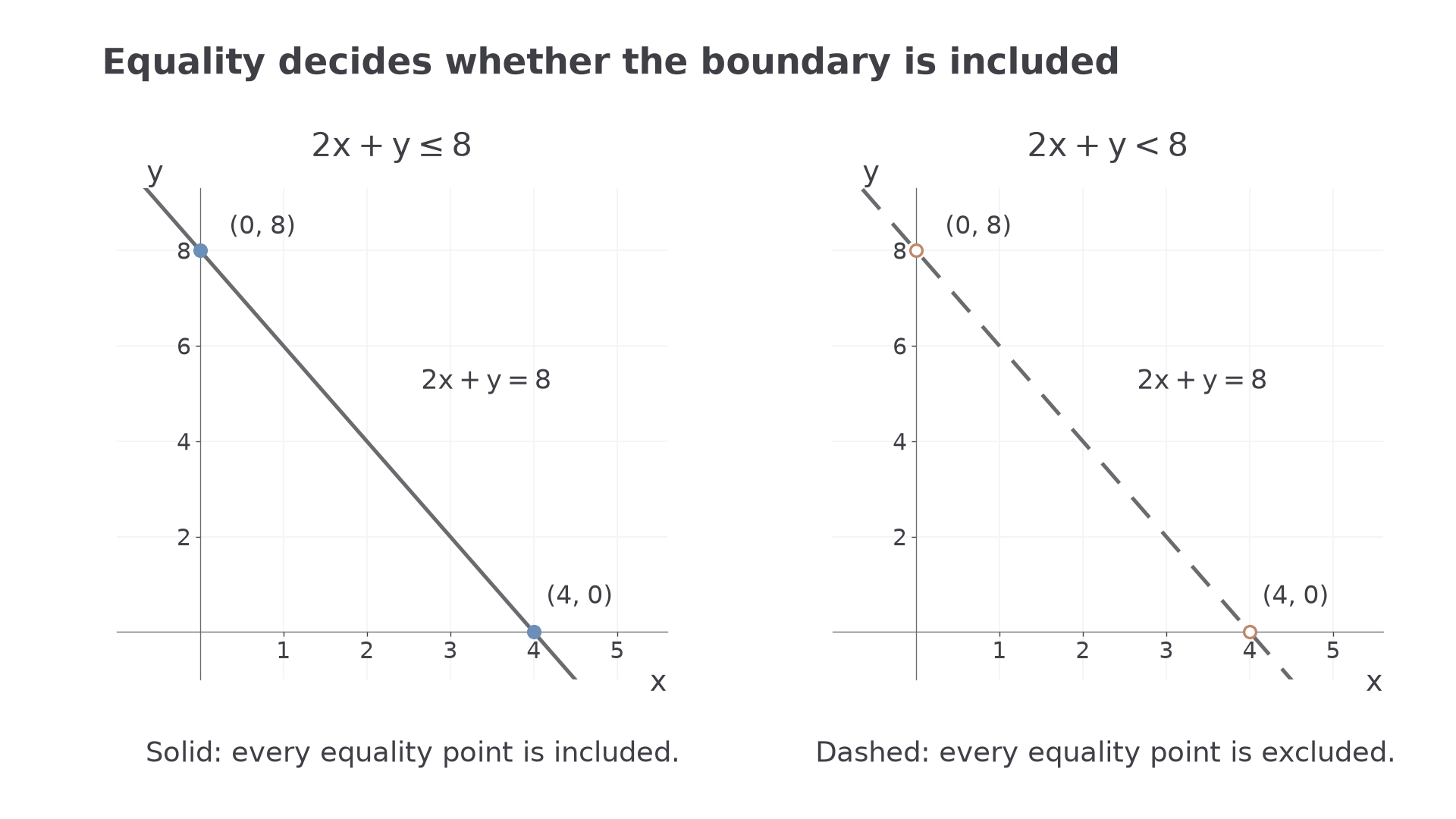
Vertical and horizontal boundaries work in the same way: has solid boundary ; has dashed boundary . Do not try to find two different intercepts for a vertical or horizontal line.
Watch out
A boundary equation identifies the line, but does not yet identify the whole solution region. Choosing the correct side is a separate decision from choosing solid or dashed.
Describe the next boundary without needing to draw it.
The feasible region
Substituting a point tells you which side of a boundary satisfies an inequality.
For , the point gives , which is true. Keep the side containing , together with the boundary. A test point must lie off the boundary; if the line passes through the origin, use another point. All points on a given side give the same strict comparison because crossing to the other sign requires crossing the boundary.
Constraints and feasible region
Constraints are conditions that restrict the allowed pairs. The feasible region is their intersection: every point in it satisfies every constraint.
A vertex is a corner where boundary segments meet. A region is bounded if it fits inside some finite rectangle; otherwise it is unbounded.
Shade the feasible side of each condition lightly, then identify the common region. If you shade unwanted regions instead, label the remaining feasible region clearly. The mathematical answer is the same.
Worked example 3: a bounded feasible region
Question. Find the feasible region and its vertices for
Plan. Work in the first quadrant, select the required sides of the two sloping lines and find their intersections.
The point satisfies all four conditions: and . Thus the feasible region is below , below and on or above the horizontal axis, with all boundaries included.
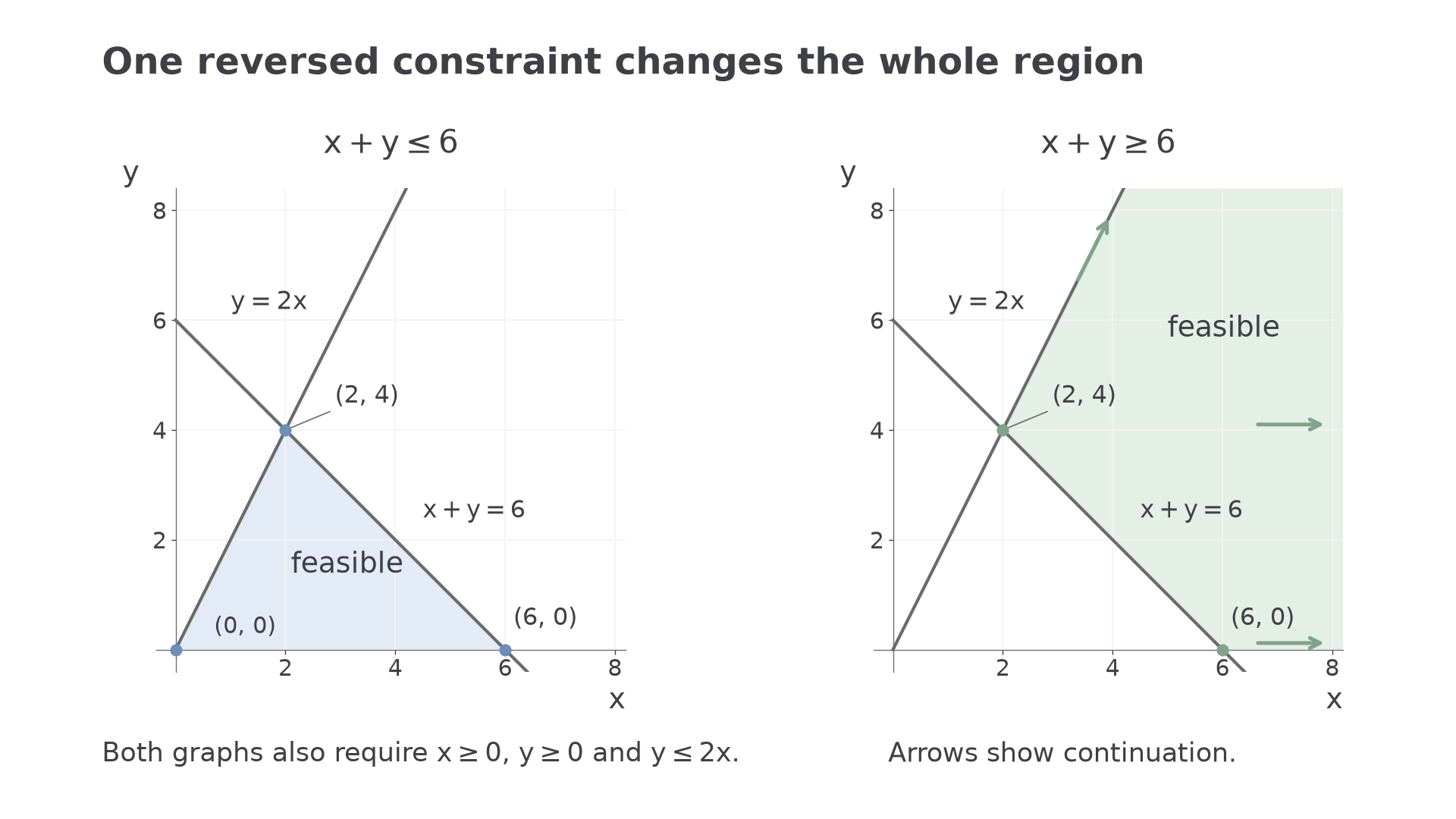
Answer. The feasible region is the filled triangle with vertices , and , shown on the left below.
Check. Each vertex satisfies every original constraint. The other intercept of is not a feasible vertex, because is false. This excludes the tempting larger triangle formed by that line and the axes.
Change only the last sign from to . The new region extends beyond the picture.
Worked example 4: an unbounded feasible region
Question. Find the feasible region for
Plan. Keep the first three conditions and select the opposite side of .
At , the last condition is false. At , all constraints are true: and . Keep the side containing , within the first-quadrant wedge below .
Answer. The region has vertices and , and continues indefinitely to the right between the rays along and . It is unbounded; the right-hand picture shows only part of it.
Check. Every point with satisfies all four constraints. Since has no upper bound, no edge of the graph window can close this region. The point fails the sum condition, since .
[DIAGRAM: asset_name: Changing one constraint makes a bounded region unbounded; asset_slug: feasible-regions; caption: Reversing the sum constraint changes a triangle into a region that continues beyond the grid; description: Two first-quadrant graphs show y equals 2x and x plus y equals 6. On the left the feasible triangle for y less than or equal to 2x and x plus y less than or equal to 6 has vertices (0,0), (2,4) and (6,0). On the right the sum inequality is reversed, so the feasible region lies beyond the segment from (2,4) to (6,0) and extends indefinitely within the wedge below y equals 2x. Arrows show continuation beyond the displayed window.]
Continue this lesson.
You’re previewing NovaLearn without an account. Create a free account to read the rest.
Create free account