7A, 7F - Parallel lines and collinearity
If two arrows have parallel directions, what extra evidence proves that three points lie on one line? You will compare coefficients in nonparallel reference directions, prove that directions are parallel and identify the extra connection needed to prove that points are collinear. In 7A, you compare coefficients in independent directions; in 7F, you use vectors to prove geometrical properties.
Comparing independent components
If the same displacement is expressed in two fixed nonparallel directions, its amount in each direction is uniquely determined.
Independent directions
Two nonzero vectors and are nonparallel when neither is a scalar multiple of the other. Together they give independent directions in their plane: movement along one cannot replace movement along the other.
Suppose
Subtracting gives . If either coefficient were nonzero, this would express one reference vector as a multiple of the other. Nonparallel directions rule that out, so both coefficients must be zero.
Comparing coefficients
For nonparallel and ,
The condition cannot be dropped. If , then , although the displayed coefficients differ. The vectors and are independent, but a general independent pair need not be perpendicular or have magnitude .
Worked example 1: two separate equations
Question. The vectors and are nonparallel. Given
find and .
Plan. Compare corresponding coefficients because the two reference directions are independent.
Answer. and .
Check. Substitution gives , the original right-hand side.
Now both unknowns occur in both components. Comparing coefficients still works, but produces simultaneous equations.
Worked example 2: linked coefficients
Question. For nonparallel and ,
Find and .
Plan. Form two equations and add them to eliminate .
Answer. and .
Check. The coefficients become and . Both original components agree.
The next equality has a different pair of coefficient equations.
Proving directions are parallel
Nonzero vectors give parallel directions precisely when one is a scalar multiple of the other.
For with and , a positive gives the same direction and a negative the opposite direction. Either proves the directions are parallel. To compare lines and , first form their direction vectors and .
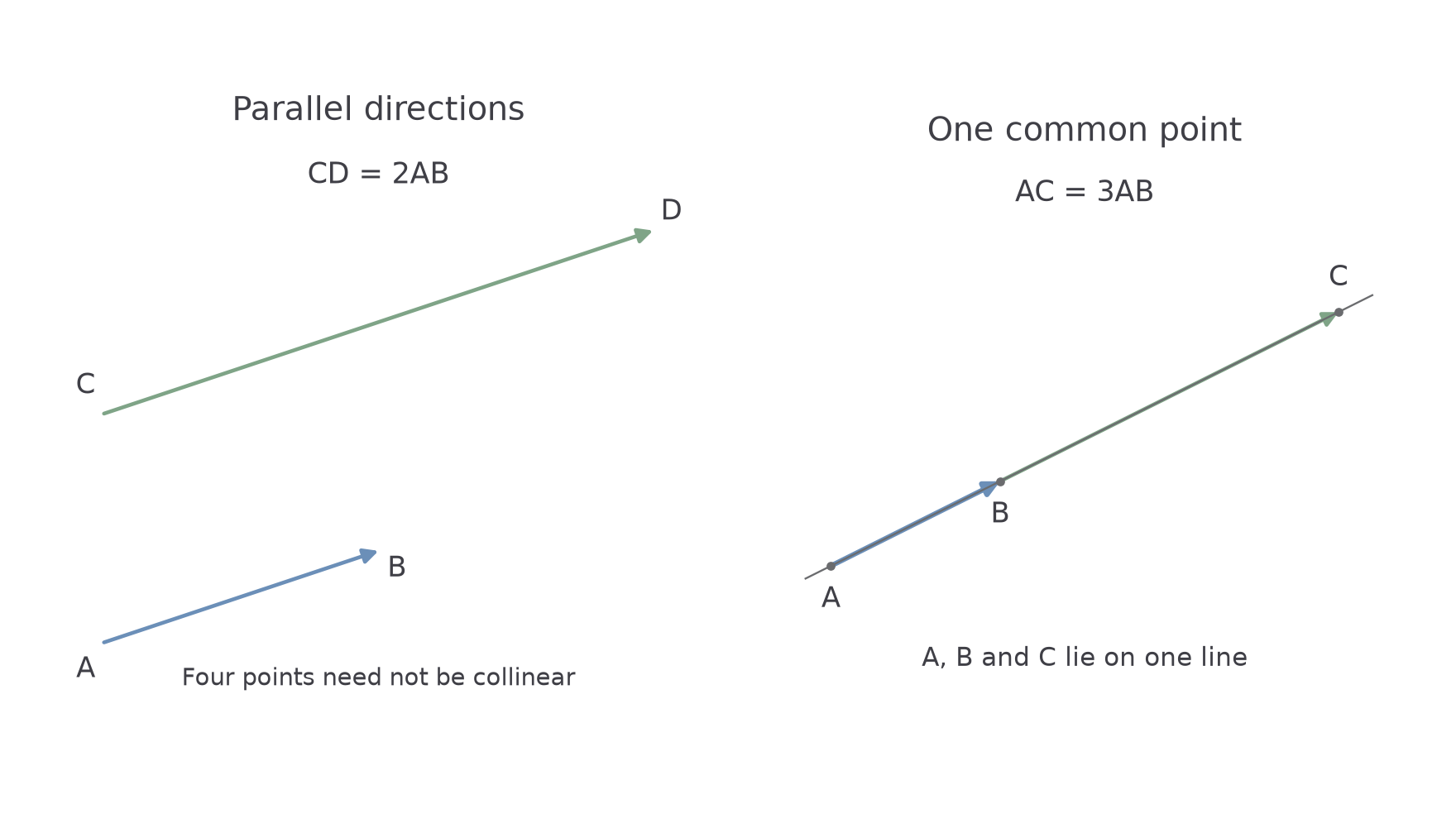
A zero vector supplies no line direction. Also, proportional direction vectors alone do not establish that two lines are distinct: the lines might coincide. Use the positions of the points when that distinction matters.
[DIAGRAM: asset_name: Parallel directions and a common point; asset_slug: parallel-collinear-distinction; caption: Proportional directions can belong to separate parallel lines; a shared point places three points on one line; description: The left panel shows AB and CD on separated parallel lines with CD twice AB. The right panel shows A, B and C on one line with AC three times AB, and both compared vectors starting at A.]
Worked example 3: a midpoint parallel
Question. In a nondegenerate triangle , and . The points and are the midpoints of and . Prove that is parallel to .
Plan. Express both direction vectors in terms of and , then find a scalar multiple.
Answer. , since their nonzero direction vectors are proportional.
Check. Take, for example, , , . Then and , confirming the factor . The vector working proves it for every such triangle.
Continue this lesson.
You’re previewing NovaLearn without an account. Create a free account to read the rest.
Create free account