10H - Trigonometric equations on an interval
A calculator gives one angle when you enter an inverse trigonometric function. How can you know that you have found every angle an equation allows? You will use symmetry, periods and the stated interval to solve equations in degrees and radians, including multiplied and shifted angles.
All angles with a given ratio
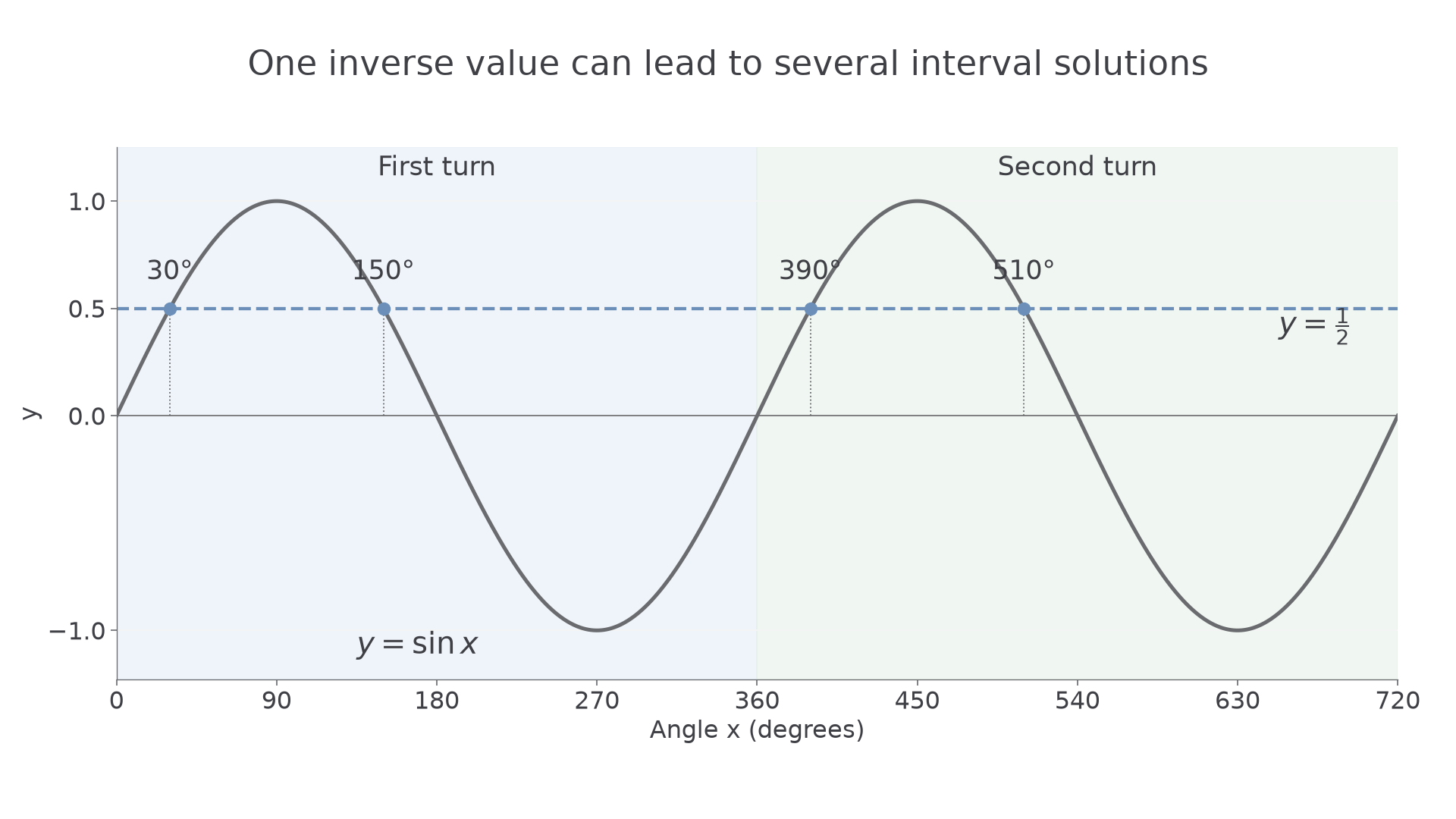
The equation has two solutions between and : and . The inverse sine button returns only , because a function must return one value for an input. The graph shows why that one answer is insufficient for the equation.
[DIAGRAM: asset_name: Repeated sine intersections; asset_slug: sine-interval-solutions; caption: Four intersections of sine x with one half over two complete turns; description: The sine graph from zero to 720 degrees crosses the horizontal line y equals one half at 30, 150, 390 and 510 degrees. The two turns are shaded in different pale colours and each intersection is labelled.]
Reference angle
A reference angle is an acute angle used with symmetry to locate angles with the same magnitude of trigonometric ratio. The signs of sine, cosine and tangent determine which quadrants to use.
For a reference angle , positive sine occurs at and ; positive cosine at and ; positive tangent at and . Negative values occupy the other two quadrants. At axes, use the actual graph values rather than treating as an acute reference angle.
Periods and solution families
Sine and cosine repeat every , or radians. Tangent repeats every , or radians.
If , all sine solutions are or .
If , all cosine solutions are .
If , all tangent solutions are , where is any integer.
Replace by and by for radians. List each distinct angle only once.
Use a permitted scientific calculator for inverse values; symbolic algebra, stored formula retrieval and symbolic differentiation or integration facilities are prohibited. First set degree or radian mode to match the question. Keep extra digits until the final answer. Sine and cosine values must lie between and ; otherwise there are no real solutions. Tangent is undefined at .
Worked example 1: negative sine
Question. Solve for .
Plan. Use reference angle , then choose the quadrants where sine is negative.
The interval contains one complete turn. Neither endpoint has the required sine value.
Answer. .
Check. Both unit-circle heights are . In this turn sine is negative only in the third and fourth quadrants, with one crossing in each.
Now use tangent and an interval containing negative angles. Its shorter period changes the number of solutions.
Worked example 2: tangent across several half-turns
Question. Solve for .
Plan. Start at , then add or subtract whole tangent periods.
The values give . The next values, and , are outside the interval.
Answer. .
Check. Each angle differs from by a multiple of , so each has tangent . Exactly three integers give angles inside the interval; the neighbouring family members are outside.
The same method works when the angle is not a special exact value. Retain the calculator's full value until you have found all the angles.
Worked example 3: a calculator angle
Question. Solve for , giving answers to one decimal place.
Plan. Use inverse cosine in degree mode for the reference angle, then reflect in the horizontal axis of the unit circle.
Cosine is positive in the first and fourth quadrants. Only now round the two angles.
Answer. , to one decimal place.
Check. The unrounded angles both give cosine . The rounded answers give approximately , consistent with the requested precision. The graph has one crossing in each of those two quadrants.
Choose the correct symmetry and period in the next equation.
Continue this lesson.
You’re previewing NovaLearn without an account. Create a free account to read the rest.
Create free account