9B - The product rule
If two factors both change, how does their product change? You will account for both contributions, differentiate products of familiar functions, and combine the product and chain rules without losing factors or signs.
Why differentiating each factor is insufficient
Does differentiating mean multiplying the derivatives ?
Expand first to check: , whose derivative is . At , the correct gradient is , not . Multiplying the derivatives has lost the original factors.
A rectangle explains what is missing. Its area is the product . If its width increases by and its height by , there are two strips of extra area, plus a small corner. Here means “change in”.
[DIAGRAM: asset_name: Two contributions to a changing product; asset_slug: product-area-change; caption: Increasing both sides adds two strips and a corner to the original rectangle; description: A rectangle of width u and height v is enlarged by delta u to the right and delta v above. The original area uv is neutral, the right strip has area v delta u in pale blue, the top strip has area u delta v in pale sage, and the corner has area delta u delta v in pale clay. Dimension arrows identify u, v, delta u and delta v.]
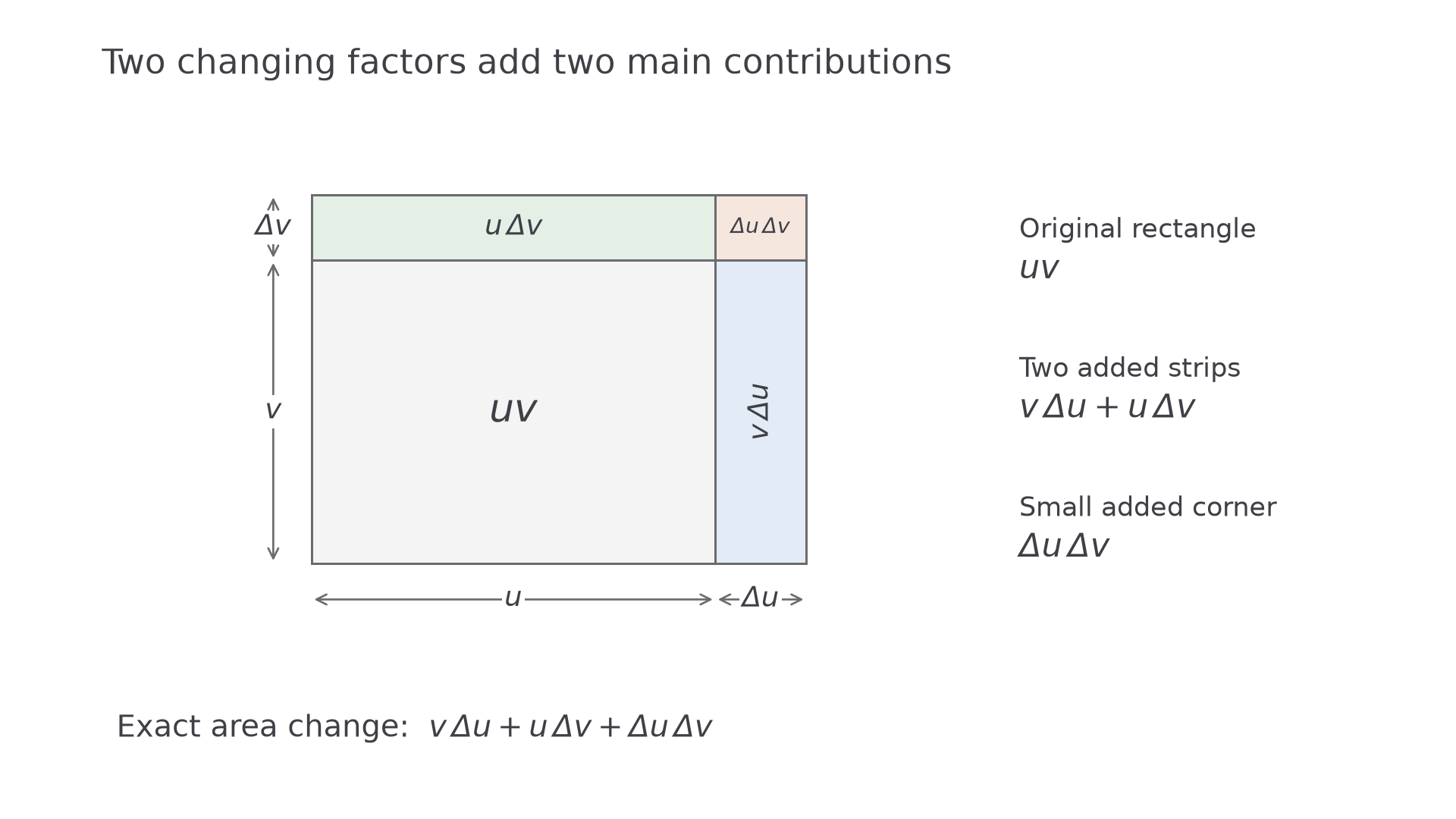
The exact change in area is
For example, increasing sides and by and adds . The new area is .
When and are differentiable functions of , both changes shrink with a small change in . After dividing by that change in , the corner contribution tends to zero. The two strips give the two surviving contributions: the rate of change of one factor multiplied by the current value of the other.
Key idea
A product has two contributions to its derivative. Each contribution differentiates one factor and leaves the other unchanged.
This rectangle argument explains the structure; it does not require the values of general functions to be positive. The product rule also applies to negative values wherever both functions are differentiable.
Differentiating a product
Choose the two factors before differentiating, then keep the two contributions separate until both are correct.
Product rule
If and are differentiable at the point considered, then
The order is equivalent.
Not on the formulae sheet: learn it.
For the opening product, and . The rule gives , agreeing with expansion. Expansion can be quickest for short polynomial products; the rule is especially useful when expansion cannot remove the product. Trigonometric inputs below are in radians.
Worked example 1: a power multiplied by sine
Question. Differentiate .
Plan. Take and , then add and .
Answer. , for all real .
Check. At , this gives . A central gradient calculated from the original with step is approximately , agreeing with .
Keep and change the other factor from sine to cosine. This changes one derivative and its sign.
Worked example 2: a power multiplied by cosine
Question. Differentiate .
Plan. Keep the same first factor and use .
Answer. , for all real .
Check. At , the derivative is . The central gradient of the original product with step is approximately .
Continue this lesson.
You’re previewing NovaLearn without an account. Create a free account to read the rest.
Create free account