1A, 1B - Logarithms as exponents
What power of gives , and what power gives ? A logarithm answers this kind of question by reversing exponentiation. In 1A you will connect logarithms to exponential graphs; in 1B you will find exact logarithms from known powers.
Reversing exponentiation
A logarithm tells you the exponent when the base and the result of a power are known.
Since , the power of needed to make is . We write this as , read “logarithm of eight to base two equals three”. The small is the base, is the argument, and the value of the logarithm is the exponent .
Logarithm
For the graphs in this lesson, is a natural number greater than . For ,
A logarithm is the exponent to which its base must be raised to obtain its argument.
The two statements contain exactly the same information. Keep the base fixed when changing form: the logarithm's value becomes the exponent, and its argument becomes the result of the power.
Worked example 1: from logarithmic to exponential form
Question. Write in exponential form.
Plan. Identify the base, exponent and result.
The base is ; the logarithm says its exponent is .
Answer. .
Check. , so the exponential statement is true.
Now reverse the direction and use a negative exponent. A negative logarithm is possible even though a negative argument is not.
Worked example 2: from exponential to logarithmic form
Question. Write in logarithmic form.
Plan. Keep as the base and make the exponent the logarithm's value.
Answer. .
Check. An exponent of means the reciprocal of , which is indeed .
Every real power of a positive base is positive. Therefore no real exponent of produces or : and have no real values. The restriction is on the argument, not on the logarithm's answer.
Exact logarithms
To evaluate a logarithm exactly, ask which exponent gives its argument.
The zero and first powers immediately give two useful values.
Special logarithm values
For ,
These values must be learnt; they are not on the examination formulae sheet.
The logarithm of is therefore , not . A logarithm whose argument equals its base has value .
Worked example 3: an argument above the base
Question. Find the exact value of .
Plan. Express as a power of .
Answer. .
Check. Raising to the proposed answer gives .
Keep the base , but change the argument to a number between and . Fractional and negative indices now work together.
Worked example 4: a fractional negative logarithm
Question. Find the exact value of .
Plan. Use , then take its reciprocal.
Answer. .
Check. Squaring gives , consistent with doubling the exponent .
For any base greater than , arguments above have positive logarithms, and arguments between and have negative logarithms. For example, tells us , even without its decimal value. A logarithm need not be an integer or a simple fraction.
Logarithmic graphs
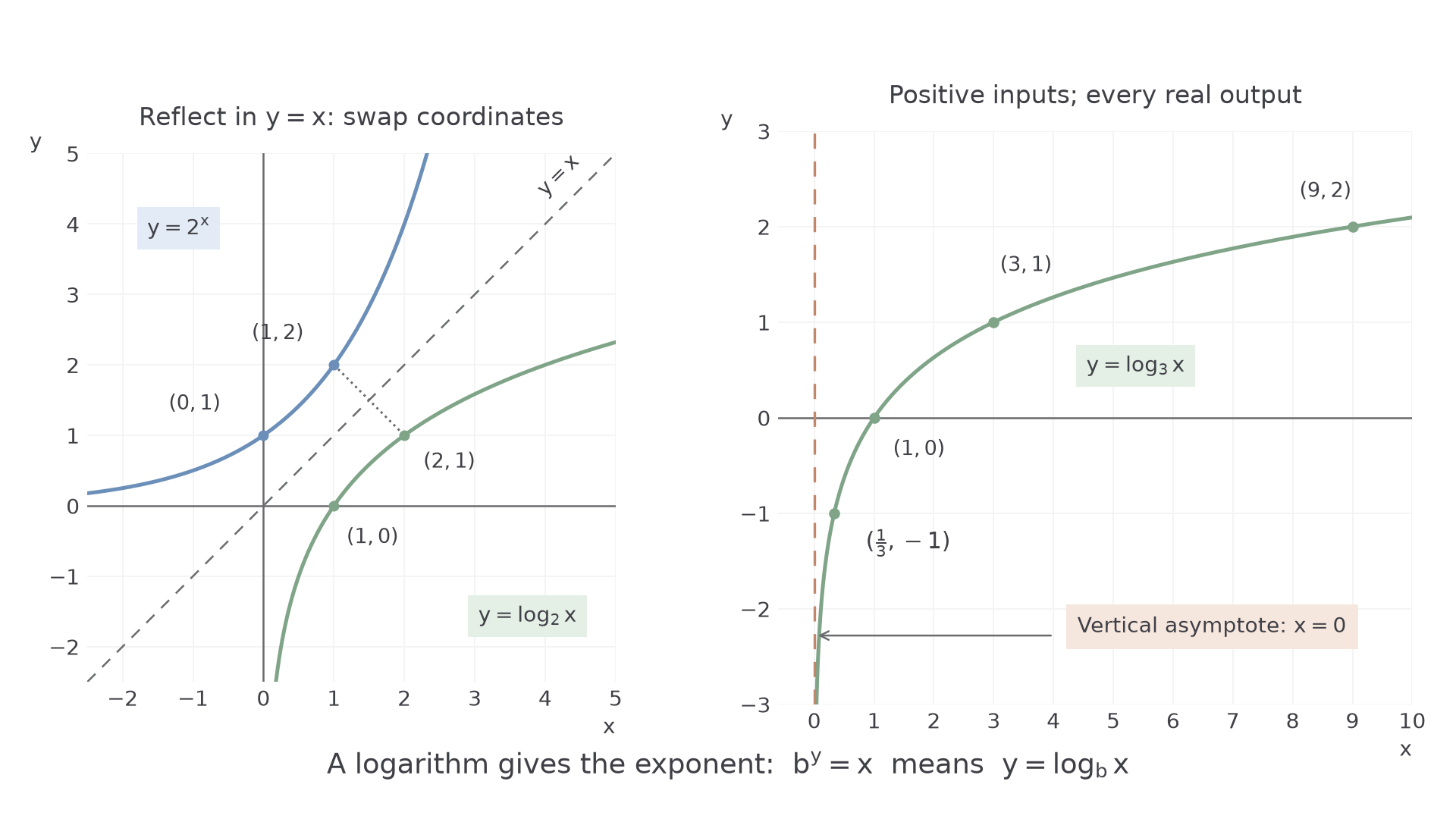
Reversing exponentiation swaps the input and output of an exponential graph.
The point lies on because . The equivalent statement puts on . Swapping every pair of coordinates reflects the graph in the line .
[DIAGRAM: asset_name: Exponential and logarithmic graphs are reflections; asset_slug: logarithm-reflection; caption: Swapping coordinates reflects an exponential graph in the line y equals x to give its logarithmic graph; description: Left panel uses equal coordinate scales to show y equals 2 to the x in blue, y equals log base 2 of x in sage and the dashed reflection line y equals x. The points (1,2) and (2,1) are connected across the reflection line, and the intercepts (0,1) and (1,0) are marked. Right panel shows y equals log base 3 of x with points (1/3,-1), (1,0), (3,1) and (9,2), approaching the vertical asymptote x equals 0 from the right.]
Domain, range and asymptote
The domain is the set of allowed inputs; the range is the set of outputs. An asymptote is a line whose distance from a point on an unbounded branch of a curve tends to zero as the point moves along that branch.
For , with natural-number :
- the domain is , because the exponential's outputs are positive;
- the range is all real numbers, because the exponential accepts every real exponent;
- the curve crosses the horizontal axis at and passes through ;
- it has no vertical-axis intercept and has vertical asymptote ;
- it increases throughout its domain, becoming less steep as increases.
As approaches from the right, the logarithm decreases without bound. As increases without bound, the logarithm increases without bound, however slowly. These are shape statements; no gradient formula is needed.
Worked example 5: transferring exponential points
Question. The points , and lie on . Find the corresponding points on .
Plan. Reflect in by swapping each input and output.
Answer. , and .
Check. , and verify the three logarithmic outputs independently.
Now change the base to . The standard shape and intercept remain, but the point with output moves.
Worked example 6: describing a logarithmic sketch
Question. Describe a sketch of , stating its asymptote and three exact points.
Plan. Use powers with exponents , and , then apply the logarithmic shape.
Answer. Draw an increasing smooth curve through these points, entirely to the right of the vertical asymptote , with the left end decreasing without bound.
Check. Each point satisfies . In particular, is absent: a logarithm cannot accept zero.
Use exact points to position the curve, then draw its smooth shape; joining the points with straight segments would misrepresent the function.
Quick Recap
The opening answers are and , because and . A logarithm gives an exponent, accepts a positive argument and can have a negative value. Its graph swaps the coordinates of the exponential graph and has vertical asymptote .