9A - Antiderivatives and integration rules
Knowing every gradient of a curve still leaves its height undetermined. You will reverse differentiation to find families of functions, integrate powers and standard trigonometric and exponential forms, and use a point to select one function from the family.
Integration as reverse differentiation
If a curve has gradient everywhere, is its equation necessarily ?
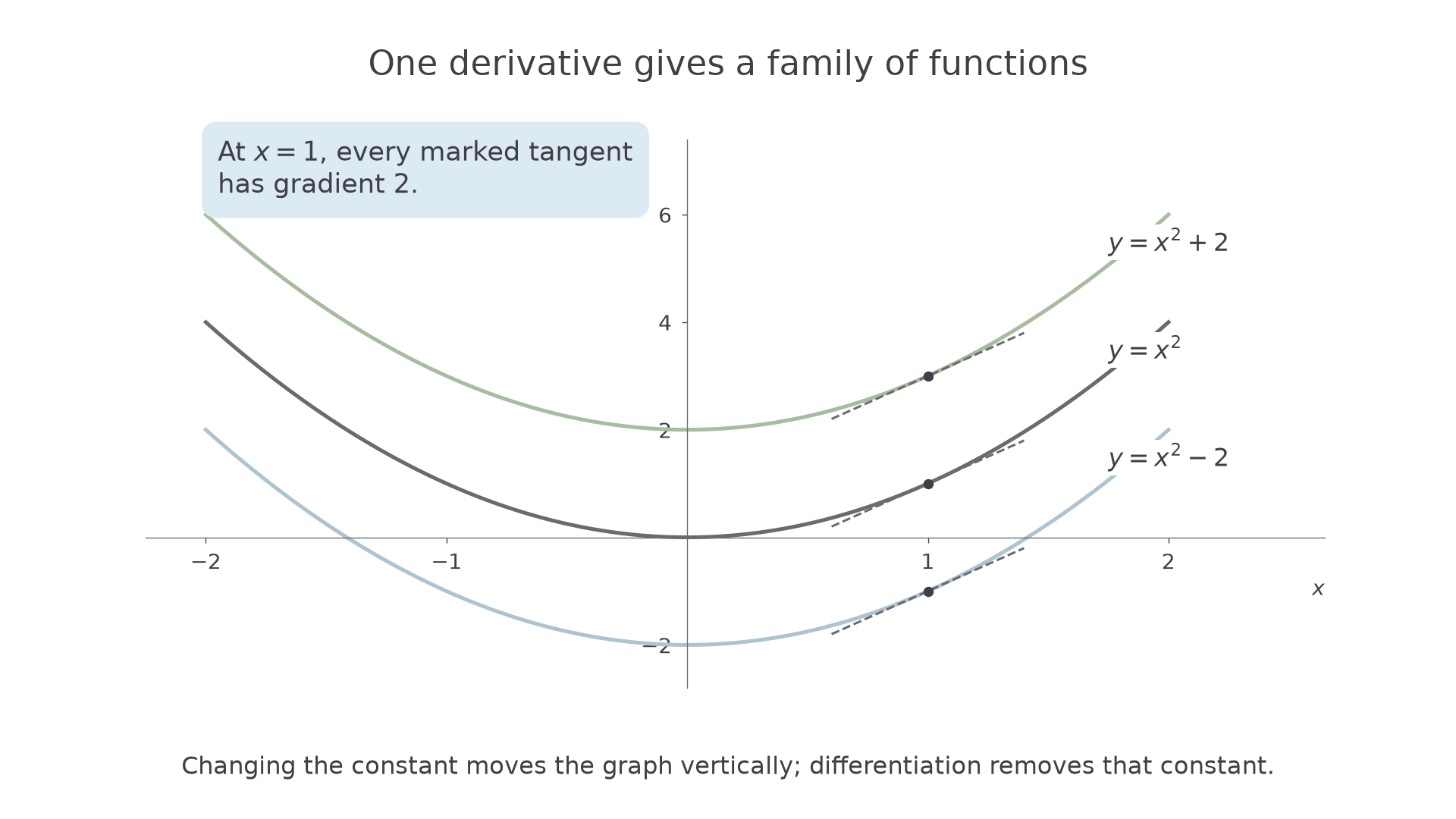
Both and differentiate to . Adding a constant moves a graph vertically without changing its gradients. The derivative cannot tell us which vertical position the curve occupies.
[DIAGRAM: asset_name: A family with one derivative; asset_slug: antiderivative-family; caption: Vertical translations have the same derivative; description: Three graphs y equals x squared minus 2, y equals x squared, and y equals x squared plus 2 have parallel tangents at x equals 1. Each tangent has gradient 2, showing that a constant changes heights without changing derivatives.]
Antiderivative and indefinite integral
An antiderivative of is a function whose derivative is . Its indefinite integral represents the family of antiderivatives:
Here identifies as the variable and is an arbitrary constant of integration. On an interval, antiderivatives of the same function differ by a constant.
One constant is enough for a whole sum: any collection of added constants combines into a single .
Worked example 1: recovering a family
Question. Find .
Plan. Find a function whose derivative is , then include the unknown constant.
Differentiating gives , so multiplying by gives the required derivative:
Answer. .
Check. , whatever constant is chosen. For instance, also has the required derivative, so omitting the family would lose information.
Add a constant term to the integrand. Its antiderivative is now a linear term; it does not merge into .
Worked example 2: reversing a sum
Question. Find .
Plan. Reverse each derivative separately and combine the results.
because differentiates to and differentiates to .
Answer. .
Check. Differentiating the complete answer gives , exactly the integrand. A proposed answer would instead differentiate to , so it would fail this check.
Differentiation is the most direct way to check an indefinite integral.
Integrating powers
The power rule reverses the change in power and the multiplication that differentiation performs.
For example, , so an antiderivative of is . Similarly, integrates to , for : the increased power is , and dividing by means multiplying by .
Power integrals
Integrate sums term by term. Rewrite roots and denominators as powers first, and use an interval where the functions are real and defined.
These standard integrals are formulae to learn; they are not supplied on the examination formulae sheet. Integration of , the excluded case , is outside this course.
The exclusion matters mathematically: putting into the displayed rule would divide by zero. Do not use it for a reciprocal first power.
Worked example 3: a negative power in a sum
Question. Find , on an interval not containing zero.
Plan. Increase each power by one and divide its coefficient by the new power.
For the second term, the new power is , which is permitted: the excluded case concerns the original integrand's power.
Answer. .
Check. Differentiating gives . In particular, differentiating gives , confirming the negative sign in the antiderivative.
Now replace throughout the integrand by . Differentiation of that inner expression contributes an extra factor , so integration must divide by .
A linear expression raised to a power
For constants and , on an interval where the expressions are defined,
The factor reverses the constant inner derivative. This shortcut relies on the inner expression being linear.
Differentiate the right side using the chain rule: the factors and cancel their denominators, leaving the integrand.
Worked example 4: the same powers with a linear argument
Question. Find , for .
Plan. Reverse each power as before, with an additional division by the inner derivative .
Answer. .
Check. Differentiating the two terms gives and . Both are recovered exactly.
Continue this lesson.
You’re previewing NovaLearn without an account. Create a free account to read the rest.
Create free account