9A, 9C - Definite integrals
An indefinite integral gives a family of functions; a definite integral gives a number for a specified interval. You will evaluate it exactly, interpret its sign and work backwards to find a missing limit or parameter, ready for later area and motion applications.
Evaluating between limits
If two antiderivatives can differ by any constant, how can an integral between two fixed numbers have one answer?
For , choose . Its change from to is . Choosing instead gives again: the constant cancels.
Evaluating a definite integral
If , and is continuous on the interval from to ,
The number at the bottom is the lower limit and the number at the top is the upper limit. Substitute into the antiderivative, then subtract the whole lower-limit value from the whole upper-limit value.
A definite answer needs no . Keep fractions and standard trigonometric values exact; a decimal is an approximation unless it is itself exact.
Worked example 1: upper value minus lower value
Question. Find the exact value of .
Plan. Integrate first, then evaluate the antiderivative at both limits.
Answer. .
Check. The integrand is a straight line with endpoint values and . Its average value over the interval is ; multiplying by the width gives , agreeing with the integral.
Keep the integrand and upper limit but move the lower limit to a negative number. Substitute that number with its sign intact.
Worked example 2: a negative lower limit
Question. Find .
Plan. Use the same antiderivative and enclose the complete lower-limit substitution in brackets.
Answer. .
Check. The straight-line endpoint values are and . Their average is , and the interval width is , giving . Adding an arbitrary constant to the antiderivative would not change the result.
Keep brackets around a negative substituted number before raising it to a power.
Signed accumulation
A definite integral records a signed net contribution, so positive and negative portions can cancel.
With limits running from smaller to larger, a graph above the horizontal axis contributes positively and a graph below it contributes negatively. One way to picture this is to add narrow strips of width , each with signed contribution approximately . The integral is the exact accumulation as the strips become narrower.
[DIAGRAM: asset_name: Cancellation in a definite integral; asset_slug: signed-contributions; caption: Equal positive and negative contributions give a zero net integral; description: The graph y equals x minus 1 runs from x equals 0 to x equals 2. The portion below the axis from 0 to 1 has contribution negative one half; the portion above from 1 to 2 has contribution positive one half. Their sum is zero, though the graph is not zero throughout the interval.]
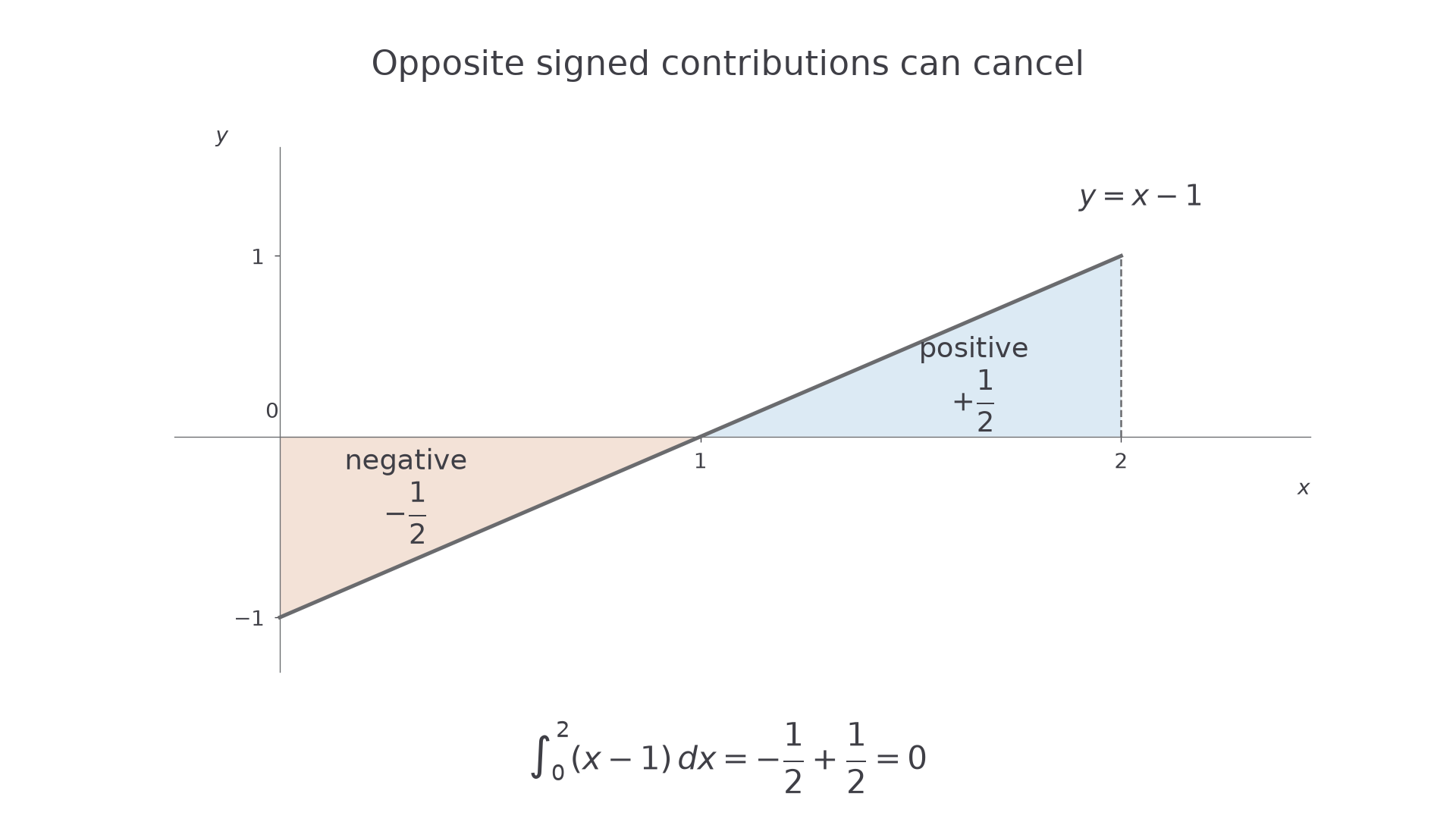
For that line, and . Adding contributions across adjacent intervals gives . A zero integral therefore does not mean the function was zero everywhere. A geometric area counts sizes positively; a definite integral preserves signs.
Continue this lesson.
You’re previewing NovaLearn without an account. Create a free account to read the rest.
Create free account