9C - Volumes of revolution
What solid appears when a flat curved region spins around an axis? You will build its volume from thin circular discs, identify the correct radius, and integrate with respect to the coordinate running along the axis of rotation.
Building volume from discs
A narrow strip joining a curve to an axis sweeps out a thin circular disc when the region makes one complete revolution.
Imagine the rectangle , rotating about the -axis. Every cross-section perpendicular to that axis is a circle of radius . Its area is ; stacking those cross-sections over length gives a cylinder of volume .
For a curved boundary the radius changes along the solid. A very thin slice can be approximated by a disc whose radius is the curve's distance from the axis at that position. Adding increasingly thin discs leads to an integral. This explains the formula without requiring a formal limiting proof.
Volume from circular cross-sections
A thin disc of radius and thickness has approximate volume
Integrating the circular cross-sectional area along the solid gives its volume. Radius squared is essential: an area integral of the radius alone does not give a volume.
[DIAGRAM: asset_name: Radius and thickness in the two orientations; asset_slug: volume-discs; caption: The radius is perpendicular to the rotation axis, while the thickness runs along it; description: Two coordinate sketches show a shaded region under y equals square root of x rotated about the x-axis and a shaded region to the left of x equals square root of y rotated about the y-axis. A vertical strip in the first is labelled radius y and thickness dx. A horizontal strip in the second is labelled radius x and thickness dy. Circular end-view sketches show the corresponding radius and disc cross-section.]
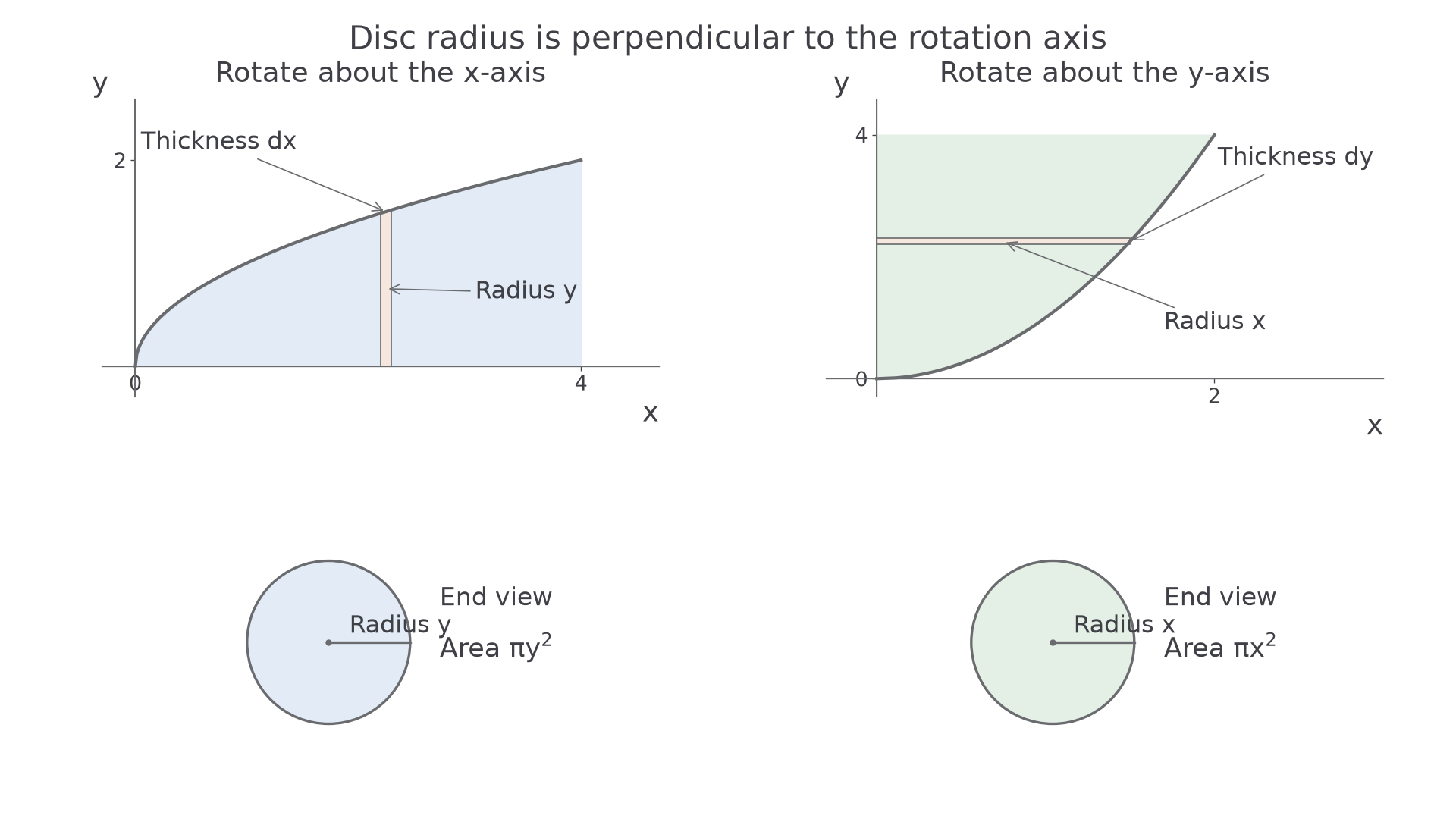
For rotation about the -axis, the distance from the axis is , so its square is , and thickness runs in the -direction. For rotation about the -axis the squared radius is , and thickness runs in the -direction. A negative coordinate does not make a negative radius or a negative volume.
These disc formulae apply when each perpendicular cross-section is a full disc: the specified region runs from the axis to its outer boundary. Identify the whole region before using them. We will use rotations about the coordinate axes.
The dimensions provide a useful check: circular area has square units, thickness has length units, and their product has cubic units.
Revolution about the x-axis
Rotation about the horizontal axis turns the vertical height of a region into the radius of each disc.
For the region between , the -axis and , each cross-section has area . Use the stated boundaries, finding an intercept if it supplies one of them. Square the entire expression for before integrating; keep the factor .
Rotation about the x-axis
For full circular cross-sections and ,
The coordinate-axis volume formulae must be learnt; they are not on the examination formulae sheet.
Worked example 1: squaring a linear radius
Question. The region bounded by , the -axis and rotates once about the -axis. Find the volume formed.
Plan. Use radius , square the bracket and integrate from to .
Answer. cubic units.
Check. The radii lie between and , so the volume lies between those of cylinders of length and radii : . Also, the antiderivative differentiates to , including the middle term.
Continue this lesson.
You’re previewing NovaLearn without an account. Create a free account to read the rest.
Create free account