9A - Differentiating sine, cosine and exponentials
The sine curve rises through the origin, flattens at its peak and then falls. Which function records those changing gradients? You will differentiate sine, cosine and the exponential function with constant multiples of the input, then combine these rules with powers and evaluate exact gradients.
Trigonometric derivatives
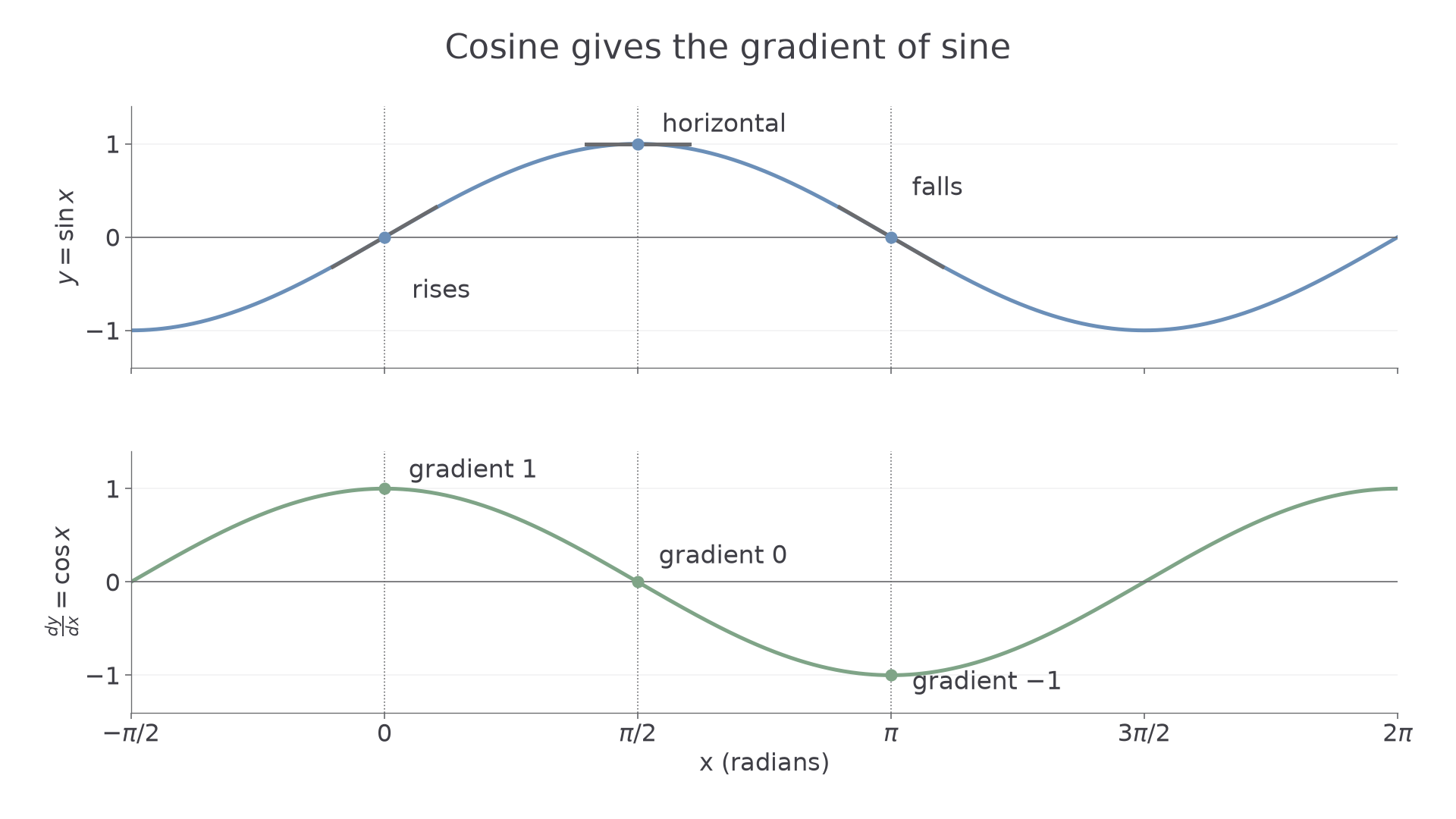
At , the graph of is rising; at it is horizontal; at it is falling. With measured in radians, these gradients are , exactly the corresponding values of .
[DIAGRAM: asset_name: Sine and its gradient function; asset_slug: sine-and-derivative; caption: The cosine graph records the gradient of the sine graph when angles are in radians; description: Aligned sine and cosine graphs from minus pi over two to two pi. Vertical guides at zero, pi over two and pi link sine points to derivative values one, zero and minus one. Short tangents on the sine graph show positive, horizontal and negative directions at these positions.]
Sine and cosine derivatives
For a constant , with angles in radians,
The factor stays outside; the whole angle stays inside the trig function. These standard derivatives must be learnt; they are not on the provided formulae sheet.
The unit matters. Near zero, approaches when is in radians, but about when is a number of degrees. Thus the displayed rules cannot be applied unchanged to degree inputs. Use radian mode for numerical checks in this lesson.
The factor reflects how quickly the angle changes: completes its oscillation three times as quickly as . It therefore has a compressed graph and steeper corresponding gradients. The cosine derivative also has a minus sign; it falls immediately to the right of its maximum at zero.
Worked example 1: a sine with a multiple angle
Question. Find the first two derivatives of .
Plan. Use the sine derivative with , then the cosine derivative on the result.
Answer. , .
Check. At zero the first derivative is . The secant from to has gradient . At , the sine is at its maximum and the derivative is .
Change sine to cosine while keeping the same angle. This isolates the negative sign and the switch of function.
Worked example 2: a cosine with the same angle
Question. Find the first two derivatives of .
Plan. Apply the cosine derivative, then differentiate its sine term.
Answer. , .
Check. At , cosine crosses down through zero and the derivative is . A central secant using inputs gives approximately . The sign agrees with the graph's downward crossing.
A constant outside a trig function is a multiplier: for example, . Do not multiply the angle by that outside constant.
Exponential derivatives
The exponential function , with , has a special property: at every input its gradient equals its height. Thus its derivative is again . This property singles out the base ; it does not mean that every exponential function differentiates to itself.
Exponential derivative
For a constant ,
The exponent remains , and differentiation introduces a multiplier . The function and derivative are defined for every real . This standard derivative must also be learnt.
Continue this lesson.
You’re previewing NovaLearn without an account. Create a free account to read the rest.
Create free account