4A - Rational functions and asymptotes
Does every forbidden input produce a graph that shoots upwards or downwards? You will distinguish a missing point from a vertical asymptote, find axis-parallel asymptotes and use them with intercepts to sketch rational functions with linear denominators.
Excluded inputs
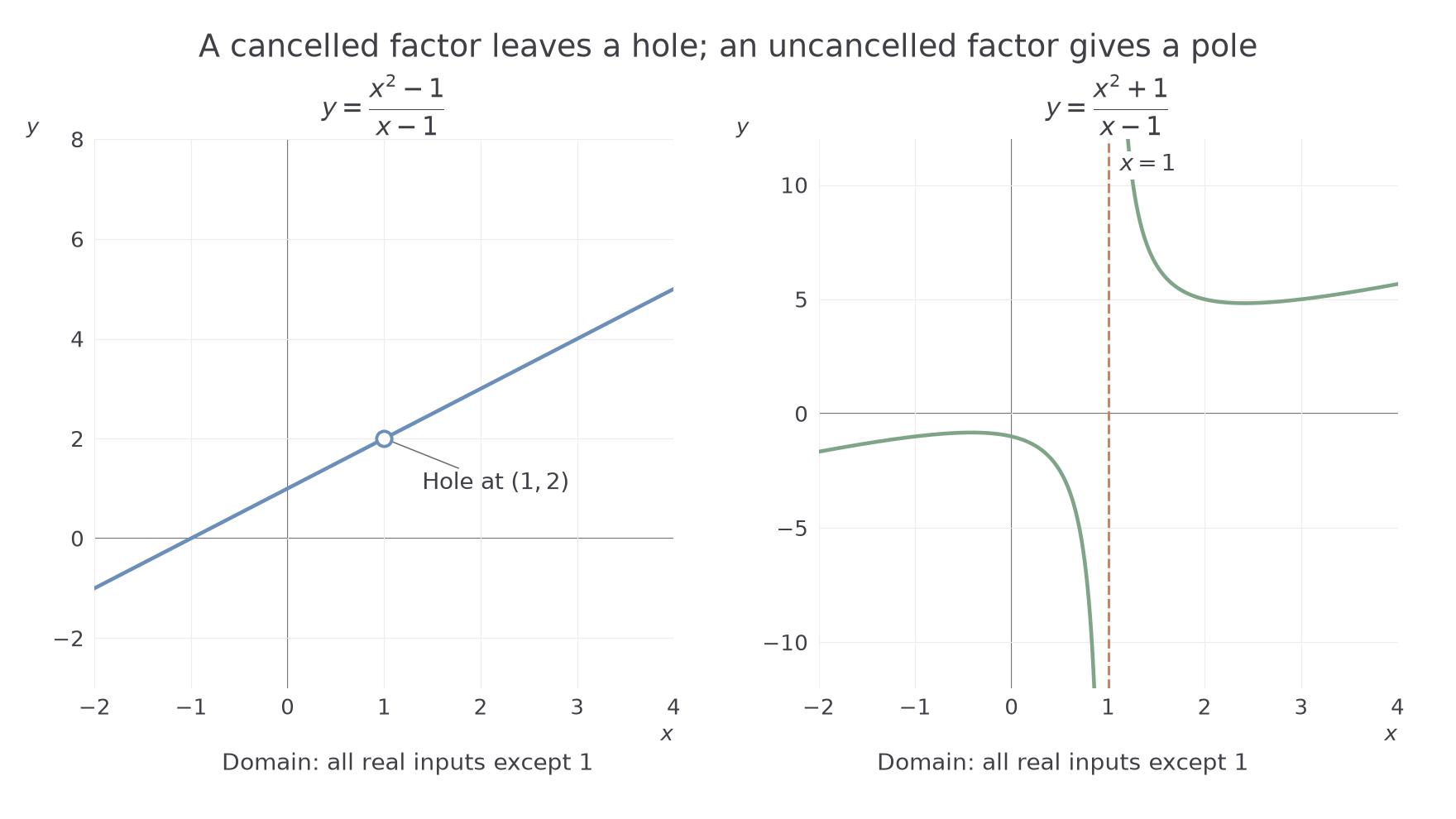
The expressions and both have denominator zero at , but their graphs behave very differently there.
A rational function is a quotient of polynomials. Division by zero is undefined, so identify forbidden inputs from the original denominator before cancelling anything. The allowed real inputs form its domain.
For the first expression, . Cancelling gives only when . Nearby heights approach , but the original expression still has no value at . Its graph is a straight line with one point missing.
Hole and pole
A hole is a missing point where the surrounding graph approaches a finite height. Draw an open circle there. An uncancelled zero of a linear denominator, with a nonzero numerator there, instead gives a pole: the heights become unbounded near the excluded input.
[DIAGRAM: asset_name: A hole compared with an uncancelled pole; asset_slug: hole-and-pole; caption: The same excluded input can give a missing point or unbounded heights; description: The left graph is (x squared minus 1) divided by (x minus 1), drawn as y equals x plus 1 with an open circle at (1,2). The right graph is (x squared plus 1) divided by (x minus 1), with separate branches tending downwards and upwards beside the dashed vertical line x equals 1. Both state that x equals 1 is excluded.]
Worked example 1: cancelling without restoring an input
Question. State the domain of and describe its graph at the excluded input.
Plan. Exclude the denominator's zero, then factor the numerator to see whether cancellation is possible.
The line would have height at , so leave that point out.
Answer. All real except ; graph with a hole at .
Check. At and , the original quotient gives and , agreeing with the line. Substitution of in the original expression still gives undefined division .
Change only the numerator's constant from to . The denominator has the same zero, but there is now no matching factor to cancel.
Worked example 2: an uncancelled denominator
Question. State the domain of and describe its behaviour near the excluded input.
Plan. Find the forbidden input and check the numerator there.
Near , the numerator is positive and close to . The denominator is a tiny negative number on the left and a tiny positive number on the right. Hence the quotient is very negative on the left and very positive on the right.
Answer. All real except ; a pole at , with unbounded negative heights on the left and positive heights on the right.
Check. and . Moving closer makes the magnitudes larger, rather than approaching a finite hole height.
Cancelling a factor simplifies permitted values; it never repairs a forbidden input in the original function.
Axis-parallel asymptotes
An asymptote gives a line that the graph approaches in a specified direction.
For , the fractional part is tiny when is very large in either direction. The graph approaches the horizontal line . Close to , the fractional part becomes unbounded, so the graph approaches the vertical line .
Vertical and horizontal asymptotes
A vertical asymptote occurs when the magnitude of the output grows without bound as the input approaches from at least one side. A horizontal asymptote occurs when the output approaches as the input becomes unbounded in a horizontal direction.
For a linear numerator and linear denominator, division separates the constant height from a fraction that tends to zero. For a constant numerator, such as , that constant height is .
Worked example 3: exposing the constant height
Question. Find the vertical and horizontal asymptotes of .
Plan. Rewrite the numerator as a multiple of the denominator plus a remainder.
The nonzero remainder gives unbounded heights near . For large , the fraction approaches zero.
Answer. Vertical asymptote ; horizontal asymptote .
Check. At , , close to . At , , showing the very different behaviour near the vertical asymptote.
Change the denominator's leading coefficient from to . Its zero and the division quotient both change.
Worked example 4: a non-monic denominator
Question. Find the vertical and horizontal asymptotes of .
Plan. Divide using the whole denominator, then solve its zero.
The numerator is nonzero at , so there is a pole. The fraction approaches zero at both horizontal ends.
Answer. Vertical asymptote ; horizontal asymptote .
Check. At , the denominator is , so . At , it is , so .
Continue this lesson.
You’re previewing NovaLearn without an account. Create a free account to read the rest.
Create free account