10C - Angles and lengths in three dimensions
Which angle measures how steeply a line climbs out of a flat surface? You will extract triangles from solids, use perpendicular projections to measure line–plane angles, and construct cross-sections for angles between planes. Exact lengths will let you combine these ideas without accumulating rounding errors.
Selecting a useful plane triangle
A cuboid has a base measuring by and height . What is the straight-line distance from one bottom corner to the opposite top corner?
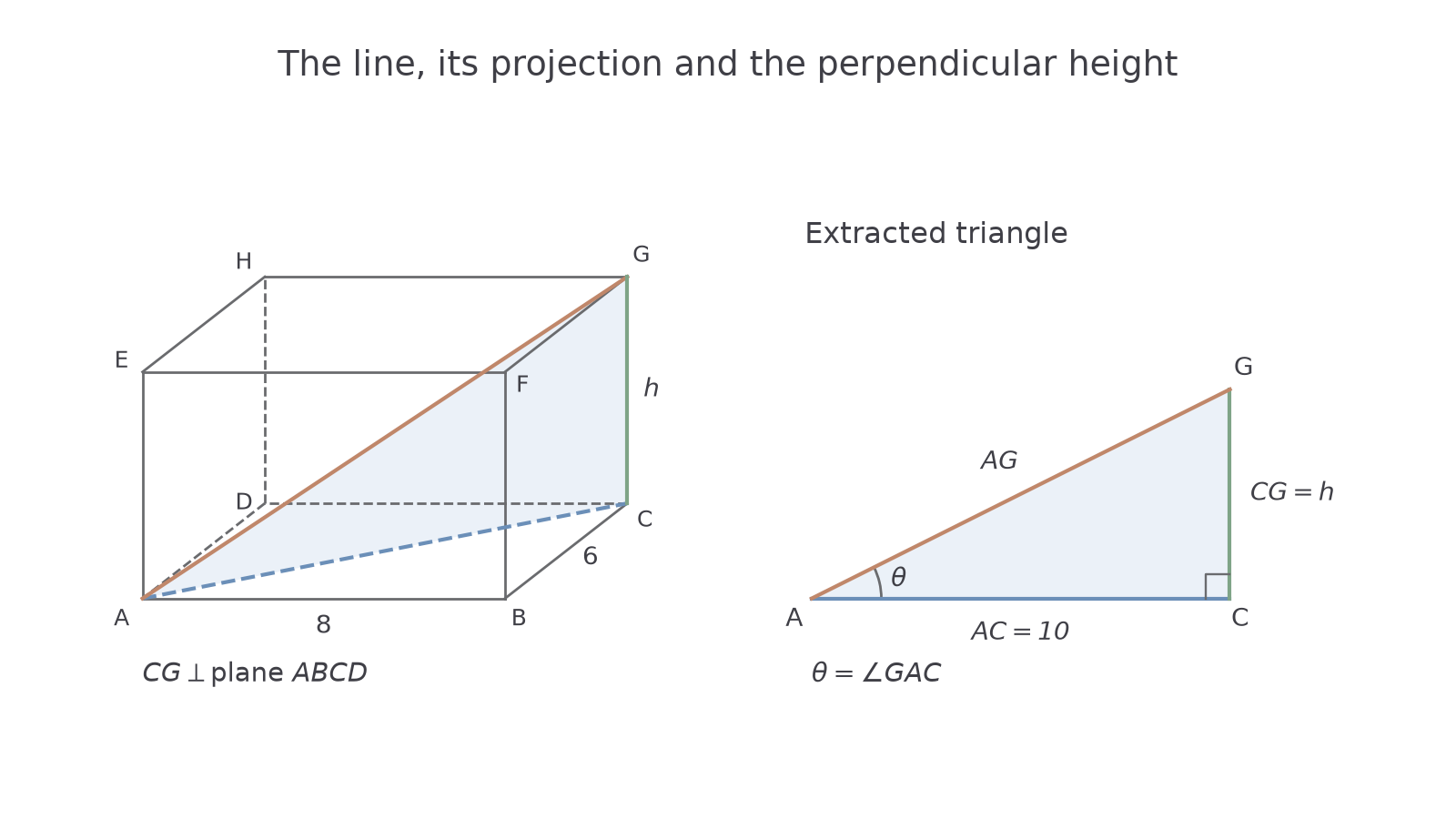
A diagonal drawn on the page can cross several edges, but the calculation takes place in one triangle. Label the base cyclically, with , , and put vertically above . The required space diagonal is .
The base diagonal and vertical edge form triangle . It is right-angled at : a vertical edge is perpendicular to the horizontal base plane, hence to every line of that plane through .
[DIAGRAM: asset_name: Extracting the diagonal triangle from a cuboid; asset_slug: cuboid-projection; caption: The space diagonal AG, its projection AC and vertical height CG form a right triangle; description: A cuboid has cyclic rectangular base ABCD with AB=8 and BC=6, and E F G H vertically above A B C D. The base diagonal AC and space diagonal AG are highlighted with CG, with a right angle at C. Alongside, the extracted right triangle has AC=10, CG=h, AG as hypotenuse, and theta at A. The figure supports either height 5 or height 12 in the examples.]
Problem-solving
Name the triangle before calculating. Establish its right angle from the solid's geometry. If the selected triangle is oblique, use known side–angle information with the sine or cosine rule instead.
A drawing in perspective does not preserve lengths or angles. An edge that looks vertical on the page is perpendicular to the base only when the geometry says so.
Worked example 1: the space diagonal
Question. A cuboid has , and , with the labelling above. Find exactly.
Plan. Find the base diagonal in triangle , then use the perpendicular triangle .
Answer. .
Check. An alternative cross-section first gives . Since is perpendicular to the side face containing , , agreeing with the result.
Keep the base, but change the height from to . The base diagonal remains ; only the second right triangle changes.
Worked example 2: changing the vertical height
Question. A cuboid has , and . Find exactly.
Plan. Reuse the base diagonal , and combine it with the new height.
Answer. .
Check. The alternative side-face route gives and . The diagonal also exceeds each individual edge and the base diagonal, as it should.
For a cuboid with mutually perpendicular dimensions , this reasoning gives . It does not apply unchanged to a sloping prism or an arbitrary three-dimensional shape.
Angle between a line and a plane
The steepness of a sloping line is measured against its own shadow on the plane.
For the cuboid, drop perpendicularly to the base at . Since already lies in the base, the perpendicular projection of is . The angle between and the base is therefore , not an angle with whichever base edge looks closest on the picture.
Angle between a line and a plane
The perpendicular projection of a point onto a plane is the foot of its perpendicular to the plane. Project the endpoints of a segment to obtain its projected segment.
For a line meeting a plane obliquely, the angle between the line and the plane is the acute angle between the line and its perpendicular projection onto the plane. A line parallel to or lying in the plane has angle ; a perpendicular line has angle , even though its projection collapses to a point.
If a segment meets the plane at and is the perpendicular foot of , use right triangle . With ,
Here is the perpendicular height, the projected length, and the sloping length. The plane extends beyond the visible face, so a perpendicular foot can lie outside the face and still be in the plane.
Worked example 3: a space diagonal and the base
Question. In a cuboid with , and , find the angle between and plane , to one decimal place.
Plan. Project to , so use angle in right triangle .
From the base rectangle, . Therefore
Answer. The angle is .
Check. Since , the independent sine calculation gives . Also the height exceeds the projected length, so the angle should exceed .
Keep the cuboid but change the line from to . Its upper endpoint has the same perpendicular foot; its lower endpoint, and therefore its projection, changes.
Worked example 4: a different line has a different projection
Question. In the same cuboid, find the angle between and plane , to one decimal place.
Plan. Project to ; calculate angle in triangle .
Answer. The angle is .
Check. , so , which gives the same angle. The shorter projection makes steeper than at the same height.
The opening steepness question therefore has a precise answer: use the line's projection, rather than an arbitrary line on the surface.
Angle between two planes
Two planes meet along a line, and their tilt is measured in a cross-section perpendicular to that line.
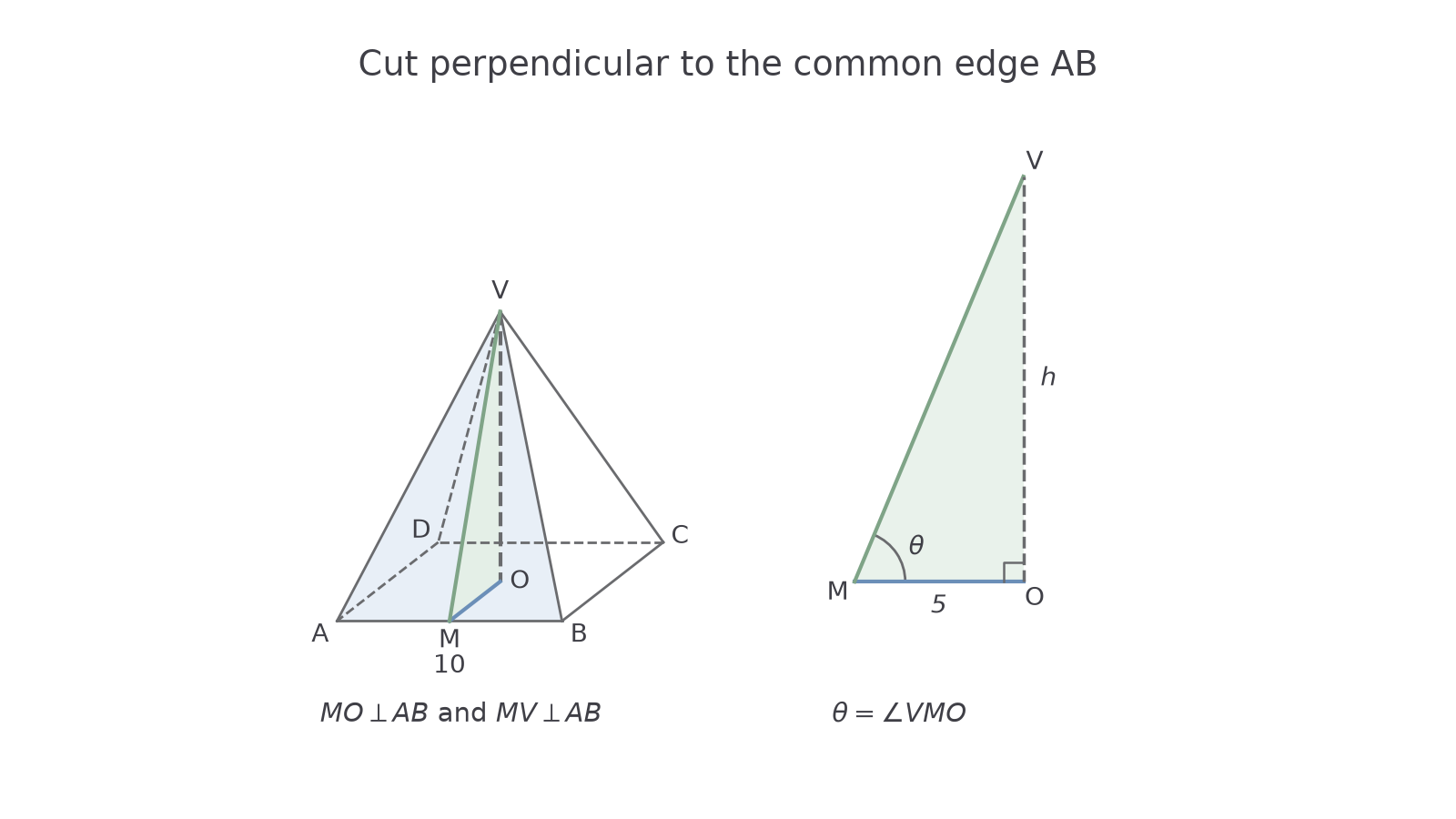
Imagine the base and one triangular face of a right square pyramid. The apex lies vertically above the centre of square . To compare face with the base, their common edge is . Let be the midpoint of .
In the base, . In the face, , because makes triangle isosceles. Thus measures the tilt of the face from the base. The lines must meet the common edge at the same point.
[DIAGRAM: asset_name: A perpendicular cross-section measures the plane angle; asset_slug: pyramid-plane-angle; caption: Both MV and MO are perpendicular to the shared edge AB, so angle VMO measures the face–base angle; description: A right square pyramid VABCD has apex V above centre O and M the midpoint of edge AB. Segment VO is vertical, OM lies in the base perpendicular to AB, and VM lies in the face perpendicular to AB. The triangular cross-section VMO is highlighted. Alongside, an undistorted right triangle M O V shows OM=5 and VO=h, with theta at M and a right angle at O.]
Continue this lesson.
You’re previewing NovaLearn without an account. Create a free account to read the rest.
Create free account