5B - Geometric sequences
Repeated multiplication produces a different kind of pattern from repeated addition. You will find geometric terms, recover possible ratios from term conditions, and use logarithms to locate the first term beyond a growth or decay threshold.
Common ratio and nth term
The sequence keeps halving. Will any term actually equal zero?
Every term is half the previous term. After three multiplications the value is ; at position , there have been multiplications. A finite number of halvings leaves a positive value, however small.
Geometric sequence
A geometric sequence is formed by multiplying each term by the same common ratio, , to get the next term. Its terms begin .
When a term is nonzero, divide the next term by it to find . For example, has . The arithmetic sequence has no constant ratio.
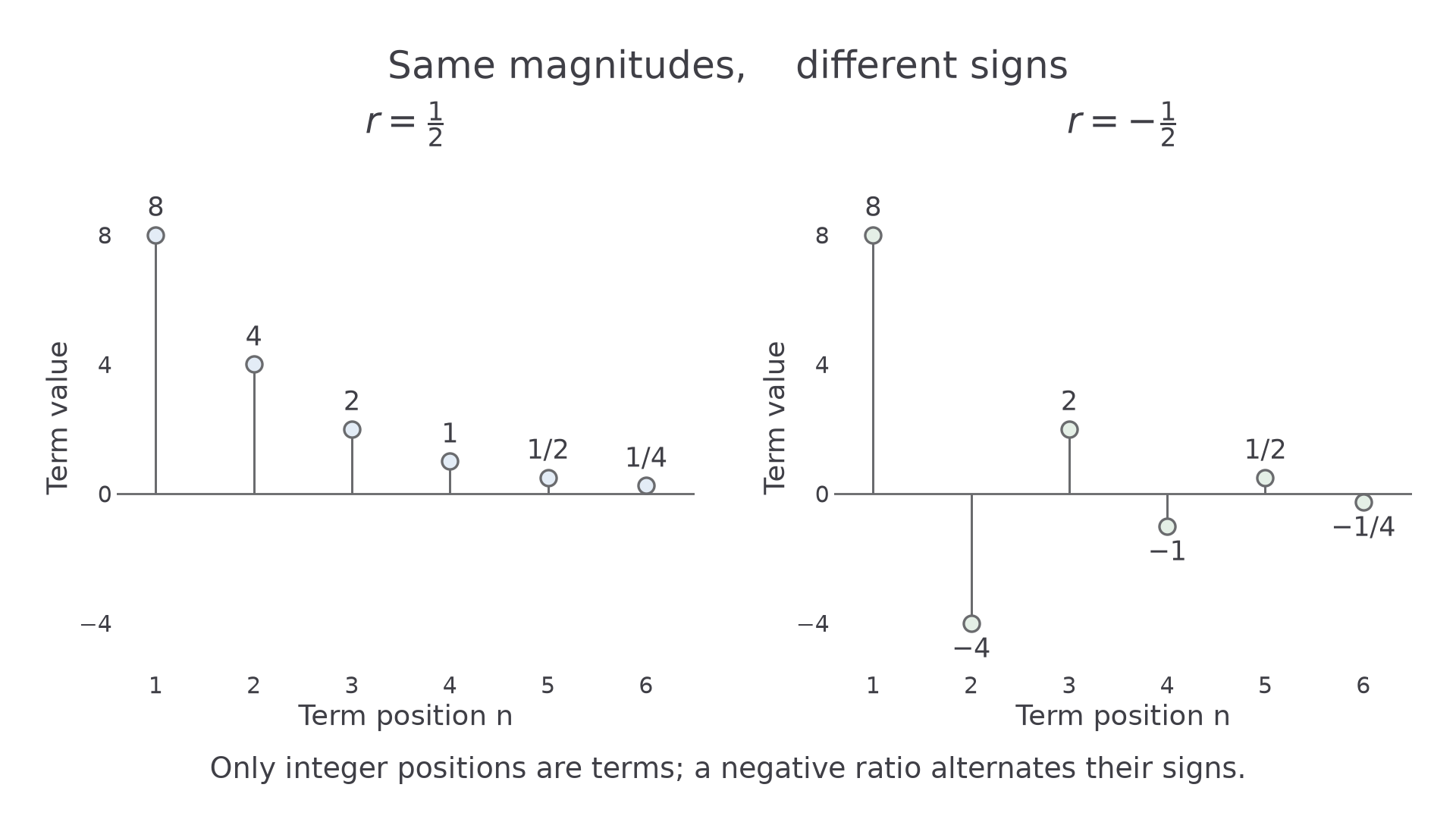
With a nonzero first term, a negative ratio changes the sign at every multiplication. Its magnitude determines whether the sizes grow, shrink or stay the same.
[DIAGRAM: asset_name: Positive and negative halving ratios; asset_slug: signed-geometric-terms; caption: A negative halving ratio alternates signs while the term magnitudes shrink; description: Two discrete term plots compare first term 8 with ratios one half and minus one half. The positive sequence is 8,4,2,1,one half,one quarter; the negative-ratio sequence is 8,minus4,2,minus1,one half,minus one quarter. Points are shown at integer positions only.]
Geometric nth term
For a nonzero common ratio and a positive integer ,
If , write the first term as and all later terms as , without evaluating . If , every term is .
Not on the formulae sheet: learn it.
The ratio belongs inside brackets when it is negative.
Worked example 1: repeated halving
Question. Find the sixth term of .
Plan. Use the first term and five factors of .
Answer. .
Check. Continuing the listed terms gives , then .
Change only the sign of the ratio. The magnitudes are unchanged, but the sixth term now has an odd number of negative factors.
Worked example 2: a negative ratio
Question. Find the sixth term of .
Plan. Raise the entire ratio to the fifth power.
Answer. .
Check. The fourth term is , the fifth is , and the sixth is , as the plot shows.
For a nonzero first term, alternates between and without changing size. If every term is zero, many ratios generate the sequence, so dividing terms cannot identify a unique ratio.
Finding geometric sequence parameters
Dividing two nonzero term equations removes the first term and leaves a power of the common ratio.
If and , then , provided the denominator is nonzero. The exponent counts the gaps. An even power can leave two real sign possibilities; an odd power fixes the sign.
Worked example 3: two possible signs
Question. A geometric sequence has third term and fifth term . Find all possible real values of and the corresponding first term.
Plan. Divide the fifth-term equation by the third-term equation, then test both square roots.
Answer. or , with in both cases.
Check. Both and meet the two stated conditions. They differ at the even positions.
Keep the third term, but use a sixth-term condition. There are now three gaps, so an odd power determines one real ratio.
Continue this lesson.
You’re previewing NovaLearn without an account. Create a free account to read the rest.
Create free account