3D - Solving linear inequalities
An inequality can have infinitely many solutions, so finding one successful value is only a start. You will rearrange linear inequalities, describe their full solution sets and combine conditions while keeping track of which endpoints are allowed.
Equivalent inequalities
For which values of is at least as large as ? Values such as and work, but does not. We need a rule describing every value that works.
Solution set
The solution set of an inequality contains all values that make it true. Equivalent inequalities have the same solution set.
The signs and are strict: equality is excluded. The signs and include equality.
Adding or subtracting the same quantity on both sides preserves the order. Multiplying or dividing both sides by a positive number does too. For example, gives after multiplication by .
A negative multiplier reverses the order: , but . On a number line, multiplication by reflects both numbers in zero, so the number that was on the left moves to the right. This is why division by a negative number also reverses the inequality sign. Division by zero is never allowed.
Worked example 1: unknowns on both sides
Question. Find the set of values of for which .
Plan. Collect the -terms on the left and the constants on the right.
Answer. .
Check. At , both original sides equal , so the boundary is excluded. Subtracting the original right side from the left gives , which is negative exactly when .
Now choose an inequality whose rearrangement gives a negative coefficient of . The final division must reverse the sign.
Worked example 2: division by a negative number
Question. Find the set of values of for which .
Plan. Collect the variable terms, then divide by their coefficient.
Answer. .
Check. The original difference is . This is nonnegative exactly when . At , both original sides equal , so equality is allowed.
You could instead obtain and divide by positive . Both routes describe the same set.
Watch out
The line is wrong: division by reverses the sign. The correct result is . Adding or subtracting a negative number does not itself reverse a sign.
Keep the inequality sign throughout the next solution.
Representing solution sets
A number line shows a whole solution set at once, including its endpoints.
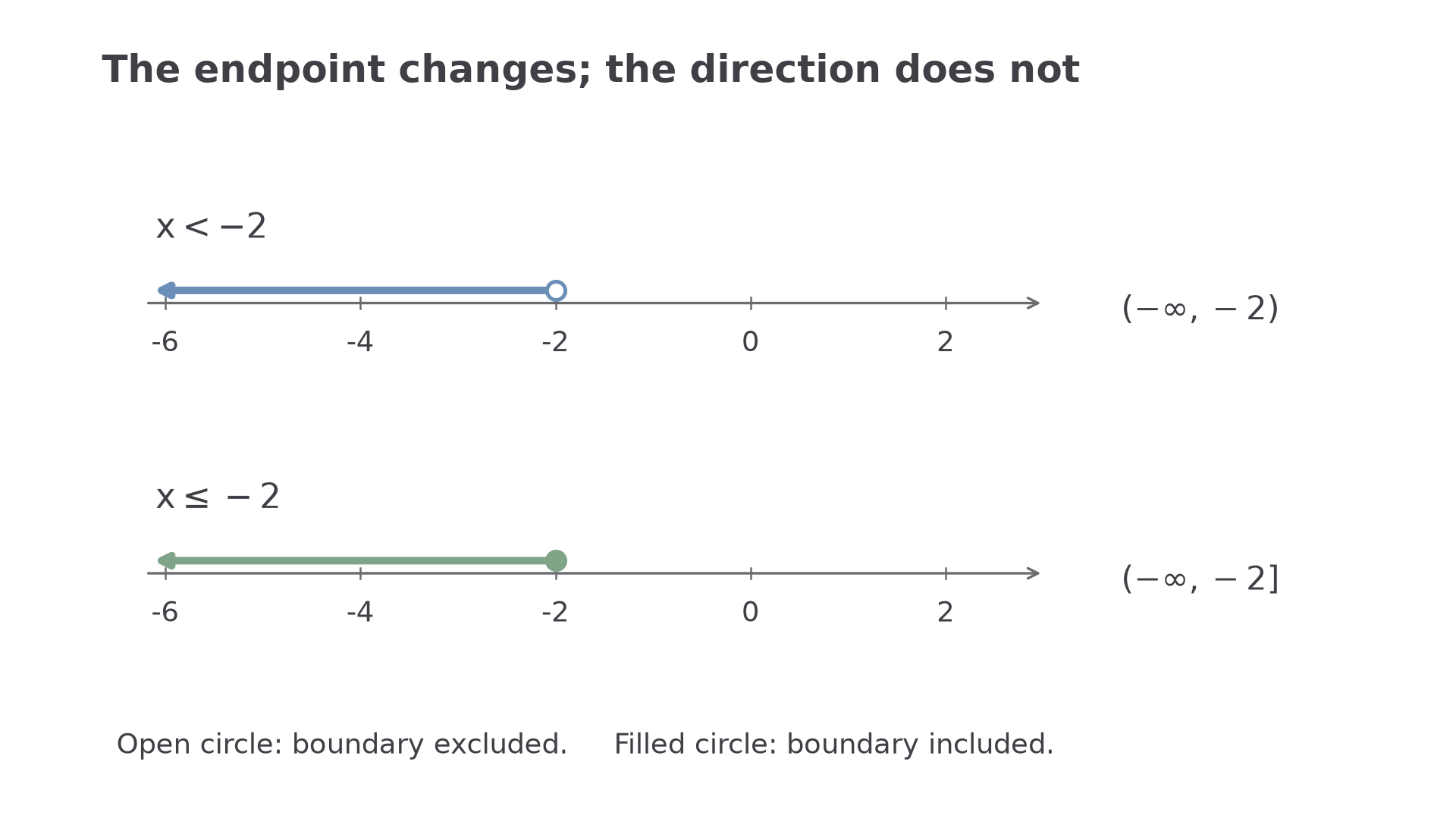
Use an open circle for an excluded endpoint and a filled circle for an included endpoint. Extend the solution to the left for smaller values and to the right for larger values; an arrow shows that it continues without a final value.
[DIAGRAM: asset_name: Strict and inclusive endpoints on a number line; asset_slug: linear-endpoints; caption: The sets x less than minus 2 and x less than or equal to minus 2 differ only at the endpoint; description: Two number lines share the boundary minus 2. The upper solution extends left from an open circle at minus 2 and is labelled x less than minus 2. The lower solution extends left from a filled circle at minus 2 and is labelled x less than or equal to minus 2. Their interval forms are shown alongside.]
Interval and set notation
An interval describes a continuous range. Round brackets exclude a finite endpoint; square brackets include it. For example, means .
The symbol means the real numbers. In set-builder notation, means “the real numbers for which ”.
The symbols and describe continuation without a bound. They are not real endpoints to include, so always use round brackets next to them.
Continue this lesson.
You’re previewing NovaLearn without an account. Create a free account to read the rest.
Create free account