7D, 7F - Position vectors and division points
Two places can be described by arrows from one origin, but how do we find the movement from one place to the other? You will use position vectors to join points, locate a point dividing a segment in a given ratio and calculate the same vector by different routes through a figure. In 7D, you describe positions relative to an origin; in 7F, you locate points dividing a segment.
Vectors from an origin
Choosing one fixed origin lets us describe each point by the displacement needed to reach it.
Position vector
The position vector of , relative to origin , is . It fixes the location of once the origin is chosen. The point has position vector .
If , the route to to gives . Subtracting isolates the movement from to .
Joining two position vectors
Use finishing position minus starting position. Equivalently, travel from back to , then from to .
The origin is a reference point, not a compulsory stop on the actual journey. If we move the origin, the two position vectors change, but their difference still represents the same displacement .
Worked example 1: finding the joining vector
Question. Given and , find .
Plan. Subtract the position of the starting point from the position of the finishing point.
Answer. .
Check. Starting at , moving right and down reaches , the position of .
Now the movement is known and the finishing position is missing. Rearrange the same route relation.
Worked example 2: finding a new position
Question. Given and , find .
Plan. Add the displacement from to the position vector of .
Answer. .
Check. Subtracting from the answer gives , the supplied movement.
Read the letter order before subtracting.
A point dividing a segment
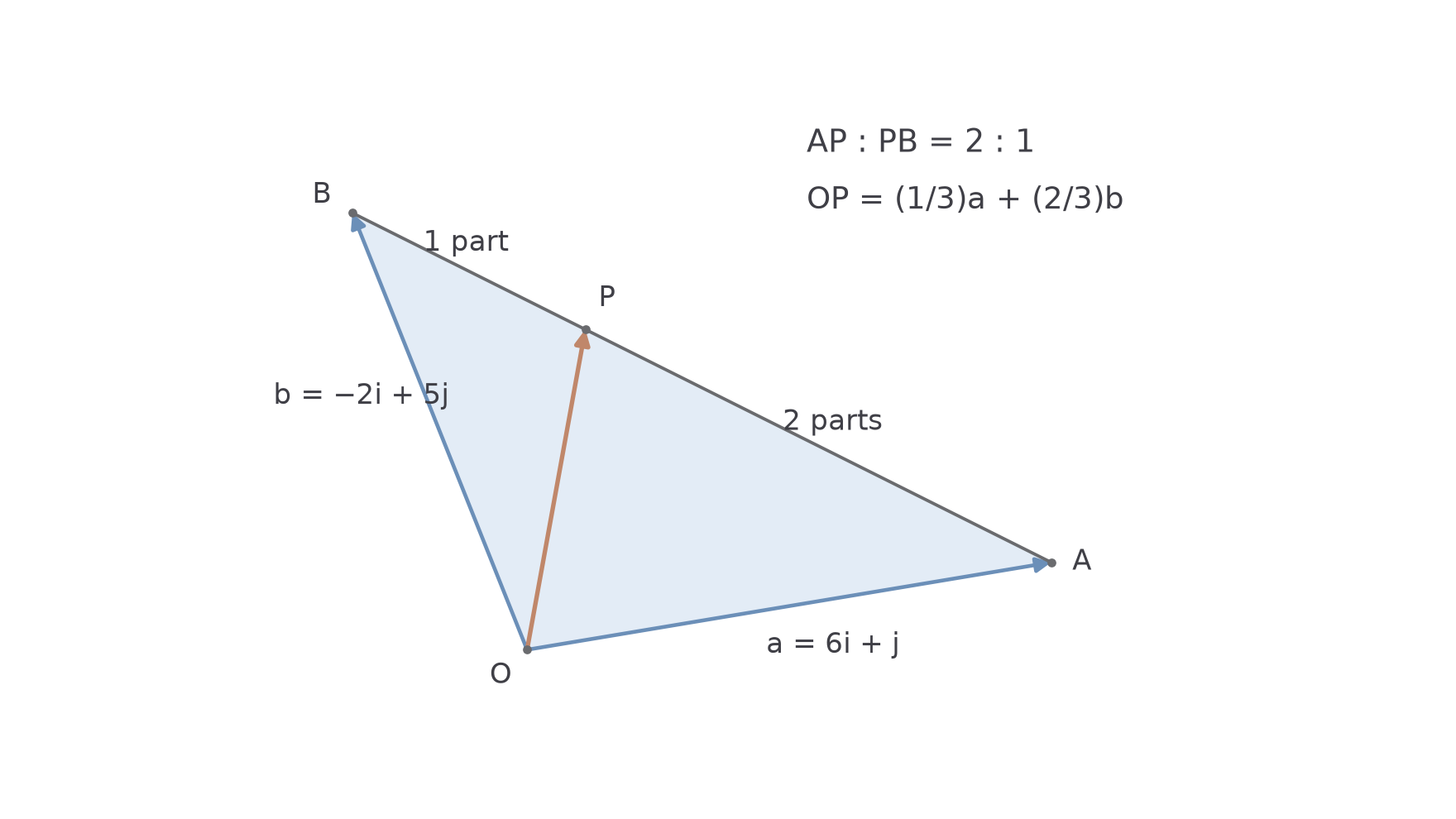
A point partway along can be reached by starting at and taking a fraction of the displacement .
Suppose divides the segment internally with , where . There are equal ratio parts in the whole segment, and contains of them. Therefore . The fraction lies strictly between and , which places between the endpoints.
Internal division
For distinct , with , and , where ,
For a midpoint, , giving .
Notice that the weight of is the proportion travelled from towards . Deriving the route prevents the common mistake of putting the ratio weights beside the wrong endpoints.
[DIAGRAM: asset_name: Internal division by a vector route; asset_slug: internal-vector-division; caption: A point two thirds of the way from A to B has position vector one third a plus two thirds b; description: Triangle OAB has position vectors a equals 6i plus j and b equals minus 2i plus 5j. P lies on AB with AP to PB equal to 2 to 1. The arrow OP locates the point with position vector one third a plus two thirds b.]
Continue this lesson.
You’re previewing NovaLearn without an account. Create a free account to read the rest.
Create free account