9E - Maximum and minimum problems
A fixed amount of material can make a tall narrow container or a short wide one. You will turn a practical constraint into a function of one variable, use calculus to find its best value and check that the answer is possible in the original problem.
Building a one-variable model
If a closed cylindrical can has a fixed surface area, does making its radius larger always increase its capacity?
A larger radius also uses more material in the circular ends, leaving less for the height. Both dimensions affect the volume, so we need to connect them before differentiating.
Objective and constraint
The objective is the quantity being maximised or minimised. A constraint is a relation restricting the possible dimensions. Use the constraint to express the objective in one variable, and state the feasible domain: the values that make sense in the problem.
For a cylinder of radius and height , the volume is . Its curved surface unwraps into a rectangle of width and height , so that area is . Each circular face adds .
[DIAGRAM: asset_name: Surface constraints for closed and open cylinders; asset_slug: cylinder-models; caption: Removing a lid changes the surface constraint while the volume formula stays the same; description: Two labelled cylinders show the radius r and height h. The closed cylinder has two circular faces and total surface area 2 pi r squared plus 2 pi r h. The open cylinder has one circular face and surface area pi r squared plus 2 pi r h. Both have volume pi r squared h and require positive radius and height.]
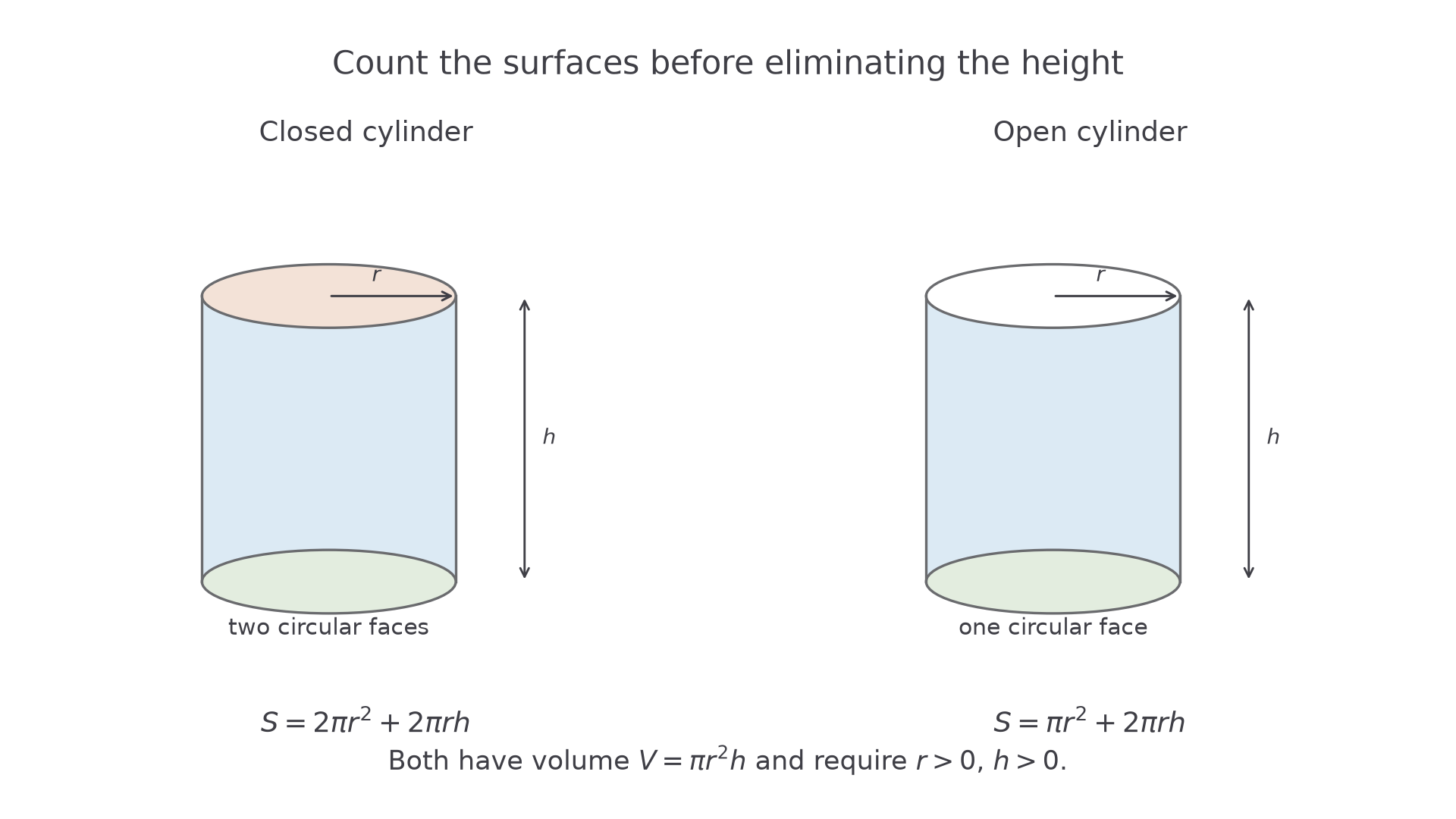
For a cone, the curved surface area , where is the slant height, is supplied on the formulae sheet. For any solid, decide which faces are present before writing its constraint.
Worked example 1: a closed cylinder
Question. A closed cylinder has total surface area . Express its volume in terms of and state the feasible domain.
Plan. Count both circular ends, express in terms of , then substitute into the volume.
A real container requires and . Thus , giving .
Answer. , with .
Check. At , the model gives . The surface area is , and both the direct volume and the model give .
Keep the same amount of material but remove the lid. Only the number of circular faces changes; do not retain the closed-cylinder constraint.
Worked example 2: an open cylinder
Question. An open cylindrical container has one circular base and surface area . Express its volume in terms of and state the feasible domain.
Plan. Replace two circular faces by one, then eliminate as before.
The conditions and give .
Answer. , with .
Check. At , , giving surface area . The direct volume is , matching from the model.
The domain comes from the dimensions, rather than from the algebraic expression for volume alone.
Finding and justifying an optimum
A stationary value is a candidate for an optimum, but the feasible domain decides which candidates can be used.
Differentiate the objective with respect to its remaining variable. Solve for zero derivative, discard infeasible solutions, and justify the nature of each remaining point. On a closed interval, compare all relevant stationary values and endpoint values. On an open interval, a limiting value at an excluded endpoint is not an attained optimum.
Worked example 3: a feasible stationary maximum
Question. Find the radius giving the greatest value of for , and justify your answer.
Plan. Find the positive stationary radius, then check the gradient over the feasible domain.
Only is feasible. The second derivative is
so this is a local maximum. On the full feasible interval, before and after , establishing the greatest volume there.
Answer. gives the greatest volume.
Check. The volume approaches zero as approaches either feasible-domain boundary, while . The boundaries themselves do not describe containers with positive radius and height.
Continue this lesson.
You’re previewing NovaLearn without an account. Create a free account to read the rest.
Create free account