2C - Quadratics with related roots
You can form a quadratic for a changed pair of roots without solving the original equation. You will calculate the new sum and product for shifts, multiples, reciprocals, squares and simple combinations, then turn them into a complete equation.
Shifting and scaling roots
The roots of are and . What equation has roots and , without finding or ?
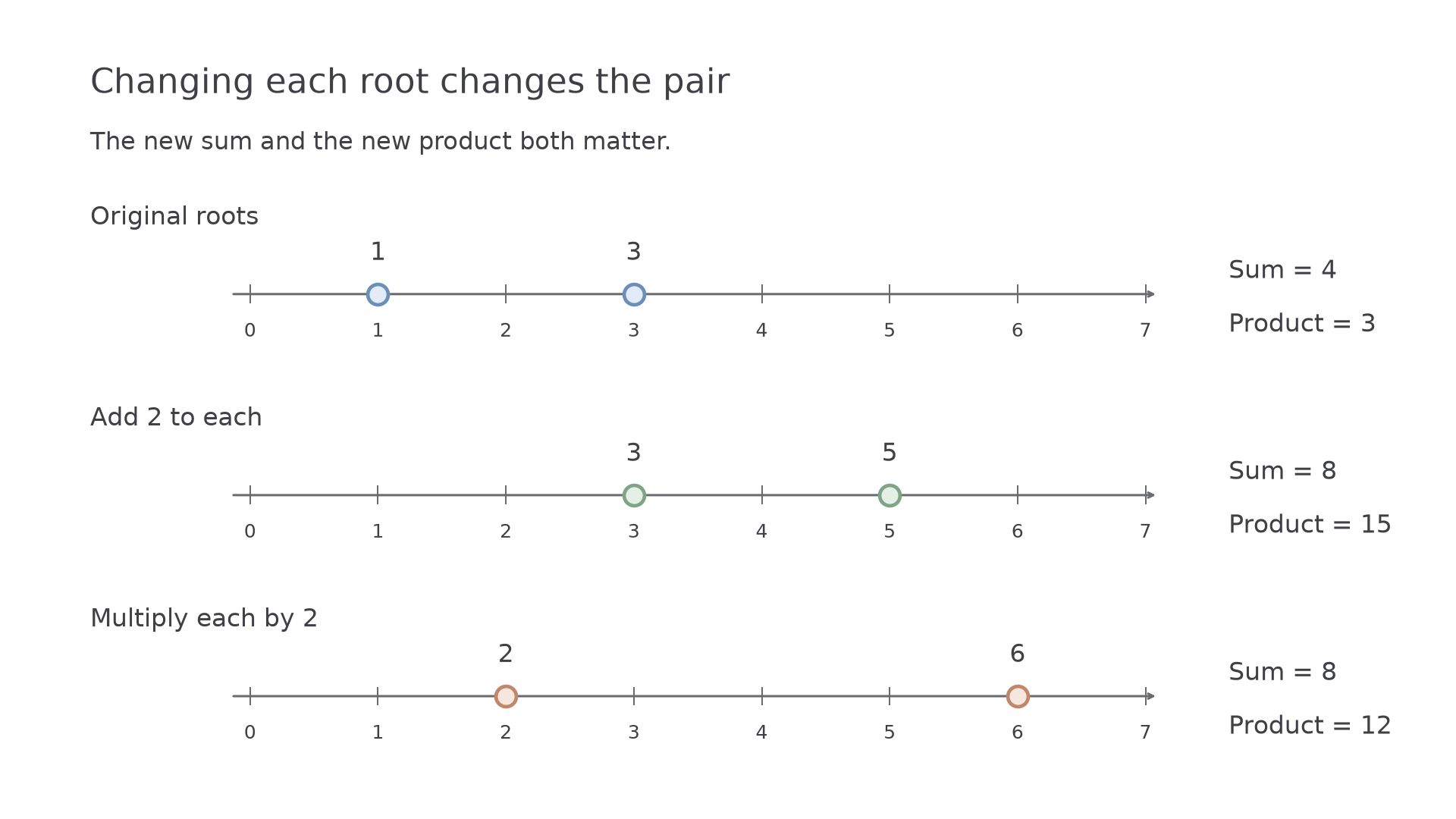
First try a visible pair: and . Adding to each gives and . Multiplying each by gives and . Both changed pairs have sum , but their products are and . You need the new product as well as the new sum.
[DIAGRAM: asset_name: Shifting and scaling a pair of roots; asset_slug: root-shift-scale; caption: Adding 2 and multiplying by 2 give the same sum for this pair, but different products; description: Three aligned number lines show original roots 1 and 3, shifted roots 3 and 5 after adding 2 to each, and scaled roots 2 and 6 after multiplying each by 2. The original sum is 4 and product is 3; the shifted sum is 8 and product is 15; the scaled sum is 8 and product is 12.]
You already know
For , with , write and . A pair with new sum and product has equation .
The prime marks here simply mean “new”. For a shift by , expand the new product before substituting values:
For a scale factor , both factors in the product acquire a , so the new product acquires .
Shifted and scaled roots
For roots , ,
For roots , ,
These are expansions, not additional formulae on the formulae sheet. They work for any real ; if in the scaling case, both new roots are zero and the equation is .
Use these new values in the equation-construction rule, rather than changing coefficients by guesswork.
Worked example 1: shifting both roots
Question. The roots of are and . Without solving, form an equation with roots and .
Plan. Read the original sum and product, calculate the shifted pair's sum and product, then construct the equation.
Answer. .
Check. If is a new root, is an original root. Substitute into the original equation:
This independently gives the same equation.
Keep the original equation and the number , but change addition into multiplication. The two new sums happen to agree here; the products do not.
Worked example 2: multiplying both roots
Question. The roots of are and . Without solving, form an equation with roots and .
Plan. Multiply the original sum by and the original product by .
Answer. .
Check. If , then . Substituting into the original equation gives . Multiplying every term by gives , as required.
The multiplication affects each root separately.
Watch out
For roots and , the product is , not . Write the two factors before simplifying.
Try another scale factor on a different original equation.
Reciprocals and squares of roots
For reciprocals or squares, calculate the sum and product of the transformed expressions before constructing the equation.
If the original roots are and , their reciprocals are and , with sum and product . These come from dividing the original sum and the number by the original product .
In general,
Both original roots must be nonzero, so . Check this before dividing. If the constant of the original quadratic is zero, the pair of reciprocal roots is not defined.
For squared roots, the sum uses the square identity you already know, while the product is .
Reciprocal and squared roots
For roots , , provided ,
For roots , ,
These results follow from the identities and are not on the formulae sheet. Squaring does not require nonzero roots.
Different original roots can give the same squared root. For example, and both become , so the new equation is . Count the repeated root twice in its sum and product.
Worked example 3: reciprocal roots
Question. The roots of are and . Without solving, form a quadratic equation with integer coefficients and roots and .
Plan. Check the original product is nonzero, then calculate the reciprocal pair's sum and product.
Answer. .
Check. A new root is nonzero and its reciprocal satisfies the original equation. Thus . Multiplying by gives , the same equation.
Keep the original equation but square each root instead. This changes both transformation identities, so start again from the original and .
Worked example 4: squared roots
Question. The roots of are and . Without solving, form a quadratic equation with integer coefficients and roots and .
Plan. Use the sum-of-squares identity and square the original product, then clear fractions.
Answer. .
Check. The original roots are approximately and . Their squares are approximately and ; these add to and multiply to , allowing for rounding.
The sign of an original root disappears when you square it, but its contribution to the new sum still has to be calculated correctly.
Watch out
The sum of squared roots is , not . Squaring each root and squaring their sum are different operations.
Use the square identity again with new coefficients.
Other simple root transformations
For a less familiar pair, write its sum and product explicitly, then use expansion, common denominators and the identities you have learnt.
There is no need for a new formula for every pair. Decide which expression to simplify first: a product of fractions may cancel immediately, even when their sum needs more work. Keep using , for the original roots and , for the new pair.
Consider ratios. Provided ,
If the numerators are squared, making a common denominator produces cubes:
The denominator changes which power is needed in the numerator. Show that algebra before substituting numbers.
Worked example 5: ratios of the roots
Question. The roots of are and . Without solving, form a quadratic equation with integer coefficients and roots and .
Plan. Check the ratios are defined, then simplify their product and put their sum over a common denominator.
The original values are , , so neither denominator is zero.
Answer. .
Check. Directly dividing the original roots gives ratios approximately and . Their sum is approximately and their product is , agreeing with the constructed equation.
Now change only the numerator power from one to two. The new sum needs the cube identity, and the product retains one copy of each original root.
Worked example 6: squared numerators in the ratios
Question. The roots of are and . Without solving, form a quadratic equation with integer coefficients and roots and .
Plan. Use the cube identity for the common-denominator sum and cancel factors in the product.
Again , , so the ratios exist.
Answer. .
Check. Solving this new equation gives approximately and . Direct evaluation of and , using the original roots, gives the same two values.
Products involving sums or differences need expansion instead of cancellation. For roots and , the sum uses squares and the product uses cubes:
The last term is positive because it comes from . This expansion explains which identities you need; it is more useful than trying to remember the final expression.
Worked example 7: a cross-subtracted pair
Question. The roots of are and . Without solving, form a quadratic equation with roots and .
Plan. Find the square and cube sums from , , then use the expanded new sum and product.
Answer. .
Check. The original roots are and . The transformed values simplify to and . Their sum is and product is .
Change subtraction to addition in both transformed roots. Expand the new product again: the cube terms now have positive signs, while the final stays positive.
Worked example 8: a cross-added pair
Question. The roots of are and . Without solving, form a quadratic equation with roots and .
Plan. Retain the square sum and cube sum , then calculate the changed sum and product.
Answer. .
Check. The new values simplify directly to and . Their sum is and product is .
For each pair, the same construction is the final step, however you found the new sum and product.
Problem-solving
Write the new roots as two expressions. Add them and multiply them separately, simplify using the original and , then finish with . Fractions require nonzero denominators; subtraction requires careful expansion of every sign.
The opening shifted pair has equation . The longer transformations use the same idea: the roots can remain unknown throughout.
Quick Recap
- Find the original sum and product before changing the roots.
- For shifts and multiples, expand the new pair's sum and product; scaling both roots scales the product twice.
- For reciprocals, require ; for squares, use and .
- For other simple pairs, use common denominators or expand the product, then apply the square or cube identity.
- Finish with a complete equation and clear fractions when integer coefficients are requested.
Adding to each root of gives the roots of , without finding the original roots.