10A - Radians, arcs and sectors
Measure an angle using the circle itself, then use radians to calculate curved lengths and areas. You will distinguish an arc from a sector perimeter and a sector from a segment, keeping exact answers where possible.
Radian measure
What angle turns a radius through an arc exactly as long as that radius?
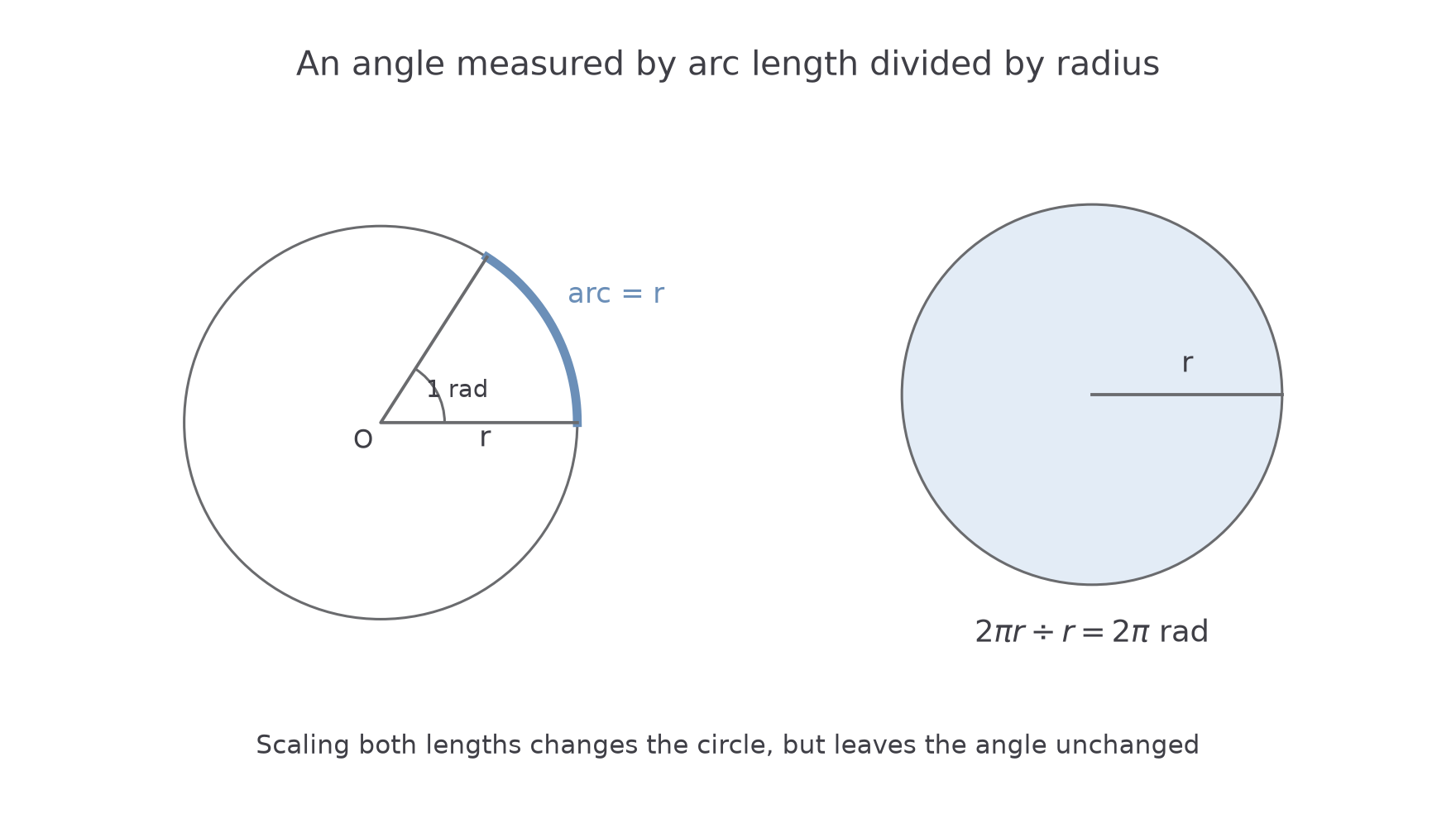
Take a circle of radius . An arc of length subtends an angle of one radian at its centre. If both lengths are doubled, their ratio stays the same, so the angle stays the same. The angle measures how many radius lengths fit along the arc.
[DIAGRAM: asset_name: One radian compares an arc with a radius; asset_slug: radian-measure; caption: An arc equal to the radius subtends one radian; description: A circle of radius r has a highlighted arc of length r subtending an angle of 1 radian. A second panel shows that a full circumference has length 2 pi r, so a full turn is 2 pi radians.]
Radian
An angle of one radian subtends an arc equal in length to the radius. For an arc of length on a circle of radius , its central angle in radians is .
A full circumference is , so a full turn measures radians. A half-turn is therefore both and radians. Radians and degrees name the same angle using different units.
Changing angle units
These follow from . Not on the formulae sheet: learn the conversion.
A value containing is often an exact radian value; radians can also be ordinary decimals. For example, . A bare angle in a radian calculation is understood to be in radians; write a degree symbol whenever you mean degrees.
Worked example 1: degrees to radians
Question. Express in radians, exactly.
Plan. Replace each degree by radians and simplify.
The fraction counts the same fraction of a half-turn.
Answer. .
Check. is three-quarters of , so its radian measure should be three-quarters of .
Reverse the conversion next. The factor must cancel when the answer is in degrees.
Worked example 2: radians to degrees
Question. Express in degrees.
Plan. Multiply by .
Answer. .
Check. is , a quarter-turn plus , giving .
Set the calculator to RAD for trigonometric calculations with radian inputs, and DEG for degree inputs. Changing its mode does not convert a number already written on your page.
Arc length and perimeter
An arc is only the curved part of the boundary; a sector also has two straight radii.
A quarter-circle of radius has arc length . Its angle is radians, and multiplying by gives that same length. More generally, rearrange the radian definition .
Arc length and sector perimeter
For radius and central angle in radians,
For an ordinary sector with ,
The arc-length formula is not on the formulae sheet: learn it. The perimeter formula adds the two radii.
For a major arc, use the reflex angle that belongs to it. If the minor angle is , the major angle is . A complete circle has circumference , with no exposed radii in its boundary.
Worked example 3: a curved length and a complete boundary
Question. A sector has radius and angle . Find its arc length and perimeter exactly.
Plan. Find the curved length first, then add the two straight sides.
Answer. Arc length ; perimeter .
Check. The angle is one-third of a full turn, so the arc is one-third of the circumference .
Now the perimeter is known and the angle is unknown. Subtract the straight sides before using the arc formula.
Continue this lesson.
You’re previewing NovaLearn without an account. Create a free account to read the rest.
Create free account