7C, 7E - Vector lengths and unit vectors
A displacement has components units east and units north: how long is the direct journey, and how can we keep its direction while changing its length? You will calculate vector magnitudes, build unit vectors and construct vectors of a specified magnitude. In 7C, you find a vector’s magnitude; in 7E, you use that length to make a unit vector.
Magnitude of a vector
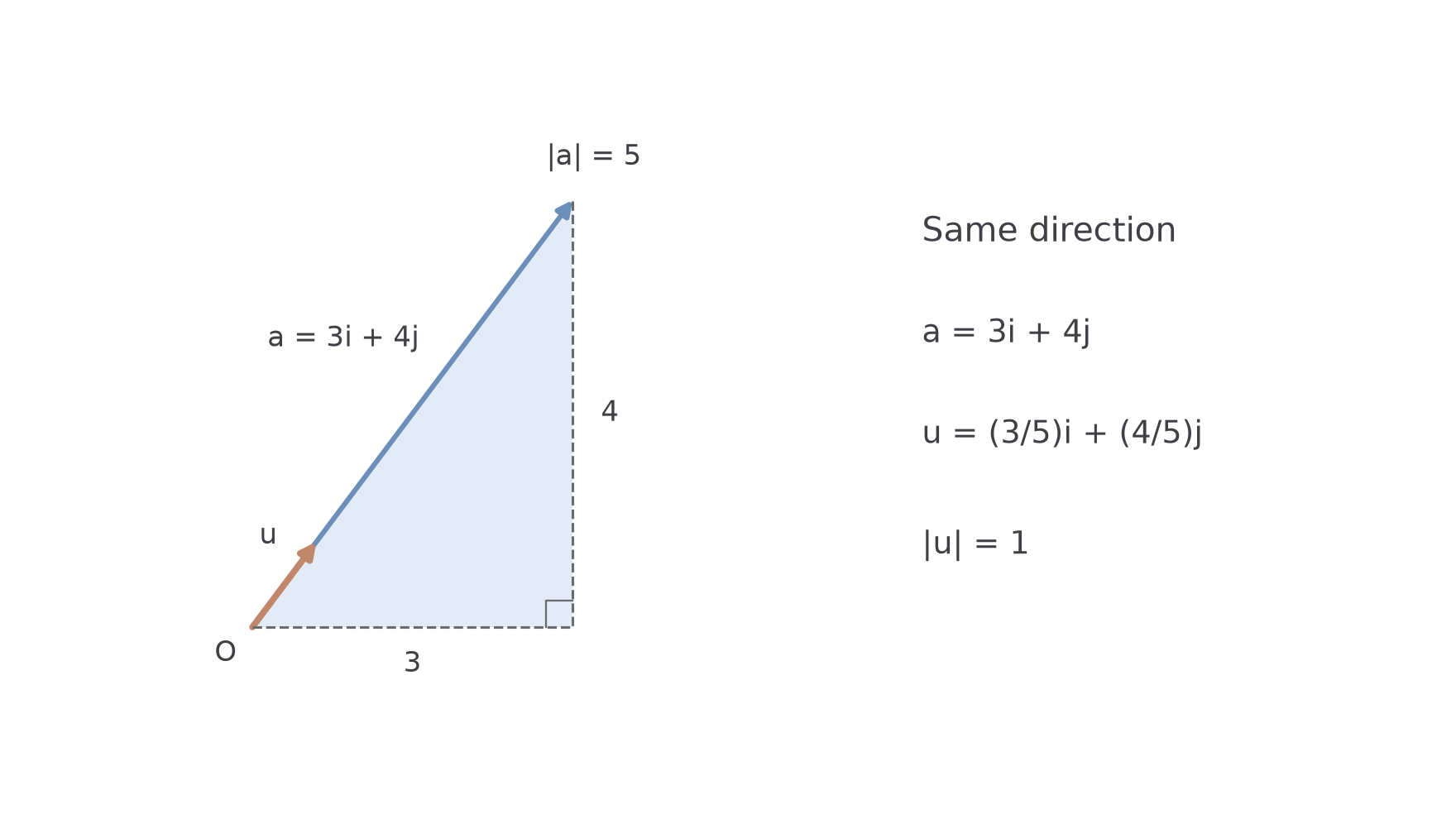
Horizontal and vertical components form the perpendicular sides of a right-angled triangle whose hypotenuse is the vector's length.
[DIAGRAM: asset_name: A vector and a unit vector in the same direction; asset_slug: magnitude-unit-direction; caption: A vector with components 3 and 4 has magnitude 5, and dividing it by 5 gives a unit vector; description: A right-angled component triangle has legs 3 and 4 and a blue displacement arrow of length 5. A shorter clay arrow from the same origin lies on the blue arrow and has components three fifths and four fifths, so its length is 1.]
Magnitude from perpendicular components
For ,
The magnitude is the nonnegative square root. The vectors and are perpendicular and each has magnitude .
This is Pythagoras applied to the component triangle. A component's sign tells you which way to move, but its square contributes positively to the squared length. The magnitude is a scalar; do not attach or to it.
The perpendicular condition matters. For arbitrary nonparallel vectors and , the coefficients of need not be perpendicular lengths, so this formula does not apply just because there are two terms.
Worked example 1: a component triangle
Question. Find the magnitude of .
Plan. Use the perpendicular component lengths in Pythagoras.
Answer. .
Check. The direct length lies between the larger component and the two-step distance ; fits.
Reverse just the horizontal component. The direction changes, but the reflected right-angled triangle has the same side lengths.
Worked example 2: a negative component
Question. Find the magnitude of .
Plan. Square the signed components before adding.
Answer. , although .
Check. Reflecting the first vector in the vertical axis gives this vector without stretching it, so their magnitudes must agree.
A magnitude need not be an integer. Keep an exact root when necessary.
Unit vectors
Dividing a nonzero vector by its length reduces its magnitude to while keeping its direction.
Unit vector
A unit vector has magnitude . The unit vector in the direction of a nonzero vector is
The hat is a label for this unit vector, not a new operation on its components.
The divisor is positive, so it does not reverse the arrow. Each component is divided by the same number, preserving the direction. There is no unit vector in the direction of : the zero vector has no specified direction, and dividing by zero is undefined.
The vectors and are particular unit vectors, but there are infinitely many others. A unit vector need not have both components positive, and its components need not be integers.
Continue this lesson.
You’re previewing NovaLearn without an account. Create a free account to read the rest.
Create free account