1C - Working with surds
A square root can be an exact answer even when its decimal expansion never ends. You will simplify square roots, combine like surds and multiply them without losing accuracy, ready to use exact lengths and solve equations later in the course.
Exact roots and decimal approximations
A square has area . Does its side have an exact length, or can we give only a decimal approximation?
Its side is the positive number whose square is . We write that number as . The symbol names an exact number; it is not an instruction we must replace with a decimal.
[DIAGRAM: asset_name: An exact length between decimal approximations; asset_slug: exact-root; caption: The diagonal of a unit square is exactly the square root of 2; description: A unit square has sides 1 and a diagonal labelled square root of 2. Pythagoras gives diagonal squared equals 1 squared plus 1 squared equals 2. A number line alongside places square root of 2 between 1.414 and 1.415; the squares of those bounds are 1.999396 and 2.002225.]
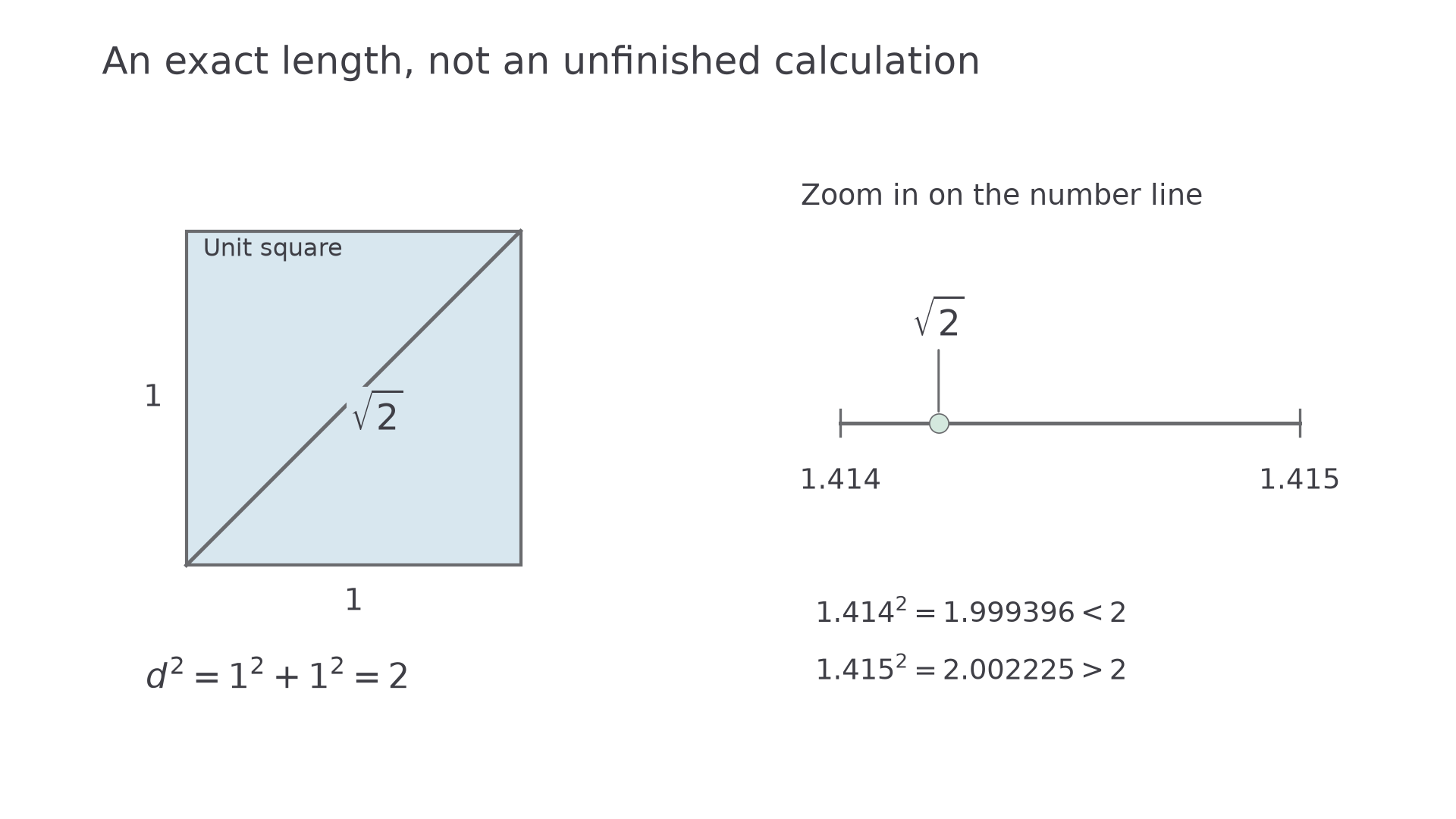
The diagonal in the picture has the same length as the side we are looking for: by Pythagoras, its square is . We can draw the length exactly even though a calculator displays only a rounded value.
Surd
A surd is a root of a rational number that has an irrational value. In this lesson we use square-root surds, such as , and .
An irrational number cannot be written as a fraction of two integers. Its decimal expansion neither terminates nor repeats. By contrast, is rational, so it is not a surd.
The square-root sign means the nonnegative square root. Thus , while the equation has two solutions, and . Also, , so a square root need not be positive.
For our opening square, , but , which is slightly less than . The decimal is useful for estimating; the surd keeps the exact value.
Key idea
Use between equal values and for a rounded approximation. An exact root is already a complete numerical answer when no further simplification is possible.
You can now distinguish an exact length from a convenient estimate of it.
Taking square factors out
A square factor lets you write a root in a simpler exact form.
Nine small squares, each with area , can form one large square with area . There are three small sides along each large side, so the large side is both and .
[DIAGRAM: asset_name: A square factor changes the side length; asset_slug: square-factor; caption: Nine squares of area 2 make a square of area 18, with side length 3 times the square root of 2; description: A three-by-three array of equal squares has total area 18. One small square is labelled area 2; its side is labelled square root of 2. A dimension line along the full bottom edge is labelled 3 square root of 2 equals square root of 18.]
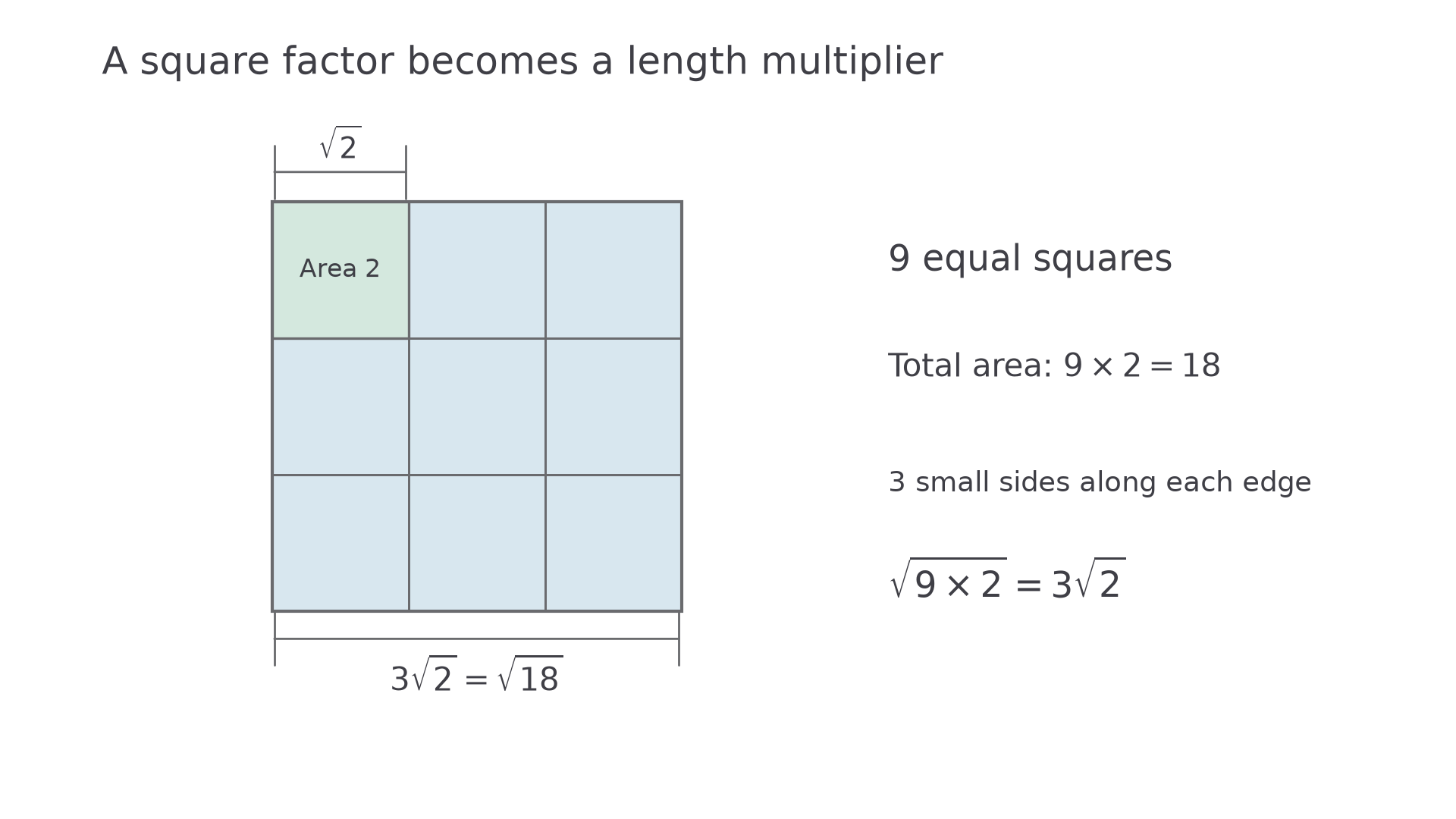
Algebra gives the same result. Multiplying by produces a nonnegative number whose square is .
Multiplying square roots
For and ,
In particular, if and , then .
Not on the formulae sheet: learn it.
To simplify a positive integer square root, look for its largest square factor. Smaller square factors also work, but may leave another simplification to do.
Worked example 1: taking out a square factor
Question. Simplify .
Plan. Factor into a square number times another integer.
Answer. .
Check. It is positive and , so it is the required square root.
Now change the number under the root from to . The same method works, but the square factor changes.
Worked example 2: choosing the square factor
Question. Simplify .
Plan. Use , the largest square factor of .
Answer. .
Check. , and the result is positive.
In both examples a square factor came out of the root. A sum behaves differently.
Watch out
: the left side is , while the right side is . The root-product rule splits a product, not a sum.
Choose the square factor before doing the next calculation.
Combining like surds
Simplifying first can reveal that two different-looking roots are multiples of the same number.
You already collect as . Replace with , and the same distributive law gives .
Like surds
Like surds have the same radical part after simplification. For example, and are like surds. and are unlike surds.
Add or subtract the coefficients of like surds. Keep the common radical part unchanged.
Worked example 3: simplifying before adding
Question. Simplify .
Plan. Write both terms as multiples of , then collect their coefficients.
Answer. .
Check. A decimal check gives about on both sides. The working above establishes the exact equality.
Keep the same roots and coefficient, but change addition to subtraction. This tests whether the sign stays with the whole second term.
Worked example 4: subtracting like surds
Question. Simplify .
Plan. Simplify each root, then subtract the coefficients.
Answer. .
Check. is larger than , so the difference must be negative; both expressions are about .
This does not make unlike radical parts interchangeable.
Watch out
cannot be collected as or . There is no common radical part. Leave the sum as .
The next expression looks different before you simplify its roots.
Multiplying surds
When multiplying surds, multiply the coefficients and the radical parts separately.
For example, . Two irrational factors can have a rational product. This is exactly why the square of our opening side length gives the whole-number area.
Worked example 5: a product of two surd terms
Question. Simplify .
Plan. Multiply the coefficients, combine the roots, then simplify.
Answer. .
Check. Both quantities are positive. Squaring the original product gives ; squaring the answer gives .
Now replace the second factor by a sum. You must multiply both terms inside the bracket.
Worked example 6: multiplying across a bracket
Question. Expand and simplify .
Plan. Distribute , then simplify any new root.
Answer. . These are unlike surds, so stop here.
Check. The original product and both give approximately on a calculator. Keep the exact surd answer above.
For an exact-answer question, keep this working in surd form. The calculator checks above are checks on a finished exact calculation, not replacements for it.
Exam tip
When an exact answer is requested, carry exact values through the working. Simplify the radical before deciding whether terms can be collected.
The opening square therefore has side , exactly. Multiplying that length by itself gives its area with no rounding error.
Quick Recap
- A surd can name an exact value that no finite decimal can equal.
- Take square factors out of roots before simplifying further.
- Add or subtract coefficients only when the radical parts match.
- For products, multiply coefficients and roots, then simplify; distribute across every term in a bracket.
The square of area has exact side length : its decimal approximation is optional.