7A, 7B - Vectors and components
If you walk east and then north, what single movement takes you from your starting point to your finishing point? Vectors describe that overall movement with both size and direction. You will add, subtract and scale vectors, then express them using horizontal and vertical components. In 7A, you learn the vector operations; in 7B, you describe a displacement using its components.
Magnitude and direction
A movement of east differs from a movement of north, even though the distances are equal.
Scalar and vector
A scalar has magnitude only, such as a mass or a distance. A vector has magnitude and direction, such as a displacement or a velocity. Displacement is the directed change from a starting point to a finishing point.
We write a vector as a bold letter, such as , or as , meaning the displacement from to . An arrow represents it: its length shows magnitude and its arrowhead shows direction. The magnitude is a nonnegative scalar written .
Two vectors are equal when they have the same magnitude and the same direction. Their arrows can start at different places. Translating an arrow without turning or stretching it leaves its vector unchanged. Equal length alone is insufficient: two opposite arrows of equal length are negatives of each other.
Reversing a journey reverses its displacement, so . A return to the starting point has the zero vector, . It has magnitude zero and no specified direction. In contrast, walking around a square gives a positive distance travelled but zero total displacement.
Key idea
Keep the order of the letters: begins at and ends at . A vector is a directed movement, not the location of its drawn arrow.
Use both features when comparing arrows.
Adding and scaling vectors
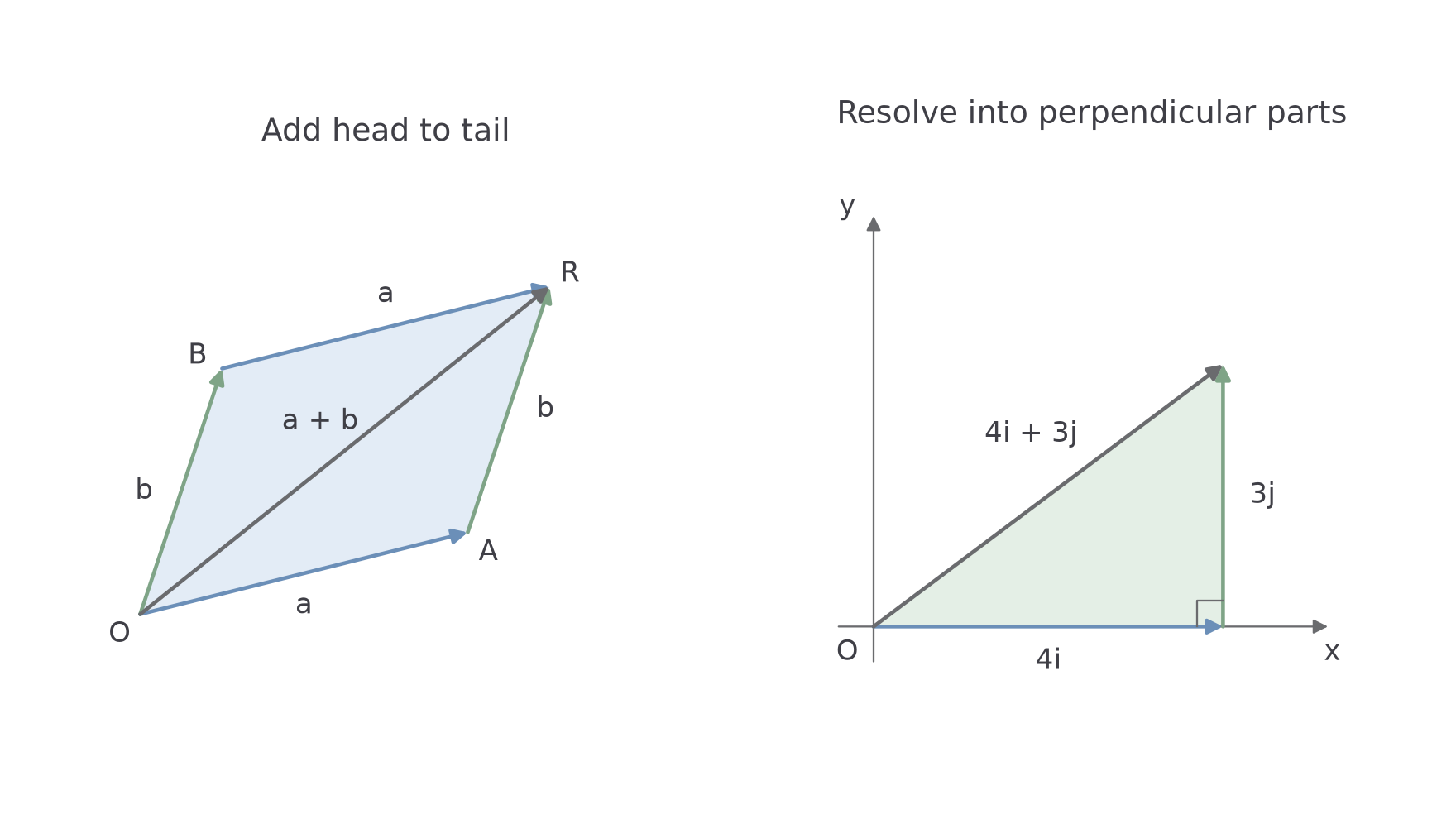
Following one displacement and then another gives the vector sum from the first starting point to the final finishing point.
For the triangle rule, put the tail of the second arrow at the head of the first. The resultant joins the original tail to the final head. Thus . For the parallelogram rule, draw both arrows from a common tail: the diagonal of the completed parallelogram represents their sum. These rules agree because opposite sides are equal vectors. Changing the order gives the same endpoint, so .
[DIAGRAM: asset_name: Adding arrows and resolving a displacement; asset_slug: vector-addition-components; caption: The triangle and parallelogram rules give the same resultant, which can also be built from horizontal and vertical parts; description: Left panel has arrows a from O to A and b copied from A to R, alongside b from O to B and a copied from B to R, with OR as their resultant. Right panel resolves a displacement of 4 units right and 3 units up into perpendicular components.]
Vector operations
For a nonzero vector and a real scalar , has magnitude times that of . It has the same direction if , the opposite direction if , and is if .
Subtract by adding the opposite vector: .
All the arrows here are coplanar: they lie in one plane. Scalars distribute across vector sums just as they do across algebraic brackets.
Worked example 1: following two sides
Question. Given and , find .
Plan. Follow the route to to , then collect like vectors.
Answer. .
Check. Removing the first movement gives , the supplied .
Continue this lesson.
You’re previewing NovaLearn without an account. Create a free account to read the rest.
Create free account