5B - Convergent geometric series
Can infinitely many nonzero terms have a finite total? You will interpret a sum to infinity through partial sums, use the geometric convergence condition, and combine finite and infinite information to recover parameters or reach a target total.
Why an infinite sum can be finite
The sum starts . Could its total be , even though no finite addition reaches ?
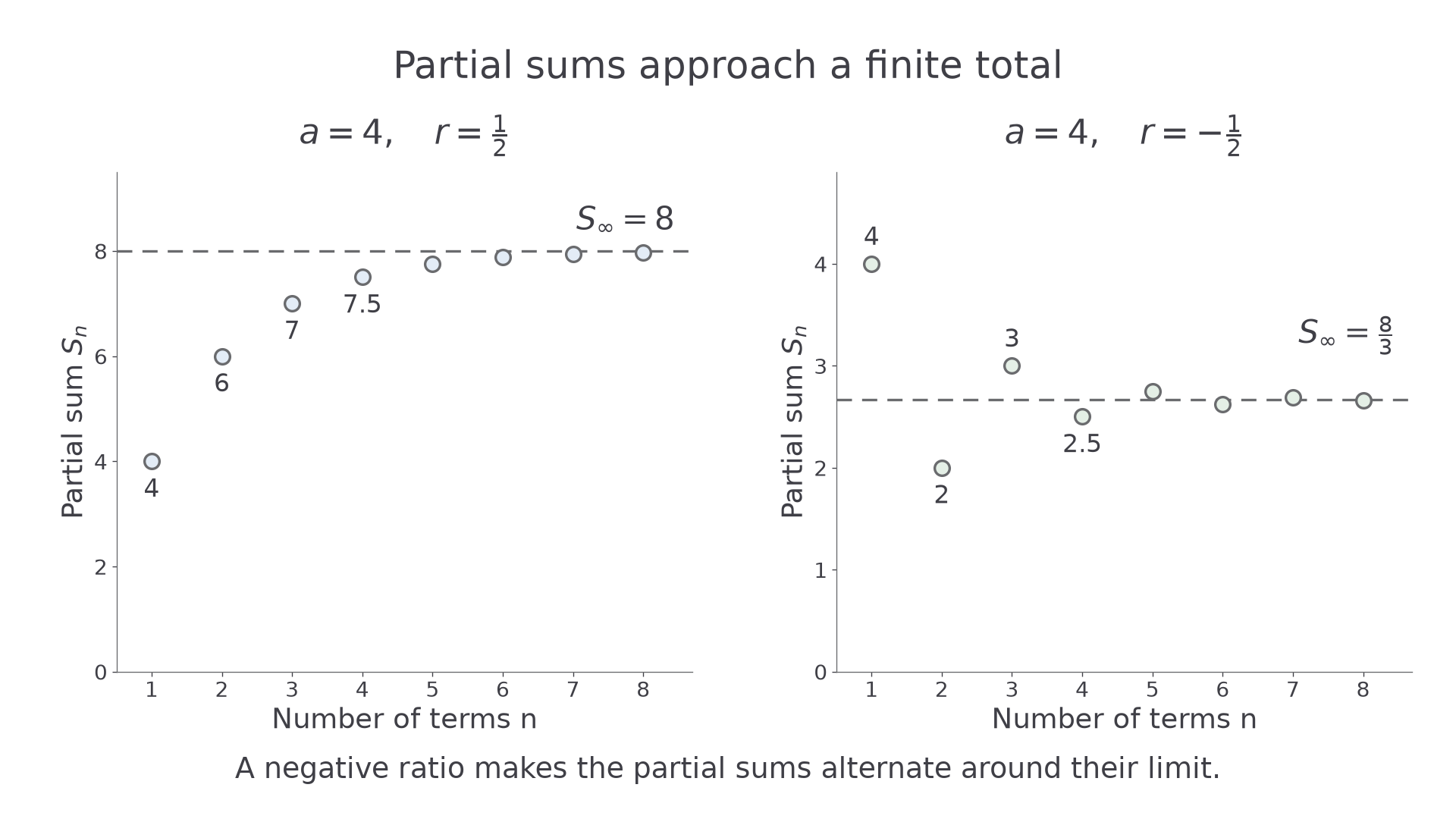
The first few totals are . Each extra term fills half the remaining gap to . The gap becomes arbitrarily small as more terms are included. Calling the sum to infinity describes this limiting behaviour; it does not mean there is a final term.
Convergent series
A partial sum, , is the total of the first terms. A series is convergent if these partial sums approach one finite value as increases without bound. That value is its sum to infinity, .
For a geometric series with a nonzero first term, the decisive condition is , equivalently . Then approaches zero. If , it changes sign while its magnitude shrinks; the partial sums can alternate above and below the limiting total.
[DIAGRAM: asset_name: Partial sums approaching finite limits; asset_slug: convergent-partial-sums; caption: Positive and negative half-ratios both give convergent partial sums; description: Two discrete partial-sum plots start with first term 4. Ratio one half gives totals 4,6,7,7.5 and onwards approaching the horizontal line S equals8 from below. Ratio minus one half gives totals 4,2,3,2.5 and onwards approaching the horizontal line S equals8over3 alternately from above and below. Only integer n values are plotted.]
The boundaries matter:
| Ratio | Behaviour when |
|---|---|
| , so no finite limit | |
| Partial sums alternate between and , so no single limit | |
| Terms do not approach zero, and the partial sums do not converge | |
| approaches zero and the geometric series converges |
At , only the first term can be nonzero, so the total is simply . The all-zero series is a trivial exception to the nonzero-first-term discussion: its partial sums are zero whatever multiplying ratio is assigned.
Watch out
The test is incomplete: , but a ratio of makes term sizes grow. Use , which includes shrinking negative ratios and excludes both boundary values.
Check each common ratio, including its sign.
Using the sum to infinity
The finite sum formula shows why the convergence condition produces a simple infinite total.
When , the factor in approaches zero. The numerator therefore approaches , while the denominator stays fixed and nonzero.
Geometric sum to infinity
For ,
On the formulae sheet, together with the convergence condition.
Identify the first term, find the signed ratio, and check the condition before substituting. A value from the fraction alone is not evidence that an infinite sum exists.
Worked example 1: a positive fractional ratio
Question. Find the sum to infinity of .
Plan. Use and , after checking convergence.
Answer. .
Check. Removing the first from a total of leaves . The remaining series is the original multiplied by , and , as required.
Change only the sign of the ratio. Subtracting a negative ratio makes the denominator larger than .
Worked example 2: an alternating convergent series
Question. Find the sum to infinity of .
Plan. Check the magnitude of , then retain its sign in the denominator.
Answer. .
Check. Removing the first term leaves , exactly times . The negative remainder is consistent with the next term being negative.
Continue this lesson.
You’re previewing NovaLearn without an account. Create a free account to read the rest.
Create free account