2B, 2C - Quadratic roots and the discriminant
A quadratic can have two different real solutions, a repeated real solution or no real solutions. In 2B you will use the discriminant to distinguish these cases and determine conditions on coefficients; in 2C you will find the roots exactly with the quadratic formula, ready to use expressions involving them.
The quadratic formula
Does have a real solution, or has a calculator missed one?
You already know that completing the square turns its left side into . This is at least , so it cannot equal zero for real . We will develop a formula that both finds roots when they exist and explains this failure.
Root
A root of an equation is a value of the variable that makes the equation true. A real root of is also the -coordinate of a point where the graph meets the -axis.
Completing a square produces one method for every quadratic. Starting with , where , multiply by , then add the term needed for a square:
When the right side is nonnegative, taking both signs of its square root and rearranging gives the quadratic formula.
Quadratic formula
For real coefficients with , the real roots of , when , are
The sign means evaluate once with and once with . If the square root is zero, these give the same value.
Not on the formulae sheet: learn it.
Put the equation in the form before identifying the coefficients. Keep the signs attached to and , and simplify the root before rounding anything.
Worked example 1: exact irrational roots
Question. Solve , giving exact answers.
Plan. Identify , , , then substitute into the formula and simplify the surd.
Answer. or .
Check. The equation is also . Substituting either answer gives , so both values satisfy it exactly.
Change only the leading coefficient from to . The denominator changes too; simplifying a surd does not remove that denominator.
Worked example 2: a nonunit leading coefficient
Question. Solve , giving exact answers.
Plan. Use , , , retaining the denominator .
Answer. or .
Check. Completing the square gives . Each answer makes the left side .
Two sign mistakes can change a correct formula into the wrong calculation.
Watch out
If , then and . Writing has lost the brackets and is not the square of . The denominator divides the whole numerator, including both terms.
The next roots also remain exact after simplifying a square factor.
Counting real roots
The number inside the formula's square root tells you how many different real roots are possible.
Compare three equations differing only in their constant term:
Their graphs show a curve crossing the axis twice, touching it once or missing it entirely.
[DIAGRAM: asset_name: Three discriminants and three root patterns; asset_slug: discriminant-root-cases; caption: Changing the constant gives two unequal real roots, equal real roots or no real roots; description: Three coordinate plots on identical scales show y equals x squared minus 4x plus 3, plus 4 and plus 5. Their discriminants are respectively 4, 0 and minus 4. The first crosses the x-axis at 1 and 3, the second touches at 2, and the third has minimum 1 at x equals 2 and never meets the x-axis.]
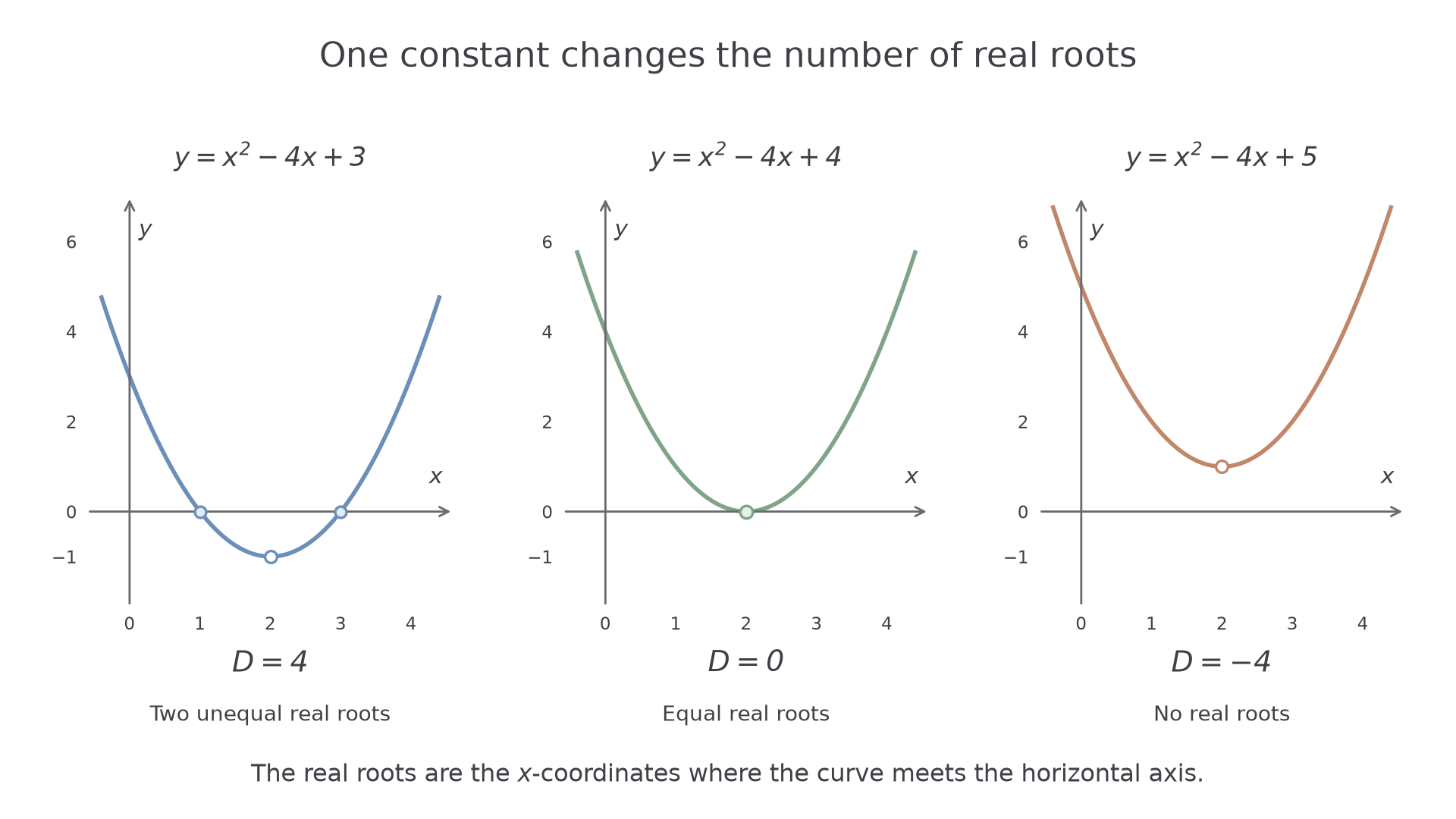
The algebra explains all three pictures.
Discriminant
The discriminant of , where , is
It is the expression under the square root in the quadratic formula.
- If , then : adding and subtracting it gives two unequal real roots.
- If , the formula gives twice: equal real roots, also called a repeated root. There is one distinct value, and the curve touches the axis there.
- If , no real number has square : there are no real roots, and the curve does not meet the axis.
You do not need to calculate the roots just to classify them.
Worked example 3: equal real roots
Question. Determine the nature of the roots of .
Plan. Calculate the discriminant and interpret its sign.
Answer. The roots are equal and real because .
Check. Factorising gives . Both factors give , one distinct repeated root.
Increase only the constant from to . The discriminant moves below zero, so the repeated root disappears from the real number line.
Worked example 4: no real roots
Question. Determine the nature of the roots of .
Plan. Evaluate the discriminant; a negative value rules out real roots.
Answer. There are no real roots.
Check. The left side is , so it cannot be zero for real . This independently confirms the conclusion.
A conclusion matters as much as the calculation that supports it.
Exam tip
Write what the sign means: for example, “, so there are no real roots.” A calculator error message alone does not explain why a real root is impossible.
Classify the next equation without calculating its roots.
Conditions on coefficients
A coefficient containing an unknown constant turns root classification into a condition on that constant.
A parameter is a constant whose value may vary between equations. For instance, changing in gives a family of quadratics. Calculate the discriminant in terms of the parameter, then use , or according to the roots requested.
The boundary belongs to equal roots. Strict inequalities are needed for unequal roots and for no real roots. Also check the leading coefficient: if it becomes zero, the equation is no longer quadratic and the discriminant rule does not classify it.
Worked example 5: a parameter in the constant term
Question. For , find the values of giving equal real roots, unequal real roots and no real roots.
Plan. Express the discriminant in terms of , then solve each sign condition.
Answer. Equal real roots: . Unequal real roots: . No real roots: .
Check. At the boundary, the expression is . On either side, gives , with two different roots, while gives , which is never zero. The equivalent equation confirms all three conditions.
Now move the parameter from the constant term to the leading coefficient, leaving the other two coefficients as and . The discriminant happens to be the same, but now needs separate treatment.
Worked example 6: checking when the equation stops being quadratic
Question. Classify the roots of in terms of . Deal separately with .
Plan. Apply the discriminant only when , then substitute into the original equation.
For ,
At , the original equation becomes , so . It is linear, not a quadratic with repeated roots.
Answer. Equal real roots for ; unequal real roots for with ; no real roots for . At , there is the single linear solution .
Check. At , the left side is . At , it is , giving different roots and . At , it is . Substitution of , gives .
The restriction comes from the equation's degree, not from solving the inequality.
Watch out
For , the inequality alone would include . Exclude it before claiming two quadratic roots. The formula assumes a nonzero leading coefficient.
The same check applies whenever a parameter can remove the squared term.
Quick Recap
- Put a quadratic in the form , with , before using the formula.
- Keep both signs and simplify exact surds; divide the whole numerator by .
- The sign of distinguishes unequal real roots, equal real roots and no real roots.
- For parameter conditions, justify strict endpoints and check whether the leading coefficient can vanish.
The opening equation has , so it has no real solution. Its completed square explains the same result geometrically.