5A, 5B - Arithmetic series
An arithmetic sequence is easy to continue, but adding many terms one by one is slow. In 5B, you will calculate arithmetic totals, recover an unknown number of terms, and find when a total reaches a target. The sigma notation from 5A lets you specify exactly which consecutive terms to add.
Adding an arithmetic sequence
How could you add the first twenty terms of without twenty separate additions?
Start with five terms: . Write them backwards underneath. Every vertical pair adds to , so two copies of the sum total . One copy is . An odd number of terms causes no difficulty because we are pairing two copies, rather than trying to split one list into whole pairs.
[DIAGRAM: asset_name: Pairing an arithmetic sum with its reverse; asset_slug: arithmetic-pairing; caption: Five equal pair totals give twice the arithmetic sum; description: The top row is 3, 7, 11, 15, 19 and the second row is 19, 15, 11, 7, 3. Each column totals 22. Two copies total 5 times 22 equals 110, so one sum is 55.]
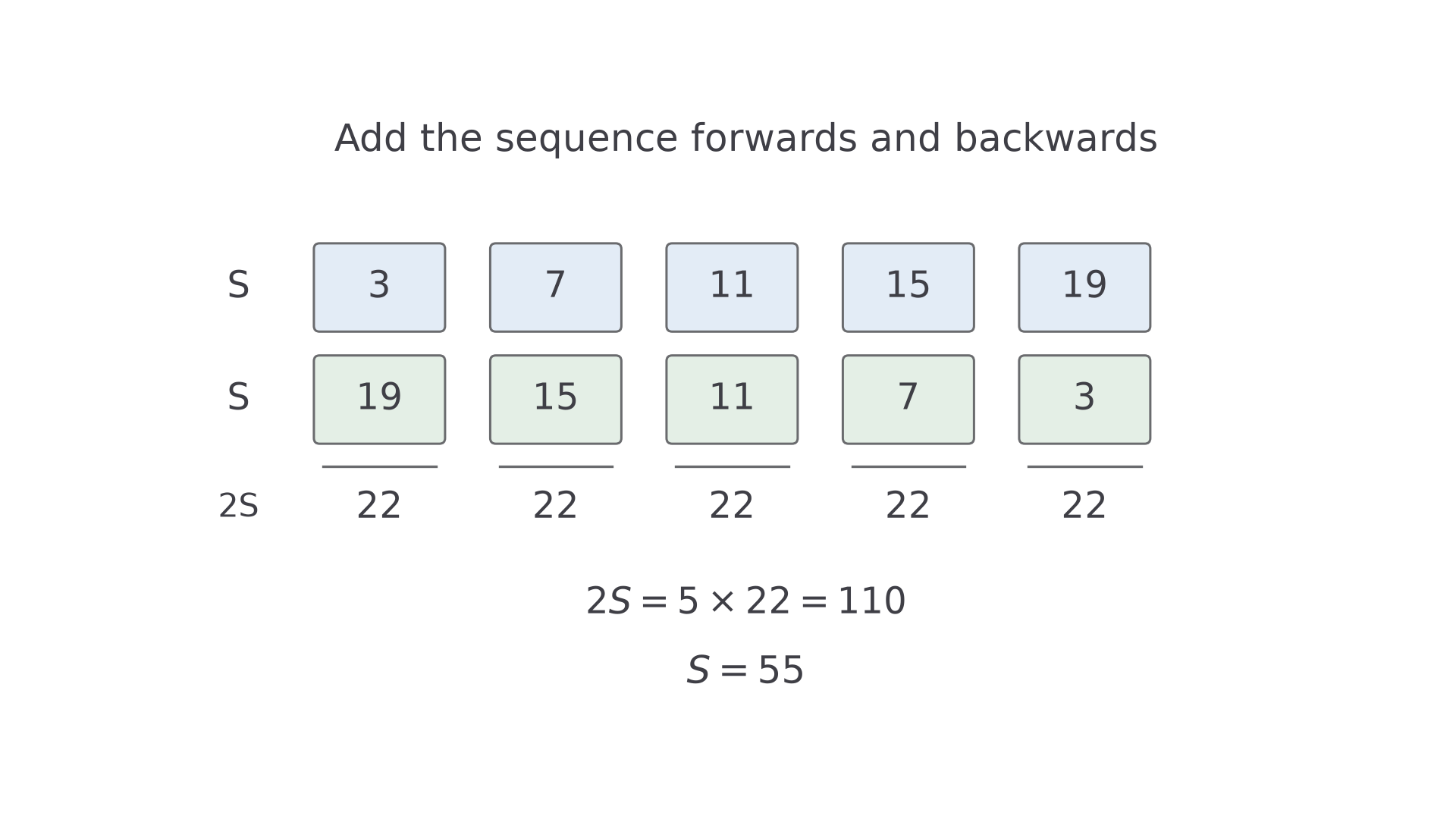
Arithmetic series
An arithmetic series is the sum of terms of an arithmetic sequence. Write for the sum of its first terms, while denotes just its nth term.
If the first term is and last term is , each forward-and-backward pair totals . This gives the useful formula without needing a formal proof.
Arithmetic sum
For a positive integer ,
The second form is on the formulae sheet. The first form follows by substituting .
Choose the form that fits the information you have.
Worked example 1: adding from the first term
Question. Find the sum of the first twenty terms of .
Plan. Use , and in the sum formula.
Answer. The total is .
Check. The twentieth term is . The mean of the first and last terms is , and .
Now add a block that starts later in the same sequence. The sum formula still works, but its first term must be the first term being added.
Worked example 2: adding between two positions
Question. For , find .
Plan. Find the endpoints and count the included terms before using the first-plus-last form.
Answer. .
Check. The first five terms sum to , so the same total is .
Subtracting would remove the sixth term as well. To keep terms onwards, remove only terms to .
Finding an unknown number of terms
A stated total becomes an equation in , often a quadratic because both the number of terms and the last term depend on .
The algebra treats as a real number; a term count must be a positive integer. Check that condition after solving, then substitute a retained value into the original information. A decreasing series can sometimes have two valid term counts, so do not discard a solution merely because there are two.
Worked example 3: recovering a term count from a total
Question. An arithmetic series has first term , common difference , and sum . Find .
Plan. Write the sum formula, solve the quadratic, then apply the term-count condition.
Answer. ; the other root is not a positive integer.
Check. The eighth term is , so .
Continue this lesson.
You’re previewing NovaLearn without an account. Create a free account to read the rest.
Create free account