8C - Gradients of straight lines
A line can rise gently, fall steeply or stand vertically. You will describe its direction using coordinate changes, distinguish zero gradient from undefined gradient and decide whether three points lie on one straight line.
Change in y over change in x
If a line rises units while moving units to the right, what number describes its steepness?
The rise per unit of horizontal movement is . Doubling both changes to and gives the same quotient. Right triangles drawn along one straight line are similar, so this ratio is constant wherever you measure it.
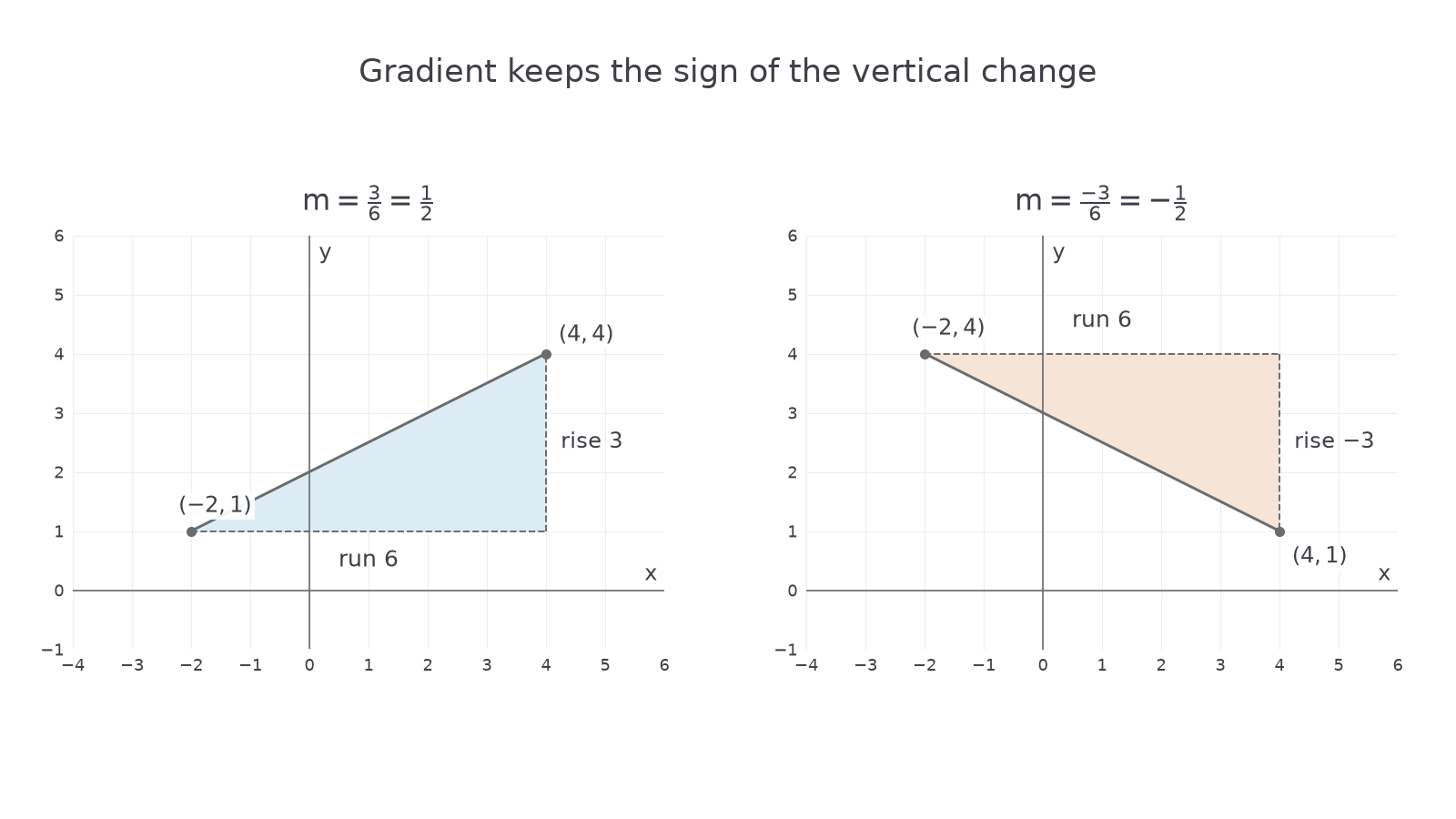
[DIAGRAM: asset_name: Positive and negative gradient; asset_slug: gradient-changes; caption: Equal horizontal changes give opposite gradients when the vertical change is reversed; description: Two equal-scale coordinate panels show a rising segment from minus 2 comma 1 to 4 comma 4 with run 6 and rise 3, and a falling segment from minus 2 comma 4 to 4 comma 1 with run 6 and rise minus 3. Their gradients are one-half and minus one-half.]
Gradient
The gradient of a nonvertical straight line is the change in divided by the corresponding change in . It measures signed rise per unit horizontal change.
Read direction from left to right: a rising line has positive gradient, and a falling line has negative gradient. For example, a gradient of means a change of in for each change of in .
Gradient from two points
For distinct points and , with ,
Subtract the coordinates in the same endpoint order in the numerator and denominator.
Not on the formulae sheet: learn it.
The quotient is signed: unlike the distance formula, we do not square or take absolute values of the changes.
Worked example 1: a rising line
Question. Find the gradient of the line through and .
Plan. Divide the change in from to by the matching change in .
Answer. .
Check. A horizontal change of gives predicted rise , matching the coordinates.
Keep the horizontal positions, but reverse the vertical change. This should reverse the sign of the gradient.
Worked example 2: a falling line
Question. Find the gradient through and .
Plan. Keep the negative rise when dividing by the positive run.
Answer. .
Check. Reversing the endpoint order gives , the same gradient.
Reversing both subtractions changes both signs and preserves the quotient. Reversing just one subtraction changes the answer incorrectly.
Watch out
For the first pair, mixes endpoint orders. Use or ; both give .
The next endpoints are given from right to left; the same rule works.
Horizontal and vertical lines
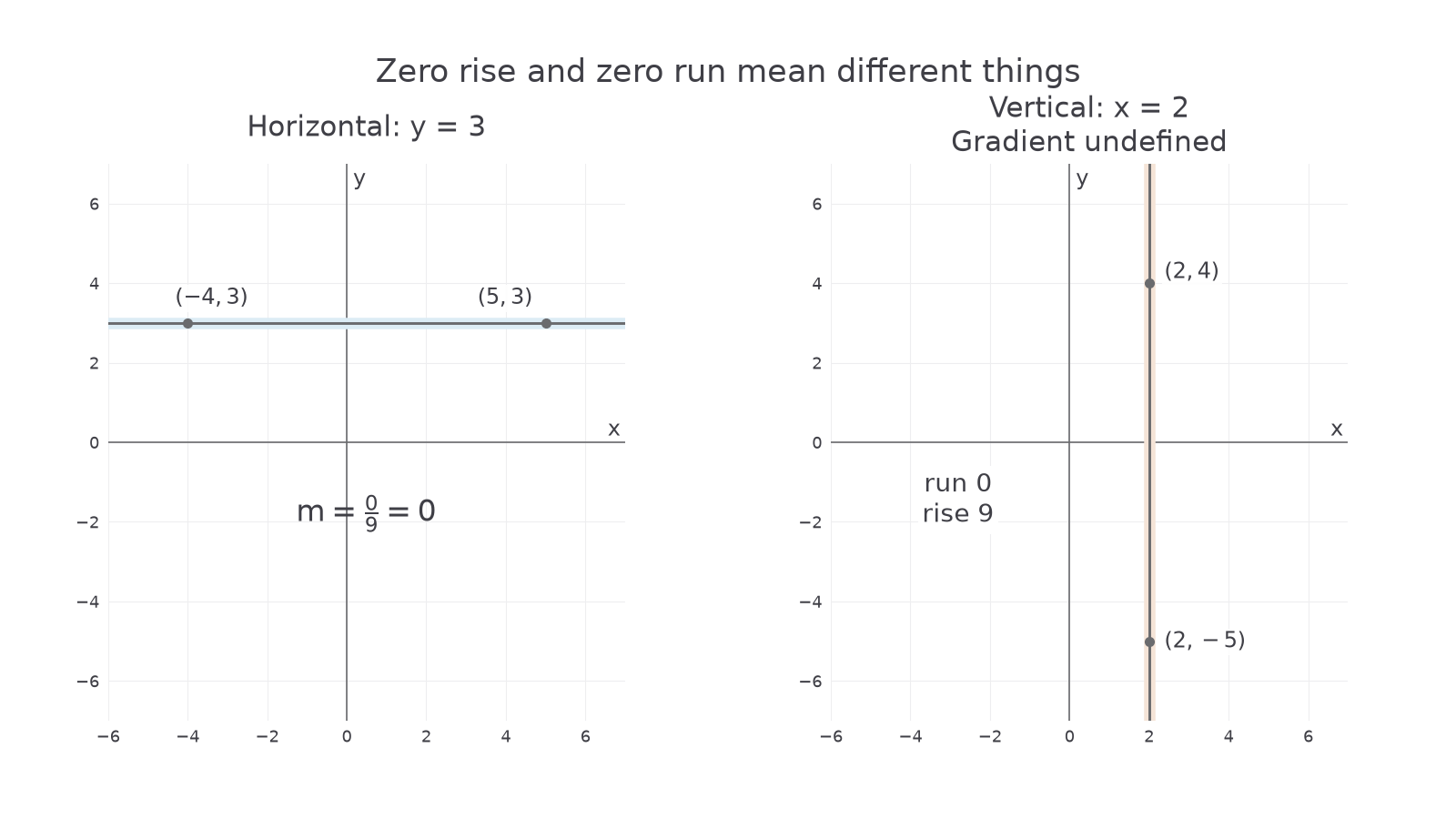
A zero numerator and a zero denominator mean different things in a gradient calculation.
Along a horizontal line, does not change, so the rise is zero. Along a vertical line, does not change, so there is no nonzero horizontal movement by which to divide.
[DIAGRAM: asset_name: Zero and undefined gradients; asset_slug: special-gradients; caption: A horizontal line has gradient zero, while a vertical line has no finite gradient; description: Two equal-scale panels show a horizontal line y equals 3 through minus 4 comma 3 and 5 comma 3, and a vertical line x equals 2 through 2 comma minus 5 and 2 comma 4. The corresponding changes are rise 0 run 9 and rise 9 run 0.]
Continue this lesson.
You’re previewing NovaLearn without an account. Create a free account to read the rest.
Create free account