9F - Tangents and normals
Many straight lines pass through one point on a curve. You will use a derivative to choose the tangent, find its perpendicular normal, and locate points where a tangent or normal satisfies a given slope condition.
Equation of a tangent
Which line through follows the direction of the curve at that point?
The coordinates alone do not decide. Both and pass through , but their gradients differ. The derivative of the curve supplies the missing gradient.
Tangent
At a point where a curve has a finite derivative, its tangent is the straight line through that point with gradient equal to the derivative there.
A tangent need not meet the curve only once; it can meet it again or cross it. Its defining feature here is its direction at the chosen point.
Tangent equation
For , if and the finite derivative exist, then the tangent at has equation
This uses the point-gradient form of a straight line.
Not on the formulae sheet: learn it.
Use the original function to find the point, and its derivative to find the gradient. Keep those two jobs distinct.
Worked example 1: a tangent to an exponential
Question. Find the equation of the tangent to at .
Plan. Find the point and derivative value, then use point-gradient form.
Answer. .
Check. The line contains . At , the original curve gives approximately , while the line gives ; they agree closely near the point. The alternative line gives , with the wrong local direction.
Change only the exponential's exponent from to . The point at stays the same, but the chain factor changes the tangent's slope.
Worked example 2: the same point with a different slope
Question. Find the equation of the tangent to at .
Plan. Include the inner derivative , then use the same point-gradient method.
Answer. .
Check. The line contains . At , the curve is approximately and the line is , consistent with the calculated local slope.
The opening curve therefore selects . Sharing a point did not make the two candidate lines interchangeable.
Watch out
The gradient is , not . The two numbers happen to agree in the first example, but are and respectively in the second.
Use a new chain factor in the next tangent calculation.
Equation of a normal
The normal passes through the same point as the tangent but meets it at a right angle.
Normal
A normal to a curve at a point is the line through that point perpendicular to its tangent, when the tangent is well defined.
For two perpendicular lines with finite gradients, the gradients multiply to . Thus, if the tangent has finite nonzero gradient , the normal has gradient .
[DIAGRAM: asset_name: Sloping and horizontal tangents with their normals; asset_slug: tangent-normal-cases; caption: A sloping tangent has a negative-reciprocal normal, while a horizontal tangent has a vertical normal; description: Two equal-scale coordinate panels show y equals x squared plus 1. The left marks P(1,2), tangent y equals 2x and normal y equals negative one half x plus five halves, with a right-angle marker. The right marks Q(0,1), horizontal tangent y equals 1 and vertical normal x equals 0, with a right-angle marker. The curve is grey, tangents pale blue-accent lines and normals sage-accent lines.]
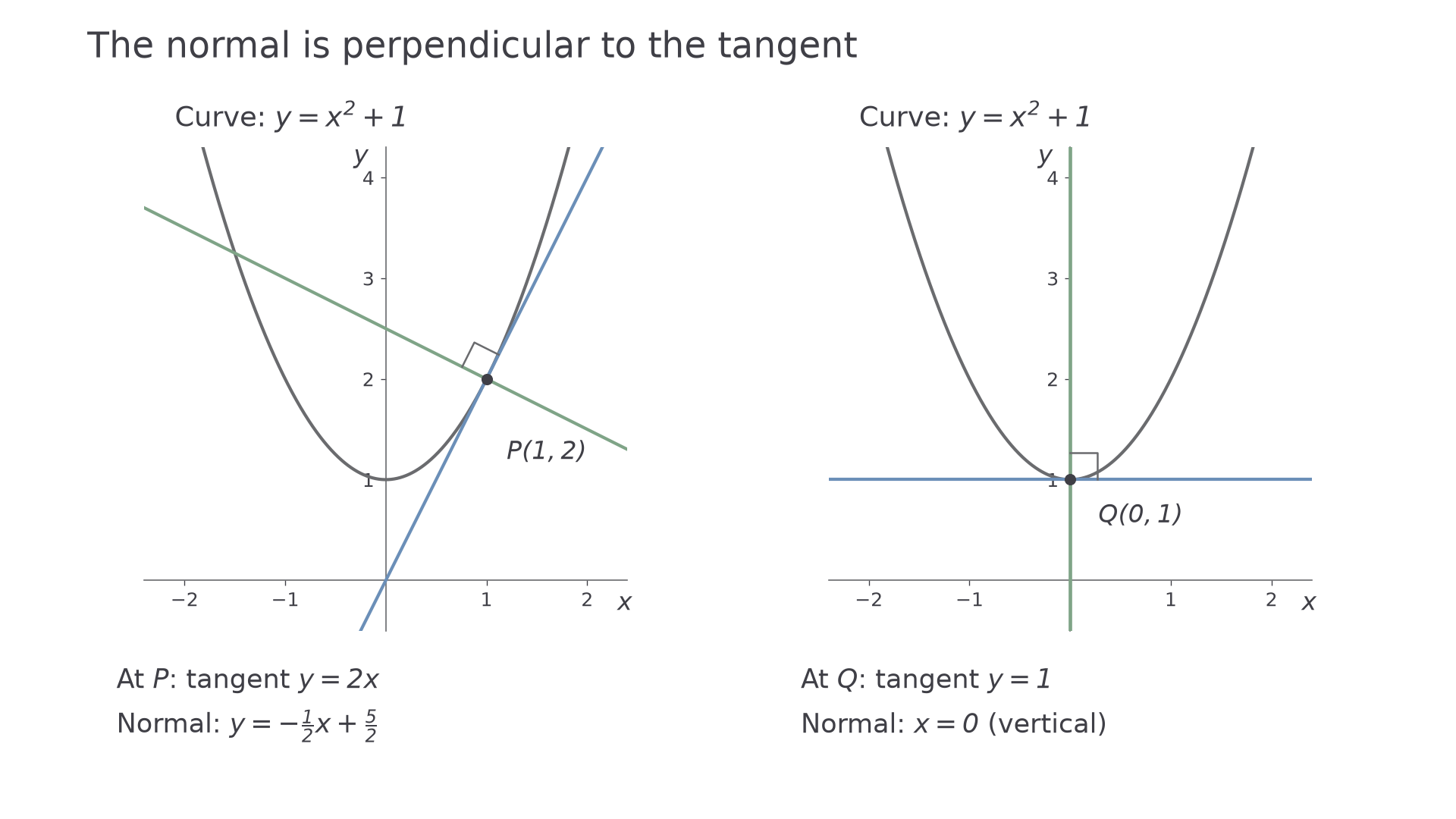
The negative-reciprocal calculation requires . If the tangent is horizontal, its perpendicular normal is vertical, so write an equation , rather than trying to divide by zero.
Worked example 3: a normal with a finite gradient
Question. Find the equation of the normal to at . Give the answer with integer coefficients in the form .
Plan. Find the tangent gradient, take its negative reciprocal, then form the line through the curve point.
Answer. .
Check. Substituting gives . The line's gradient is , and , so it is perpendicular to the tangent.
Keep the curve and change the point to . This gives the exceptional case that the reciprocal formula cannot handle.
Continue this lesson.
You’re previewing NovaLearn without an account. Create a free account to read the rest.
Create free account