4.7-4.10 - Crude oil fractions and fractional distillation
Crude oil is useful because it is not one substance. It is a mixture of many hydrocarbons that can be separated into groups called fractions. In this lesson, you will learn how industrial fractional distillation separates crude oil, then remember the main fractions, their uses, and the trends in their properties.
Crude oil as a mixture
Crude oil is a mixture. That means it contains many different substances that are physically mixed together, rather than chemically joined into one compound.
The substances in crude oil are hydrocarbons. A hydrocarbon is a compound that contains hydrogen and carbon only.
Crude oil
Crude oil is a mixture of hydrocarbons.
Because crude oil is a mixture, its hydrocarbons can be separated by a physical method. The hydrocarbons do not need to be reacted or changed into new substances for this separation.
A fraction is not usually one pure hydrocarbon. It is a group of hydrocarbons with similar boiling points. Fractions are collected over a boiling point range, so each fraction still contains a mixture of hydrocarbons.
The important exam contrast is:
| Term | Meaning |
|---|---|
| Hydrocarbon | A compound containing hydrogen and carbon only |
| Crude oil | A mixture of many hydrocarbons |
| Fraction | A mixture of hydrocarbons with similar boiling points |
How fractional distillation works
Fractional distillation separates crude oil because the hydrocarbons in crude oil have different boiling points. In an oil refinery, crude oil is heated before it enters the fractionating column. Much of it vaporises and the hot vapours enter near the bottom of the column.
[DIAGRAM: asset_name: Crude oil fractions and fractional distillation - diagram 01; asset_slug: c50_crude_oil_fractions_and_fractional_distillation__diagram_01; recommended_method: image_gen; description: A monochrome industrial fractional distillation column for crude oil, showing heated crude oil vapours entering the lower column, vapours rising through a hot-bottom/cool-top temperature gradient, and refinery gases, gasoline, kerosene, diesel, fuel oil and bitumen removed from top to bottom.]
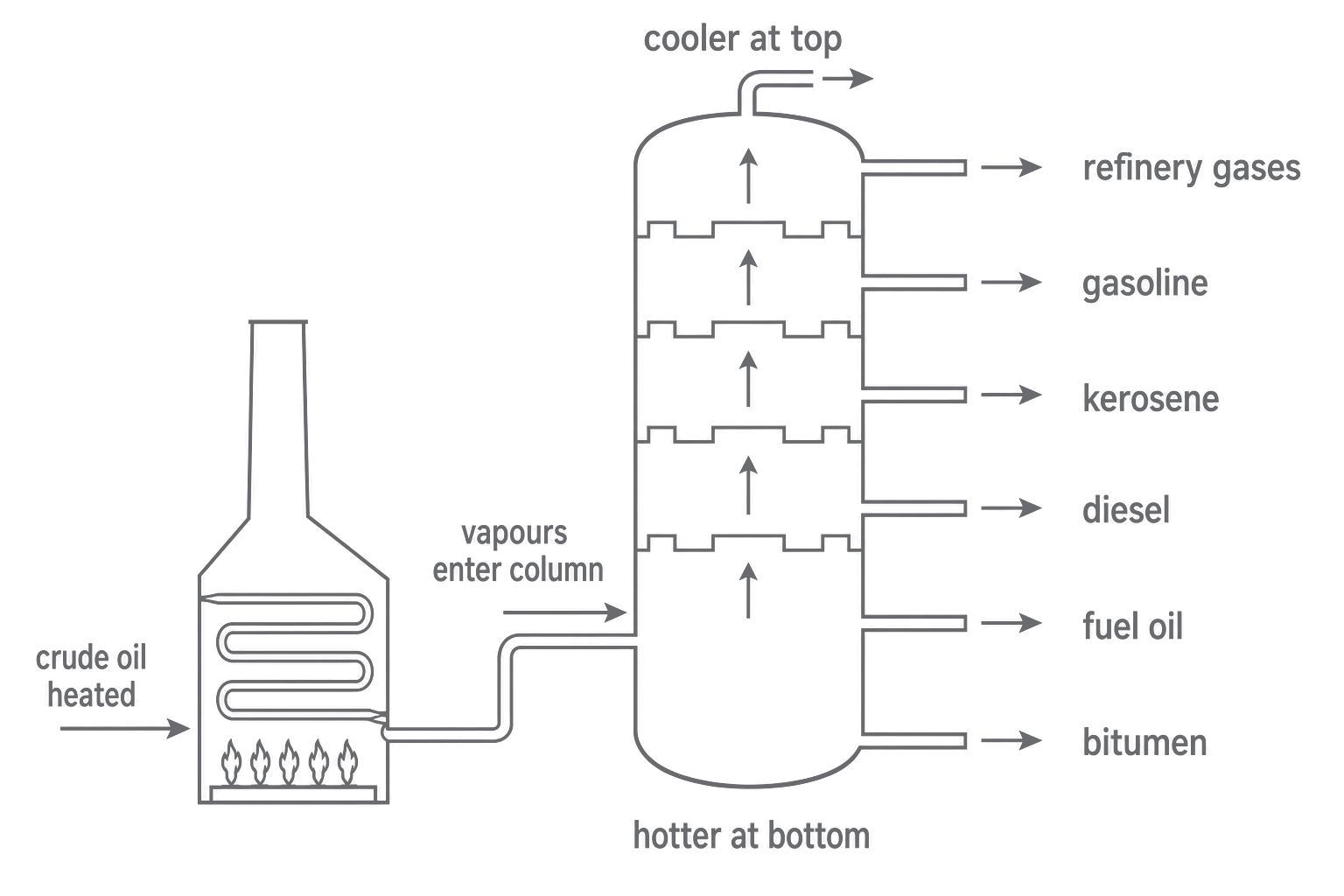
The column has a temperature gradient. It is hotter at the bottom and cooler at the top. As vapours rise up the column, they cool.
When a hydrocarbon vapour reaches a region of the column below its boiling point, it condenses to a liquid. Fractions are then tapped off or removed at different heights. Low-boiling fractions are collected higher up the column. High-boiling fractions condense lower down or remain near the bottom.
For a Pearson-style description, build the chain in this order:
| Step | Credit-worthy idea |
|---|---|
| 1 | Crude oil is heated or vaporised before entering the column. |
| 2 | The vapours enter or rise up the fractionating column. |
| 3 | The column is hotter at the bottom and cooler at the top. |
| 4 | Fractions condense at different heights or boiling point ranges and are removed. |
Avoid saying that fractional distillation breaks hydrocarbon molecules into smaller molecules. It separates the mixture into fractions; chemical breaking of molecules belongs to a later topic.
Main fractions and uses
You need to know the main fractions from crude oil in the order they are collected. The order below runs from the top of the fractionating column to the bottom.
| Fraction | Position in column | Common uses |
|---|---|---|
| Refinery gases | Top | Bottled gas, heating and cooking fuels |
| Gasoline | High up | Fuel for cars; also called petrol |
| Kerosene | Middle-upper | Aircraft fuel |
| Diesel | Middle-lower | Fuel for diesel engines in cars, buses and lorries |
| Fuel oil | Low down | Fuel for ships, power stations and heating |
| Bitumen | Bottom | Road surfacing and roofing |
The names matter. Pearson questions may give a diagram with unnamed outlets and ask for the top and bottom fractions. The top fraction is refinery gases, not just "gas". The bottom fraction is bitumen.
Some names vary in everyday use. Gasoline is often called petrol. Kerosene may be used as aircraft fuel. In exam answers, use the specification names unless the question clearly accepts an everyday alternative.
Continue this lesson.
You’re previewing NovaLearn without an account. Create a free account to read the rest.
Create free account