4.44-4.47 - Addition polymers
Addition polymers are long-chain molecules made by joining many small alkene molecules together. In this lesson, the key skill is seeing what happens to the carbon-carbon double bond: it opens up, the monomers join, and the repeat unit shows the pattern that continues through the chain.
Monomers Join
A monomer is a small molecule that can join to many others. A polymer is a very large molecule made from many repeating monomer units.
Addition Polymer
An addition polymer is a polymer formed by joining up many small molecules called monomers.
For this course, addition polymers are made from alkene monomers. The monomers are unsaturated because they contain a carbon-carbon double bond, C=C. During addition polymerisation, many monomers join together to form one long polymer chain.
[DIAGRAM: asset_name: Addition polymers - diagram 01; asset_slug: c62_addition_polymers__diagram_01; recommended_method: image_gen; description: Conceptual monochrome schematic showing many separate small alkene-like monomer units joining into one long polymer chain, with no formulae or labels.]
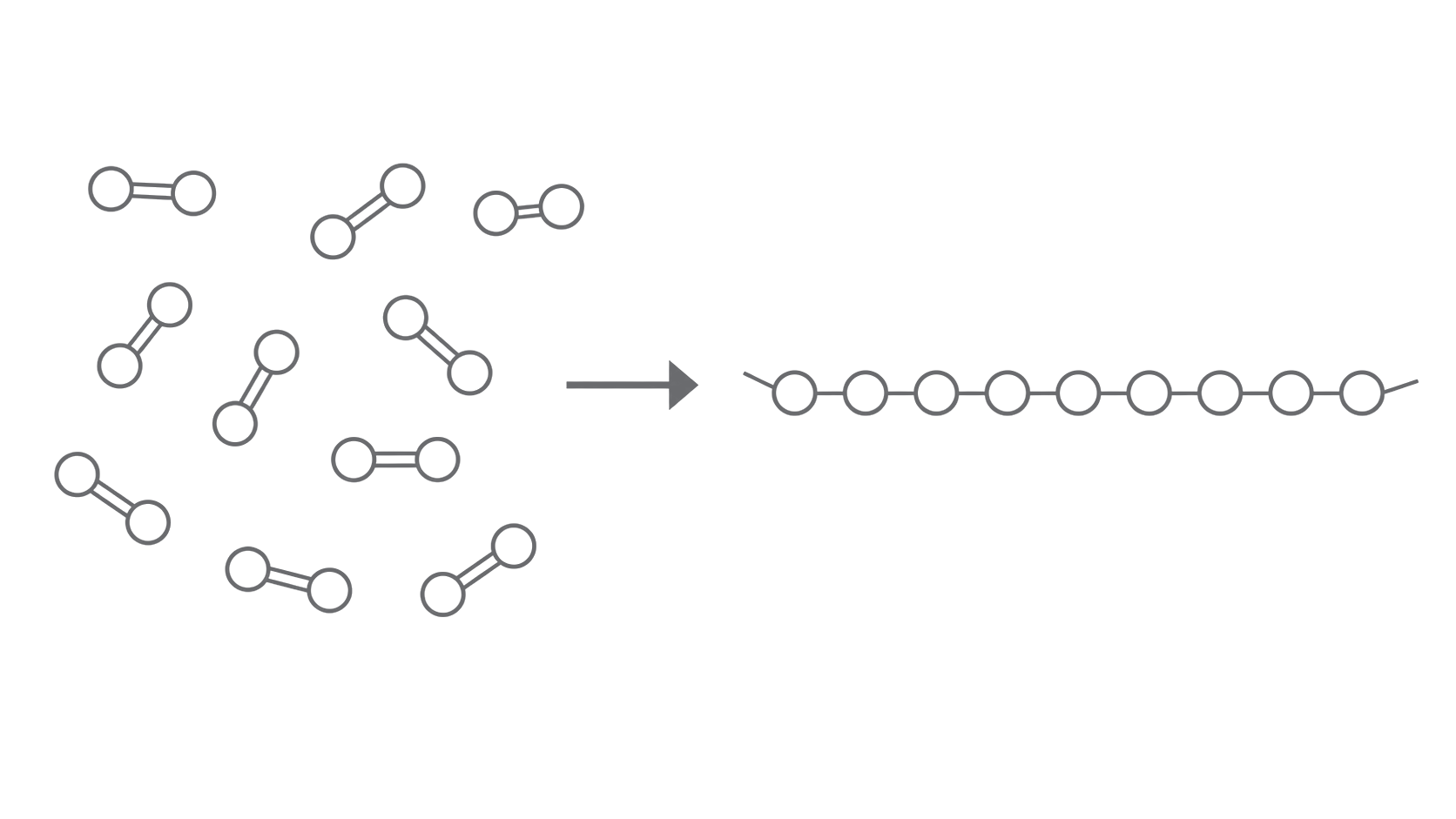
The word addition is important. The atoms from the monomers are added together into the polymer. No small molecule, such as water, is made in this reaction.
Repeat Unit Method
The repeat unit is the smallest section of the polymer chain that keeps repeating. It is not the whole polymer; it is the pattern inside the brackets.
To draw the repeat unit from an alkene monomer:
- Find the two carbon atoms in the
C=Cdouble bond. - Change the double bond into a single
C-Cbond. - Keep every atom or group attached to the same carbon as before.
- Draw a bond coming out of each end of the repeat unit.
- Put brackets around the repeat unit and write
noutside the bracket.
For ethene:
n CH2=CH2 -> [-CH2-CH2-]n
The open bonds through the brackets show that the repeat unit is bonded to more repeat units on both sides. The n means there are many repeat units in the chain.
Required Examples
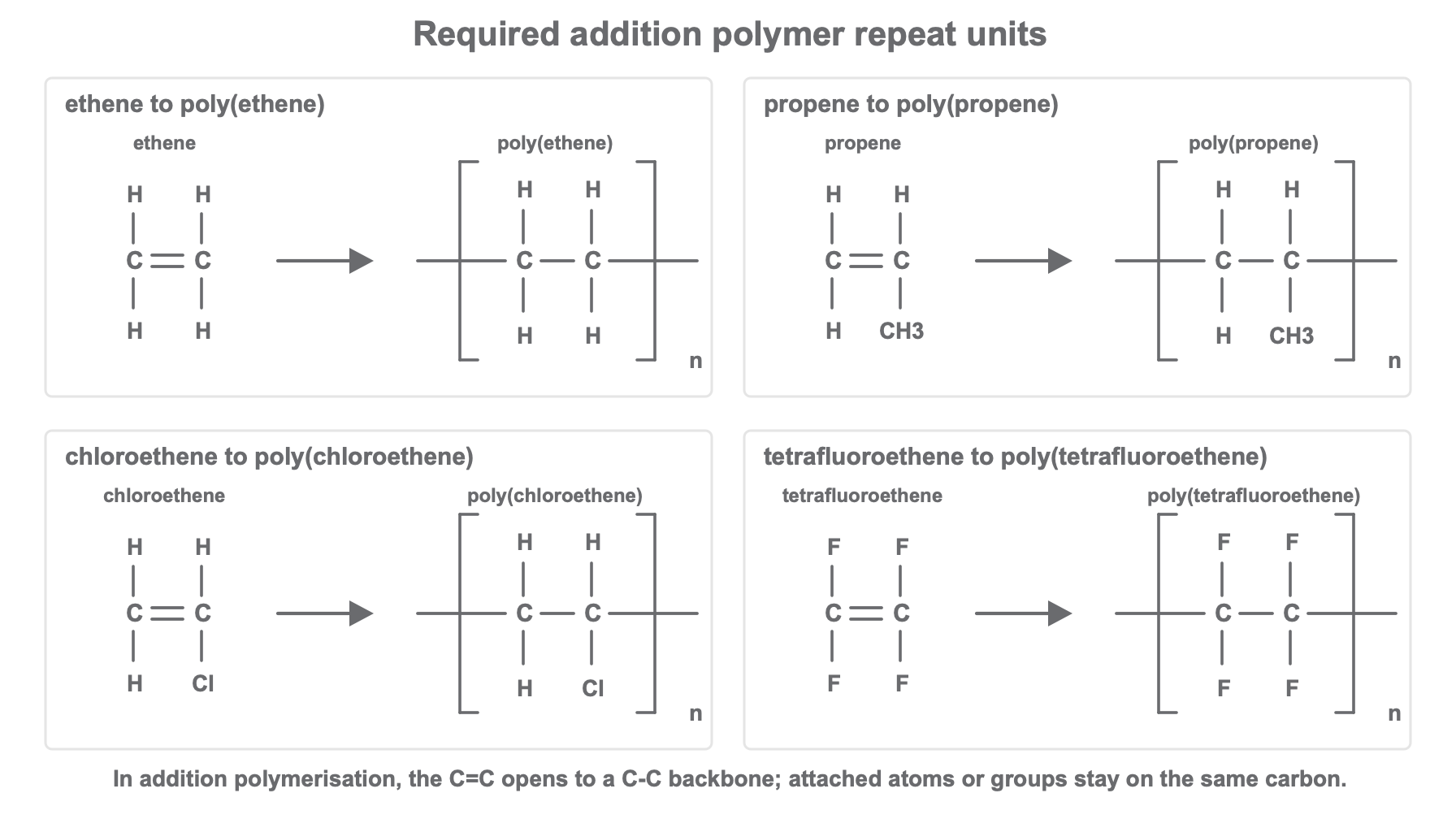
You need to recognise and draw the repeat units for four named addition polymers:
[DIAGRAM: asset_name: Addition polymers - diagram 02; asset_slug: c62_addition_polymers__diagram_02; recommended_method: deterministic_drawing; description: Exact monochrome displayed-structure sheet showing ethene, propene, chloroethene and tetrafluoroethene converting to the repeat units for poly(ethene), poly(propene), poly(chloroethene) and poly(tetrafluoroethene).]
Continue this lesson.
You’re previewing NovaLearn without an account. Create a free account to read the rest.
Create free account