2.41C, 2.43C - Preparing insoluble salts
Some salts do not dissolve in water, so they cannot be made by crystallising a solution. Instead, you make them by mixing two soluble reactants so the ions meet and form an insoluble solid called a precipitate. This lesson focuses on the practical method for making a pure, dry sample of an insoluble salt, especially lead(II) sulfate.
Precipitation method
An insoluble salt is prepared by a precipitation reaction. Two aqueous solutions are mixed. Each solution contains dissolved ions. If one positive ion and one negative ion combine to make an insoluble compound, that compound appears as a solid in the liquid.
Precipitate
A precipitate is an insoluble solid that forms when two solutions react.
The key word in this practical is insoluble. The product you want is not left dissolved in the solution. It is the solid that forms in the mixture, so it must be separated from the liquid by filtration.
[DIAGRAM: asset_name: Preparing insoluble salts - diagram 01; asset_slug: c36_preparing_insoluble_salts__diagram_01; recommended_method: image_gen; description: Monochrome three-stage precipitation schematic showing two clear soluble reactant solutions being mixed, a cloudy precipitate forming, and the insoluble solid settling below the remaining solution. No colour coding and no in-image formula labels.]
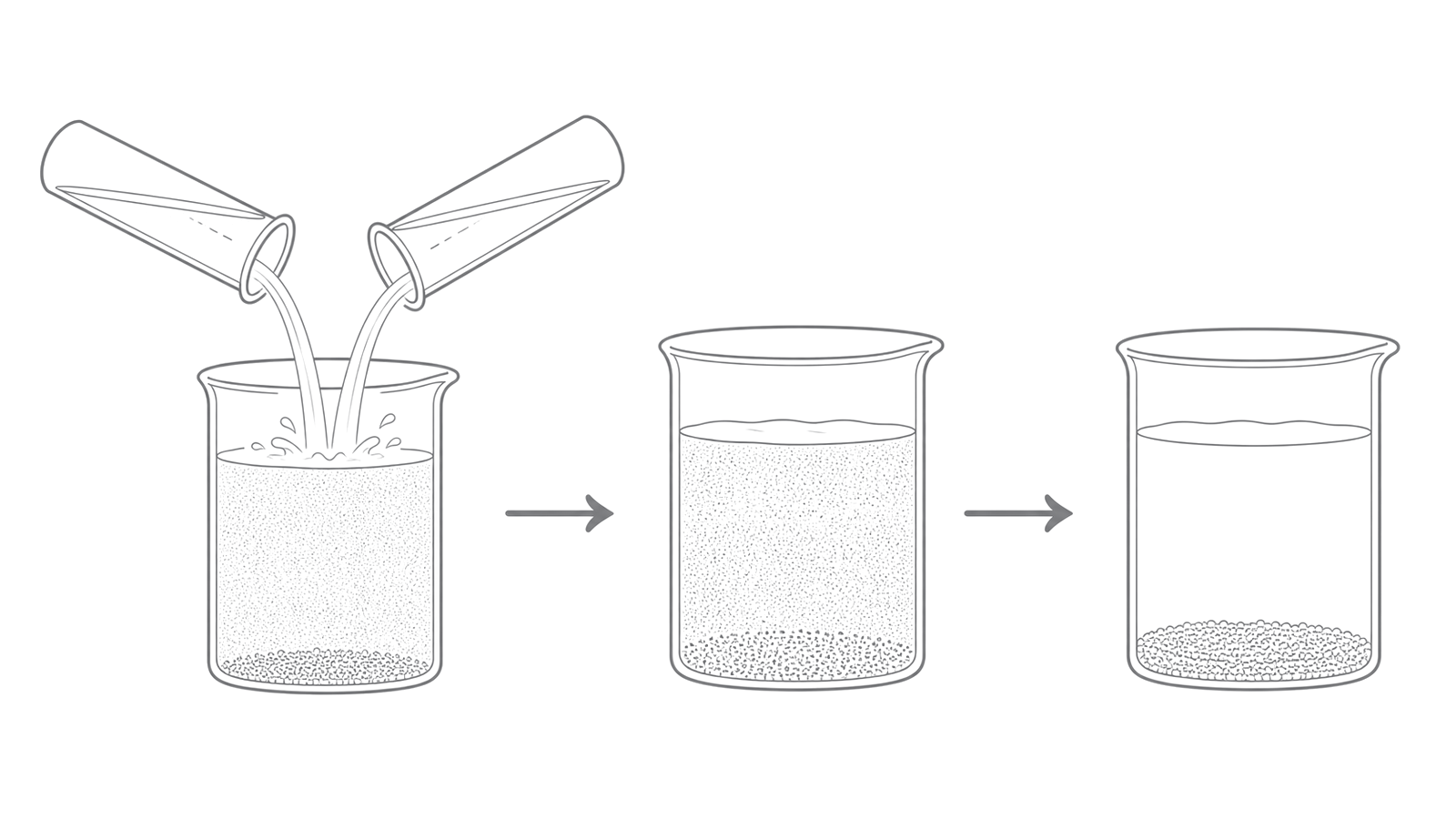
This is different from preparing a soluble salt. For a soluble salt, the salt remains dissolved and is usually obtained from the filtrate by evaporation or crystallisation. For an insoluble salt, the wanted product is the residue left in the filter paper.
Choosing reactants
To prepare an insoluble salt from two soluble reactants, choose solutions that provide the two ions in the salt you want. For lead(II) sulfate, the salt contains lead(II) ions, , and sulfate ions, .
Suitable soluble reactants are:
| Ion needed | Soluble reactant that supplies it |
|---|---|
| lead(II) nitrate solution, | |
| sodium sulfate solution, |
These are good choices because nitrates and sodium salts are soluble, while lead(II) sulfate is insoluble. When the two solutions are mixed, lead(II) sulfate forms as the precipitate and sodium nitrate remains dissolved.
Lead(II) sulfate precipitation
The state symbols matter. The two reactants are aqueous because they are soluble solutions. Lead(II) sulfate is shown as (s) because it is the insoluble precipitate. Sodium nitrate is aqueous because it stays dissolved in the liquid.
You can also show just the ions that make the precipitate:
Ionic equation
The sodium ions and nitrate ions are spectator ions. They are present in solution but do not form the insoluble solid.
Preparing lead(II) sulfate
Lead(II) compounds are toxic, so this practical is done with small volumes, eye protection, careful handling, and the teacher's disposal instructions. Do not put lead-containing solid or solution into ordinary waste unless instructed to do so.
To prepare a pure, dry sample of lead(II) sulfate:
- Measure a small volume of lead(II) nitrate solution into a beaker.
- Add sodium sulfate solution and stir. A white precipitate of lead(II) sulfate forms.
- Filter the mixture through filter paper in a funnel.
- Keep the solid residue in the filter paper. This residue is the lead(II) sulfate.
- Wash the residue with a small amount of distilled water.
- Dry the solid between filter papers, on a watch glass in a warm place, in a warm oven, or in a desiccator.
Continue this lesson.
You’re previewing NovaLearn without an account. Create a free account to read the rest.
Create free account