1.52C-1.54C - Metallic bonding and metal properties
Metals have a different structure from simple molecules, ionic compounds and giant covalent substances. A metal contains positive metal ions in a regular lattice, with delocalised electrons moving through the structure. This model explains why metals conduct electricity and why they can be hammered or pressed into new shapes.
The metallic lattice
A metal is a giant structure. It is not made from separate molecules. In a solid metal, the metal ions are packed in a regular arrangement called a lattice.
Metallic lattice
A regular arrangement of positive metal ions with delocalised electrons throughout the structure.
A 2-D diagram of a metallic lattice should show two things clearly:
- positive metal ions in regular rows or layers
- delocalised electrons between and around the positive ions
[DIAGRAM: asset_name: Metallic bonding and metal properties - diagram 01; asset_slug: c19_metallic_bonding_and_metal_properties__diagram_01; recommended_method: image_gen; description: Monochrome 2-D metallic lattice showing regular positive metal ions with plus signs and delocalised electrons as small dots moving between and around the ions.]
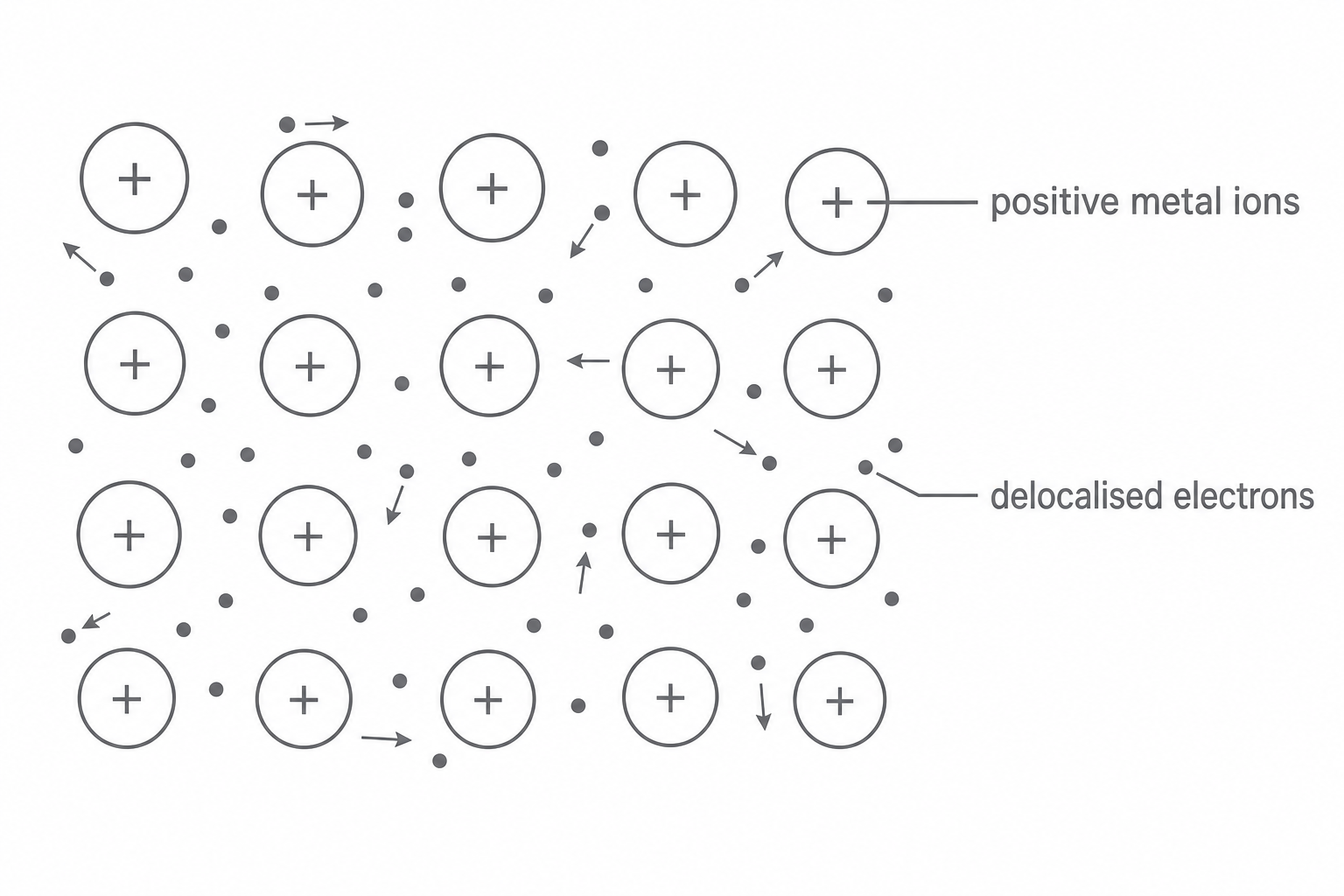
The positive ions are often drawn as circles with + signs. The electrons are usually drawn as smaller dots. The diagram is only a model: the real structure is 3-D, but a 2-D diagram is enough to show the important exam idea that positive ions are surrounded by delocalised electrons.
The electrons are called delocalised because they are not fixed to one particular metal ion. They belong to the whole metallic structure.
Metallic bonding
Metallic bonding is about electrostatic attraction. The positive metal ions and the negative delocalised electrons have opposite charges, so they attract each other.
Metallic Bonding
The strong electrostatic attraction between positive metal ions and delocalised electrons.
This attraction acts throughout the metal lattice. It is not a single bond between two atoms. A better picture is a whole lattice of positive ions held together by a shared sea of delocalised electrons.
The word electrostatic means the attraction is between charged particles. In metallic bonding, the charged particles are positive metal ions and negative electrons. Do not describe metallic bonding as an attraction between positive and negative ions; that is ionic bonding.
Many metals have high melting points because the metallic bonding is strong, so a lot of energy is needed to overcome the attractions. This is a typical property, not a rule for every metal. The two properties Edexcel most often wants you to explain from this model are electrical conductivity and malleability.
Electrical conductivity
Metals conduct electricity because they contain mobile charged particles. In a solid metal, the positive metal ions are held in the lattice. They vibrate, but they do not move through the structure to carry charge.
The mobile charged particles are the delocalised electrons. When a potential difference is applied across a piece of metal, these electrons can move through the structure. Moving electrons carry charge, so an electric current flows.
Continue this lesson.
You’re previewing NovaLearn without an account. Create a free account to read the rest.
Create free account