2.45-2.47 - Flame tests and cation tests
Cations are positive ions. In this lesson, you identify some cations by carrying out practical tests and matching the observations to known results. The key exam skill is to describe the test clearly, give the observation, and use that observation to identify the ion.
What cation tests show
A chemical test is useful only if the result is distinctive. For cations, the distinctive evidence in this lesson is either a flame colour, an ammonia gas test, or a coloured precipitate.
Cation
A cation is a positively charged ion.
Flame tests are mainly used for some metal cations. Sodium hydroxide solution is used for ammonium ions and for some transition metal ions. The test result is an observation, such as "yellow flame" or "green precipitate". The conclusion is the ion identified from that observation, such as Na+ or Fe2+.
Keep those two ideas separate in exam answers. If a question asks for the observation, write the colour or gas-test result. If it asks for the ion, give the correct ion symbol or name.
A good cation-test answer gives the reagent or method, the observation, and the cation identified.
Flame test method
A flame test identifies some metal cations from the colour they produce in a Bunsen flame.
[DIAGRAM: asset_name: Flame tests and cation tests - diagram 01; asset_slug: c38_flame_tests_and_cation_tests__diagram_01; recommended_method: image_gen; description: Monochrome three-panel method diagram for a flame test: clean the wire loop, dip it into a solid sample, place the sample in the Bunsen flame, and observe the flame colour.]
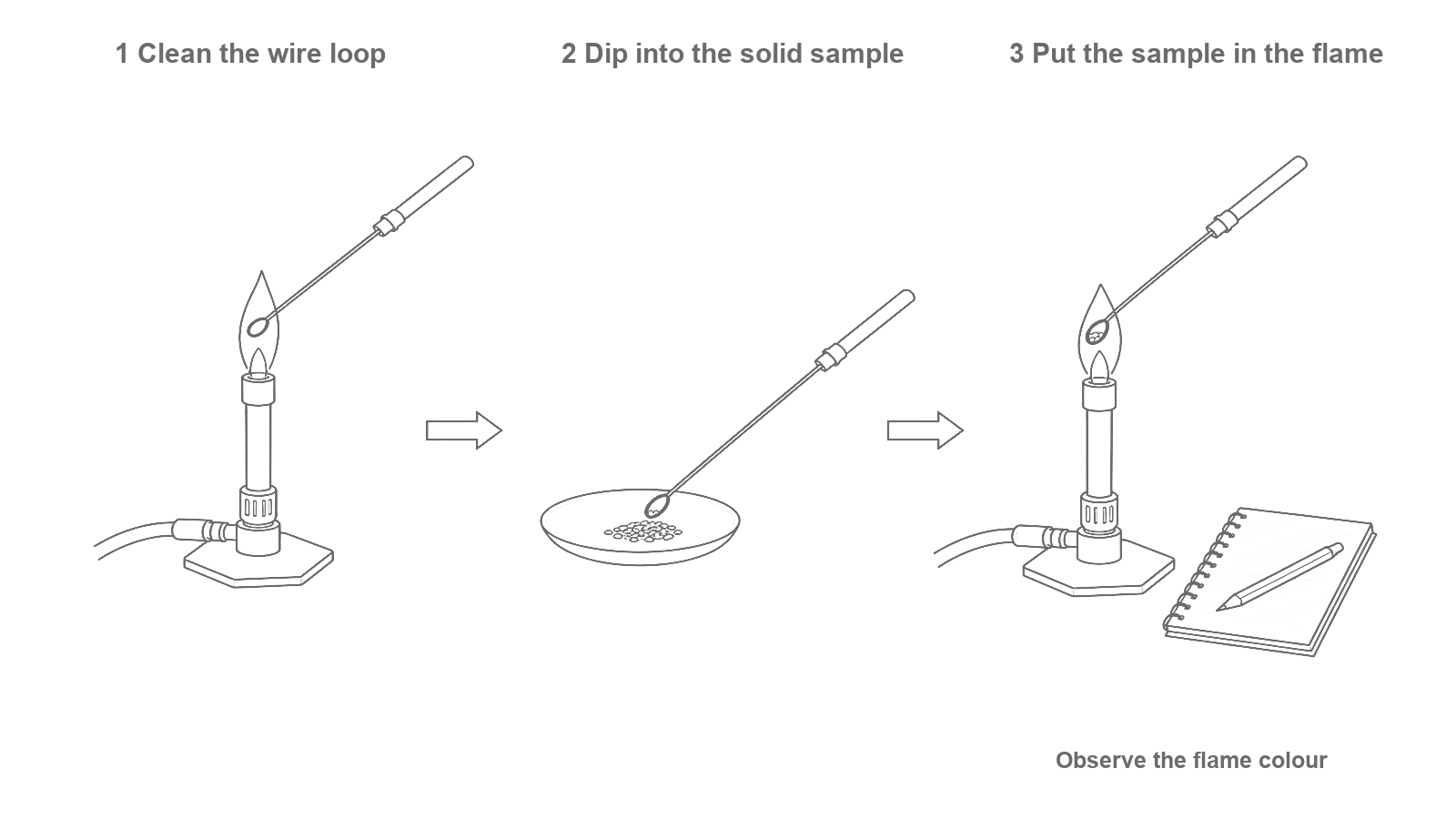
To carry out a flame test:
- Clean a platinum or nichrome wire loop so it does not give its own flame colour.
- Dip the clean loop into the solid sample, or into a little solution of the sample.
- Put the sample on the loop into the hot blue Bunsen flame.
- Observe and record the flame colour.
Cleaning the wire matters because a tiny amount of contamination can give a misleading colour. Do not describe the method as simply "burning the sample". The important action is putting the sample into the flame and observing the colour formed.
Flame test colours
Edexcel names five flame-test cations in this cluster. Learn the colour with the ion, not just with the element name.
| Cation | Flame colour |
|---|---|
Li+ | red |
Na+ | yellow |
K+ | lilac |
Ca2+ | orange-red |
Cu2+ | blue-green |
Use the specification colours in exam answers. For example, write yellow for sodium, not orange, and blue-green for copper(II), not just blue. Calcium is orange-red, so do not confuse it with lithium's red flame.
Sodium compounds can give a very strong yellow flame, so a contaminated wire can hide weaker colours. This is another reason to clean the wire loop before each test.
Continue this lesson.
You’re previewing NovaLearn without an account. Create a free account to read the rest.
Create free account