3.12-3.14C - Catalysts and reaction profiles
A catalyst is a way to make a reaction faster without changing the overall chemical reaction. In this lesson, you will learn the exact catalyst wording Pearson expects, then connect it to reaction profile diagrams. The key diagram idea is simple but powerful: a catalyst changes the pathway and the activation energy, not the overall enthalpy change, ΔH.
What a catalyst is
A catalyst increases the rate of a reaction. It may take part during the reaction pathway, but it is chemically unchanged at the end of the reaction.
Catalyst
A catalyst is a substance that increases the rate of a reaction, but is chemically unchanged at the end of the reaction.
The phrase chemically unchanged at the end matters. It does not mean the catalyst is never involved; it means the catalyst is regenerated by the end, so it has not been used up in the overall reaction.
In an exam, keep the definition separate from the explanation of how it works. If the question asks "what is a catalyst?", say that it increases the rate and is chemically unchanged at the end. If the question asks "how does a catalyst work?", use the alternative pathway and activation energy idea from the next part.
Alternative pathway and activation energy
Activation energy is the minimum energy needed for a reaction to start. On a reaction profile, it is shown by the energy rise from the reactants to the top of the pathway.
Activation energy
Activation energy is the minimum energy needed for reacting particles to react successfully.
A catalyst works by providing an alternative pathway with a lower activation energy. This lower barrier means more particles have enough energy to react successfully at the same temperature, so the reaction is faster.
[DIAGRAM: asset_name: Catalysts and reaction profiles - diagram 01; asset_slug: c44_catalysts_and_reaction_profiles__diagram_01; recommended_method: deterministic_drawing; description: Monochrome reaction profile graph with energy on the vertical axis and progress of reaction on the horizontal axis. The same reactants and products are joined by a high solid uncatalysed pathway and a lower dashed catalysed pathway, with vertical arrows labelling higher Ea without catalyst, lower Ea with catalyst, and unchanged ΔH.]
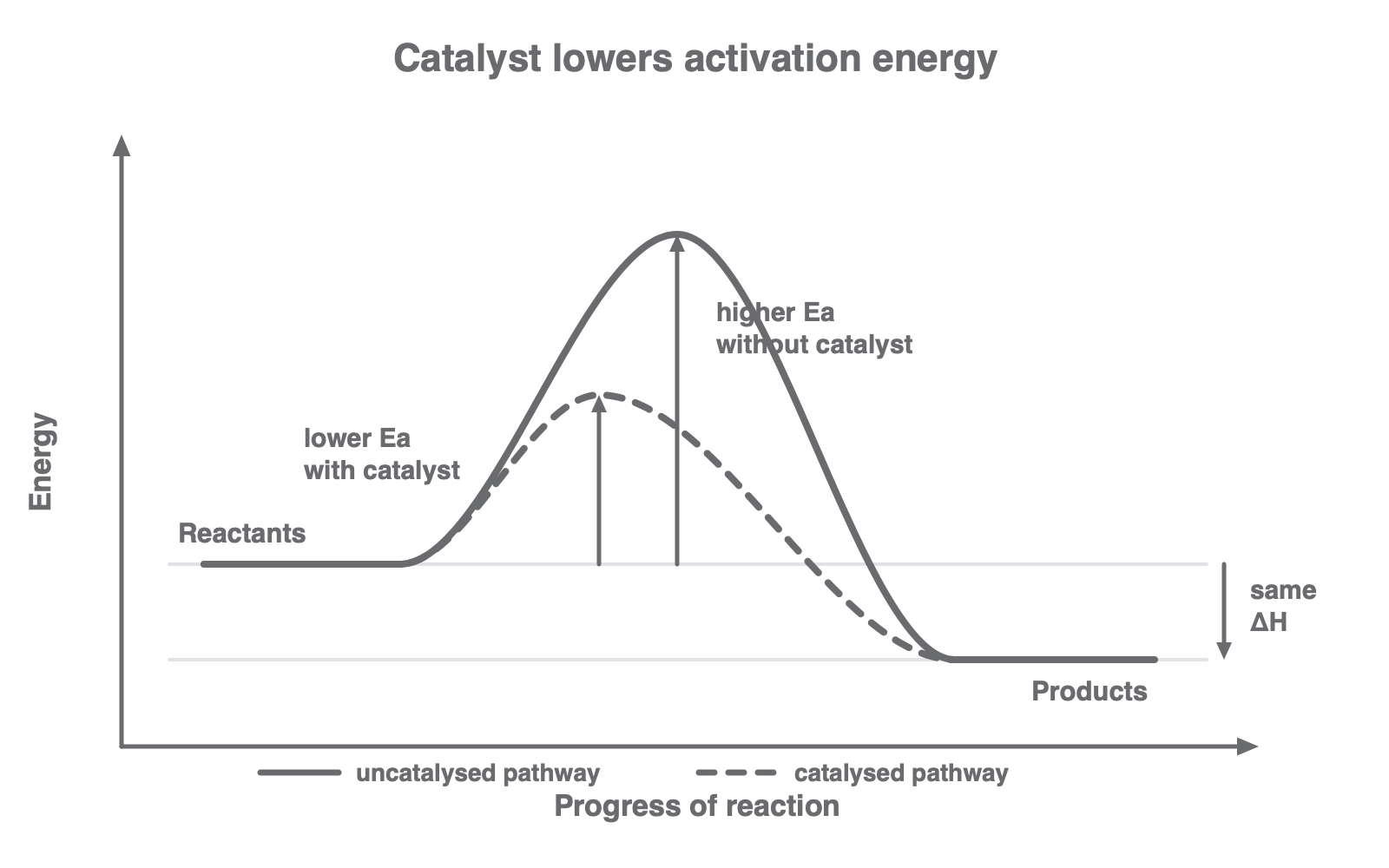
The careful wording is that the catalyst provides a different route with a lower activation energy. Do not describe this as the catalyst "adding energy" to particles. Do not draw the products at a different energy because of the catalyst. The reactants and products are the same overall reaction, so ΔH is the same.
Reading reaction profiles
A reaction profile diagram shows how the energy of the reacting chemicals changes as the reaction progresses. The vertical axis is energy. The horizontal axis is the progress of reaction, not time.
The reactants are shown by the first horizontal level. The products are shown by the final horizontal level. The curve rises because energy is needed before products can form.
[DIAGRAM: asset_name: Catalysts and reaction profiles - diagram 02; asset_slug: c44_catalysts_and_reaction_profiles__diagram_02; recommended_method: deterministic_drawing; description: Two-panel monochrome reaction profile diagram. Left panel shows an exothermic profile with reactants above products, activation energy arrow up to the peak, and ΔH arrow down from reactants to products. Right panel shows an endothermic profile with products above reactants, activation energy arrow up to the peak, and ΔH arrow up from reactants to products.]
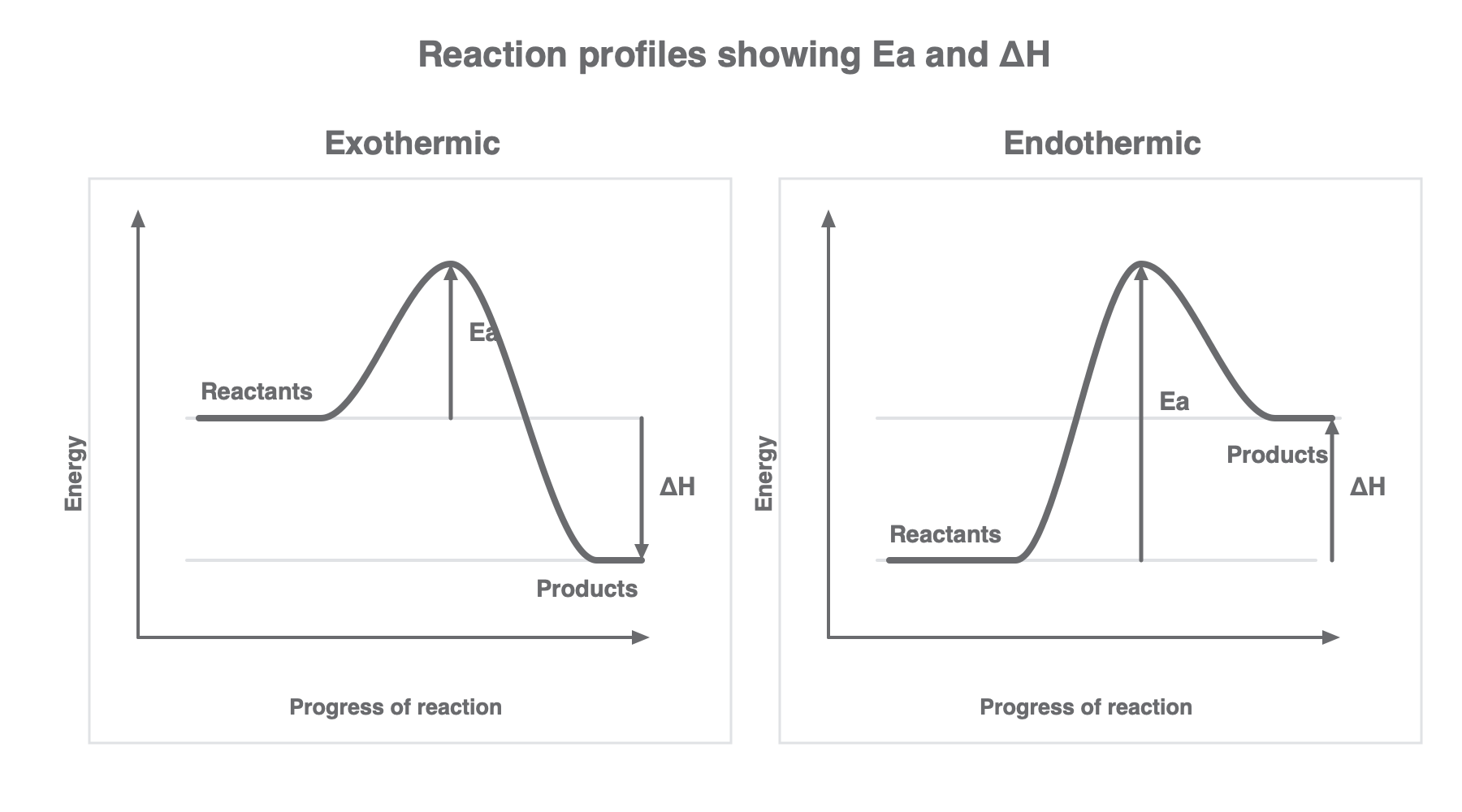
Activation energy, often labelled , is measured vertically from the reactants level to the top of the curve. It is not measured from zero on the axis and it is not measured from the products.
The enthalpy change, ΔH, is the vertical difference between the reactants and the products. If the products are lower than the reactants, the reaction is exothermic and ΔH is negative. If the products are higher than the reactants, the reaction is endothermic and ΔH is positive.
Worked example: a profile has reactants at 80 kJ, a peak at 150 kJ and products at 30 kJ. The activation energy is 70 kJ because . The enthalpy change is -50 kJ because , so the reaction is exothermic.
Continue this lesson.
You’re previewing NovaLearn without an account. Create a free account to read the rest.
Create free account