2.12-2.14 - Carbon dioxide and greenhouse gases
Carbon dioxide appears in this topic in two linked ways: it can be made in the laboratory by heating metal carbonates, and it is one of the gases that affects the Earth's energy balance. This lesson also covers a specification practical: using a reaction with a metal or a non-metal to estimate the percentage by volume of oxygen in air.
Carbon dioxide from carbonates
Some metal carbonates break down when they are heated strongly. This is a chemical reaction because new substances are formed.
Thermal decomposition
Thermal decomposition is the breaking down of a compound into simpler substances by heating.
For a decomposing metal carbonate, the general pattern is:
Thermal decomposition of a metal carbonate
The named example for this specification is copper(II) carbonate. When copper(II) carbonate is heated, carbon dioxide is formed and copper(II) oxide remains.
Copper(II) carbonate decomposition
[DIAGRAM: asset_name: Carbon dioxide and greenhouse gases - diagram 01; asset_slug: c25_carbon_dioxide_and_greenhouse_gases__diagram_01; recommended_method: image_gen; description: Monochrome setup for heating copper(II) carbonate in a clamped test tube, with a delivery tube carrying carbon dioxide into limewater. Labels show heat, carbon dioxide, copper(II) oxide remaining and limewater turning milky.]
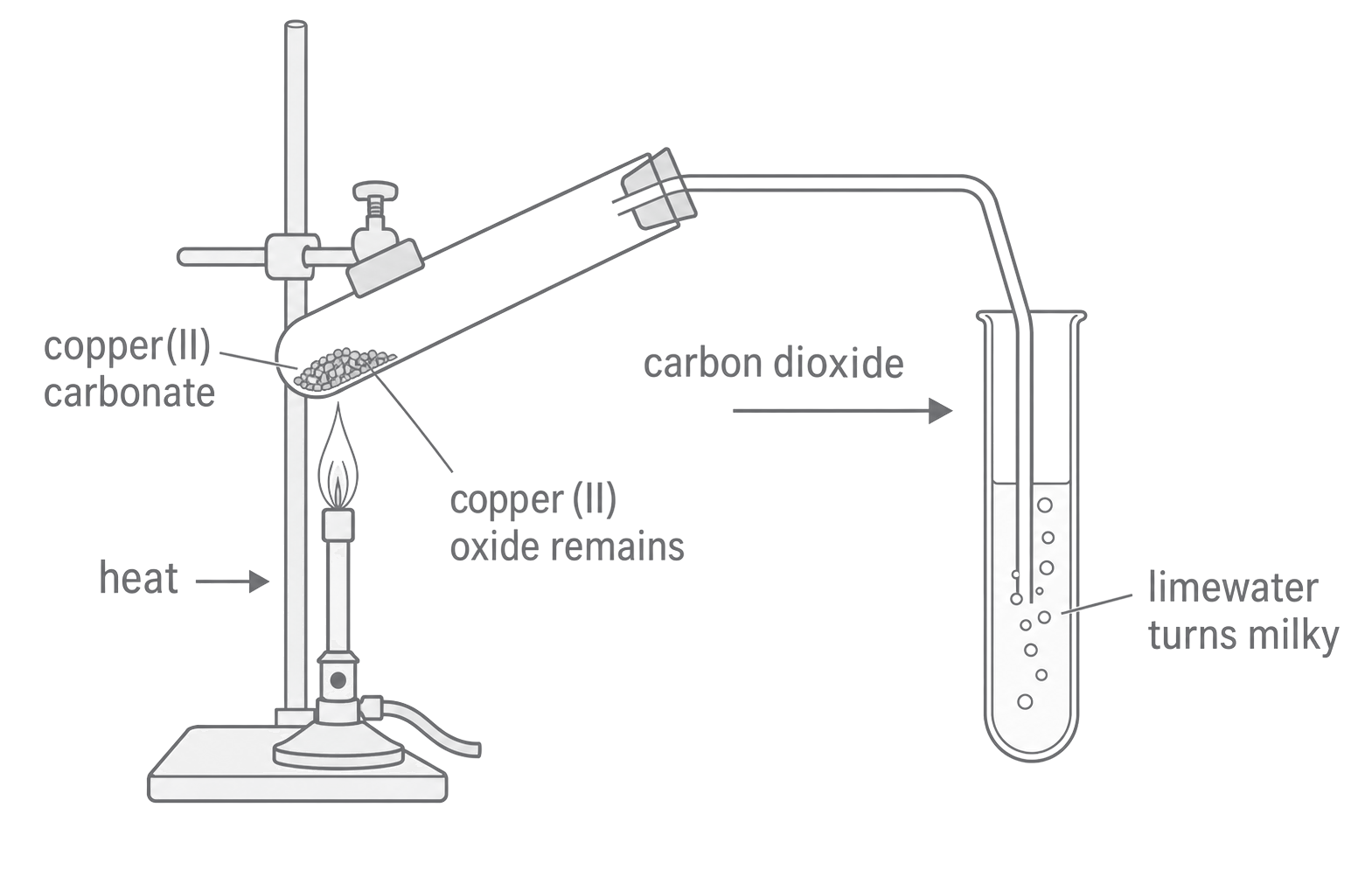
In the laboratory, the carbon dioxide can be bubbled through limewater. Carbon dioxide turns limewater milky, so that observation is evidence that carbon dioxide has been produced. The solid copper(II) carbonate is green before heating, and the copper(II) oxide formed is black.
Do not write that heating simply "melts" the carbonate. The exam idea is decomposition: one compound breaks down to form a metal oxide and carbon dioxide.
Carbon dioxide as a greenhouse gas
Carbon dioxide is a greenhouse gas. A greenhouse gas absorbs some of the infrared radiation emitted from the Earth's surface and then re-emits radiation in different directions, including back towards the surface.
[DIAGRAM: asset_name: Carbon dioxide and greenhouse gases - diagram 02; asset_slug: c25_carbon_dioxide_and_greenhouse_gases__diagram_02; recommended_method: image_gen; description: Monochrome greenhouse-effect schematic showing sunlight entering the atmosphere, infrared radiation leaving the Earth's surface, carbon dioxide in the atmosphere, and some heat being returned towards the surface.]
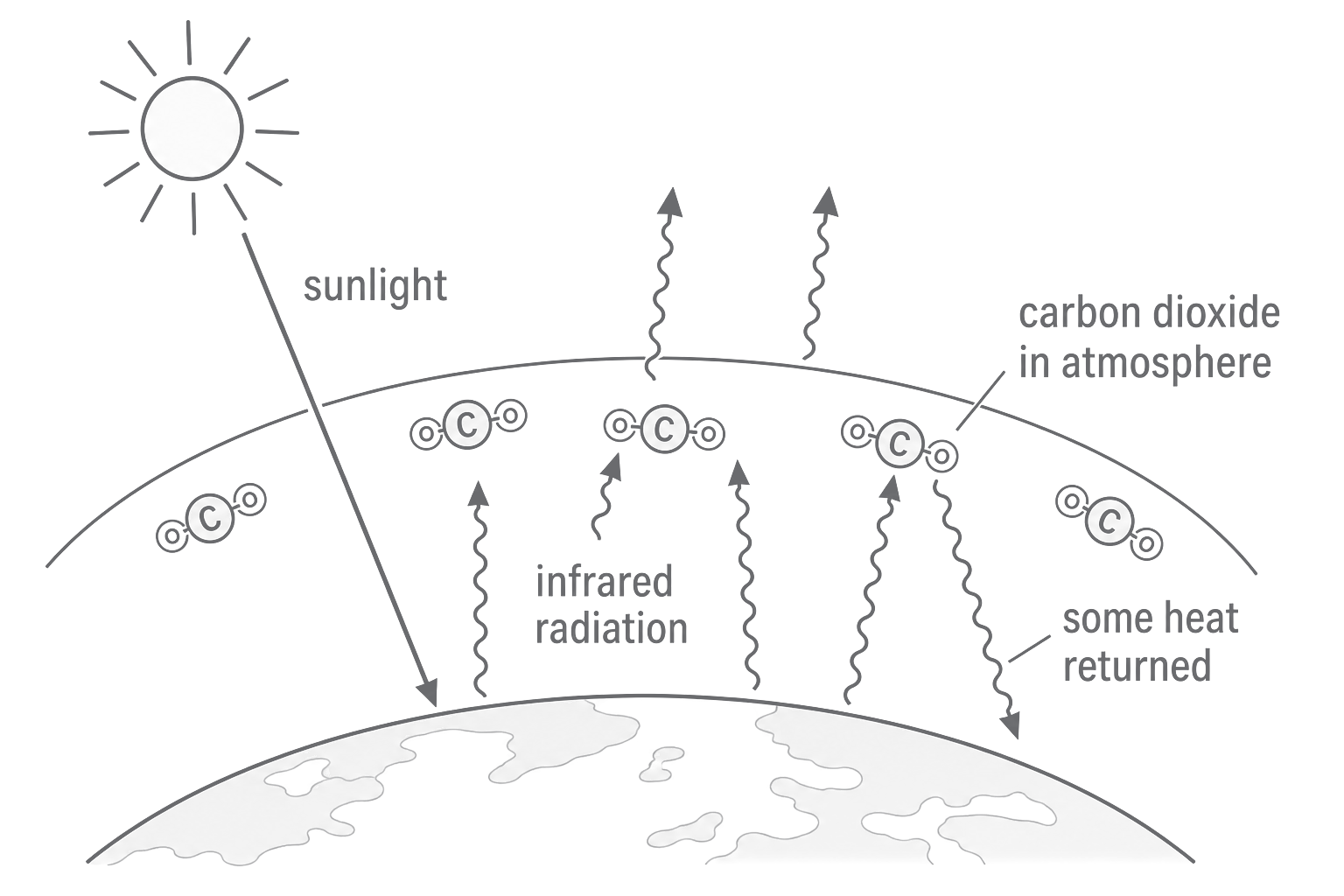
The natural greenhouse effect helps keep the Earth warm enough for life. The Edexcel point for this lesson is the enhanced greenhouse idea: increasing amounts of carbon dioxide in the atmosphere may contribute to climate change.
The chain of reasoning is:
- Carbon dioxide is a greenhouse gas.
- More carbon dioxide in the atmosphere means more outgoing infrared radiation can be absorbed.
- More energy can be retained in the atmosphere and near the surface.
- This may contribute to climate change, including an increase in average global temperature.
Use careful exam wording. Do not say "carbon dioxide destroys the ozone layer" or "carbon dioxide lets in more sunlight". The key radiation in this topic is outgoing infrared radiation from the Earth's surface.
Using iron to measure oxygen in air
The specification practical estimates the percentage by volume of oxygen in air. One method uses a metal: iron.
Wet iron reacts slowly with oxygen in the trapped air to form iron oxide. As oxygen is removed, the gas volume inside the tube decreases, so water rises. The decrease in gas volume is treated as the volume of oxygen originally present.
[DIAGRAM: asset_name: Carbon dioxide and greenhouse gases - diagram 03; asset_slug: c25_carbon_dioxide_and_greenhouse_gases__diagram_03; recommended_method: image_gen; description: Monochrome side-by-side practical diagram of wet iron wool in an inverted tube over water at the start and after several days, showing the water level rising as oxygen is used up.]
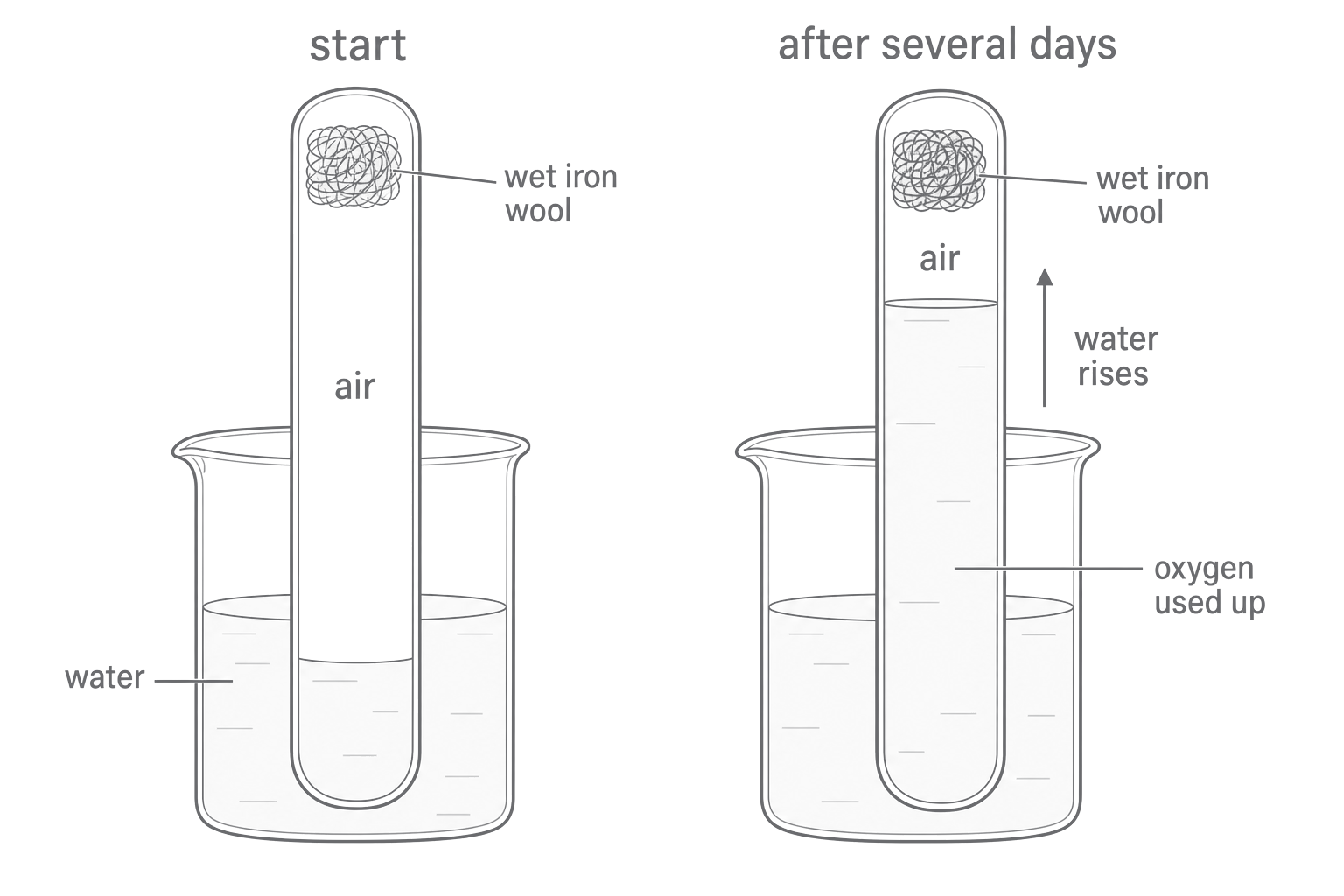
A suitable method is:
Continue this lesson.
You’re previewing NovaLearn without an account. Create a free account to read the rest.
Create free account