2.18-2.20 - Rusting and redox
Rusting is a familiar example of chemistry that quietly destroys useful iron and steel. In this lesson you will learn the conditions needed for iron to rust, how rusting can be prevented, and how to describe linked oxidation and reduction reactions using oxygen and electrons.
Conditions for rusting
Rusting is the corrosion of iron. It happens when iron reacts with oxygen and water, or moisture from the air. If either oxygen or water is missing, iron does not rust.
Rusting
Rusting is the reaction of iron with oxygen and water to form hydrated iron(III) oxide.
That reaction can be summarised with a word equation.
Rusting word equation
iron + oxygen + water -> hydrated iron(III) oxide
The chemical name for rust is hydrated iron(III) oxide. You may also see its formula written as . In short-answer exam questions, "oxygen and water" is the safest answer for the two substances needed for iron to rust. "Air" is often accepted because air contains oxygen, and "moisture" is often accepted for water.
Salt is not a required substance for rusting, but salty water usually makes rusting faster. This is why iron and steel objects near seawater are at greater risk.
Iron rusts only when both oxygen and water are present.
Use that rule whenever a rusting question describes different conditions around the iron.
Evidence from nails
A simple nail experiment can show which conditions are essential. Several clean iron nails are left in different test tubes for a few days, then compared.
[DIAGRAM: asset_name: Rusting and redox - diagram 01; asset_slug: c27_rusting_and_redox__diagram_01; recommended_method: image_gen; description: Monochrome four-test-tube rusting conditions comparison. Tube A has an iron nail in water with air above and is labelled rusts. Tube B has an iron nail in boiled water with an oil layer excluding oxygen and is labelled no rust. Tube C has an iron nail in salty water with air above and is labelled rusts fastest. Tube D has an iron nail in dry air with calcium chloride and a bung and is labelled no rust. Use white background and #6A6B6E linework/text only.]
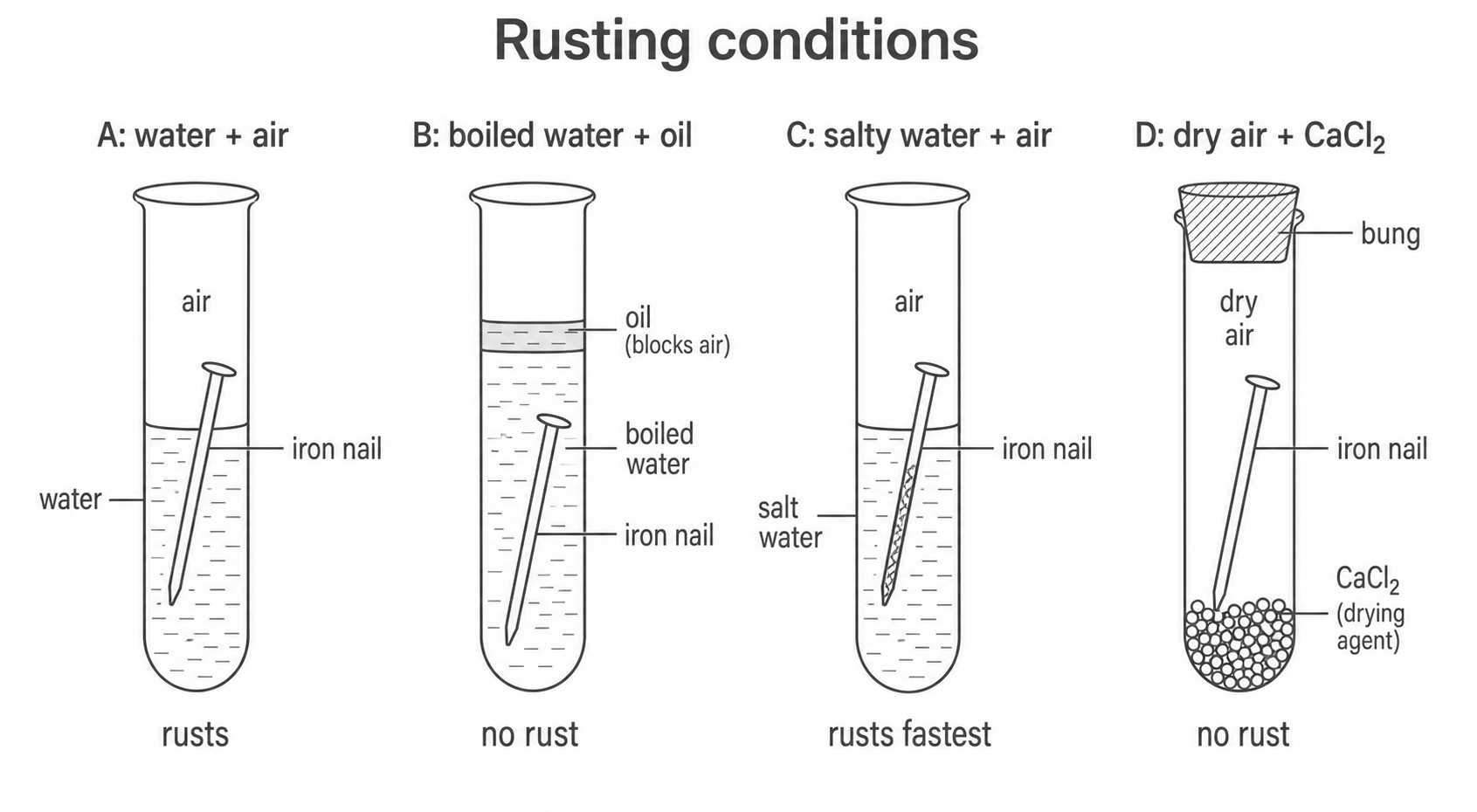
Tube A contains water and air, so the nail rusts. Tube B contains boiled water with oil on top. Boiling removes dissolved air and the oil stops more oxygen from dissolving, so the nail has water but not enough oxygen and does not rust. Tube D contains air but has a drying agent such as anhydrous calcium chloride, so the nail has oxygen but not water and does not rust.
Tube C shows a useful extra point: salty water makes rusting faster. The exam point is still that oxygen and water are the two required substances.
Preventing rusting
Rusting can be prevented by stopping oxygen or water from reaching the iron, or by making a more reactive metal react instead.
[DIAGRAM: asset_name: Rusting and redox - diagram 02; asset_slug: c27_rusting_and_redox__diagram_02; recommended_method: image_gen; description: Monochrome comparison of three rusting prevention methods. Left: iron bar covered by paint/plastic/oil barrier blocking oxygen and water. Middle: galvanised iron with zinc coating; a scratch exposes iron but zinc remains beside it. Right: iron pipe connected to a more reactive metal block labelled zinc or magnesium, with the more reactive metal oxidising instead of iron. Use white background and #6A6B6E linework/text only.]
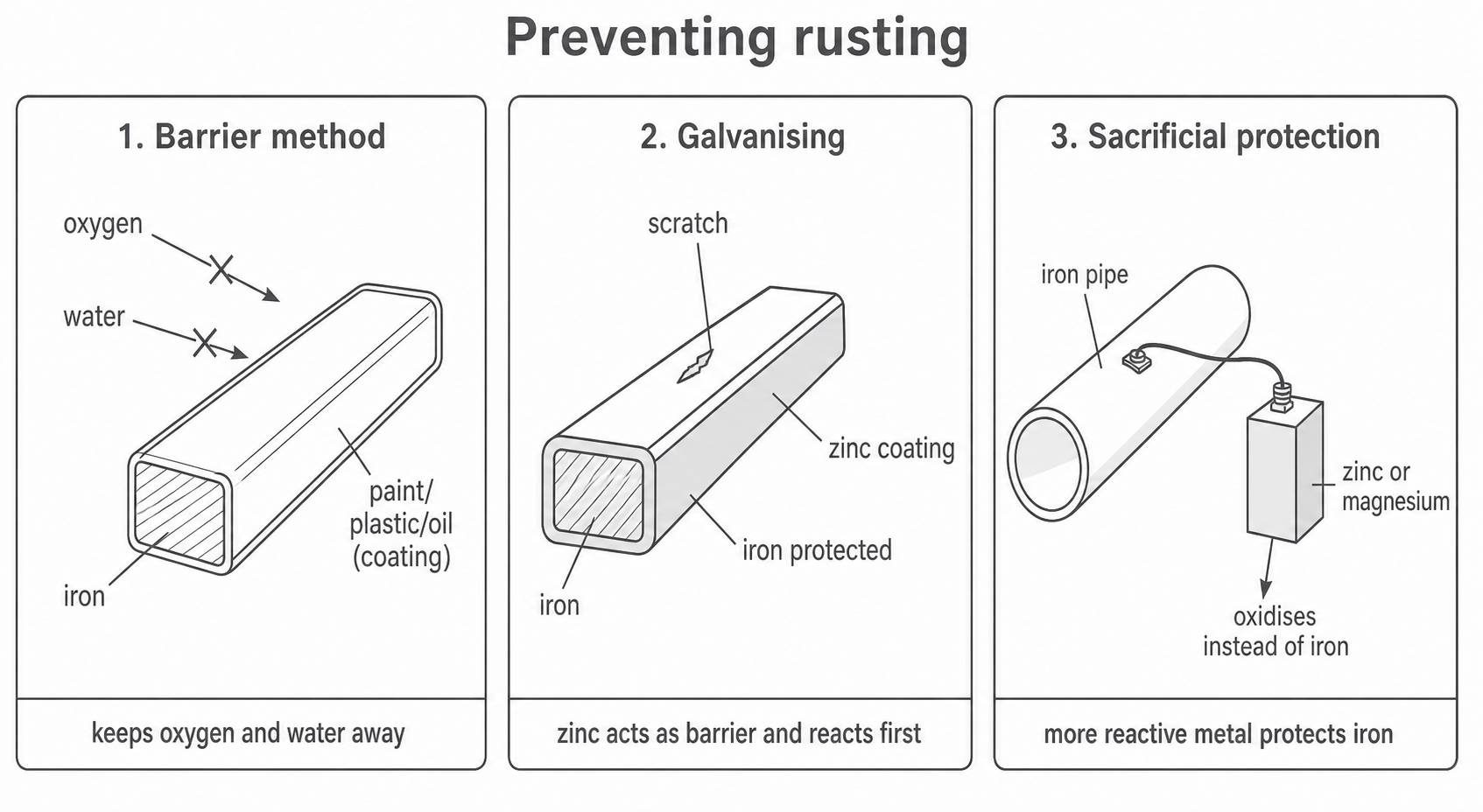
Barrier methods cover the iron so oxygen and water cannot reach its surface. Examples include painting, oiling, greasing, coating with plastic, and electroplating. A barrier method works only while the barrier is unbroken. If paint is scratched and water and oxygen can reach the iron, rusting can begin at the scratch.
Continue this lesson.
You’re previewing NovaLearn without an account. Create a free account to read the rest.
Create free account