1.55C-1.58C - Electrolysis principles and products
Electrolysis uses electricity to decompose an ionic substance when its ions can move. In this lesson, the important skill is not writing half-equations; it is knowing which particles can carry charge, where ions move, and what products form at inert electrodes in the named examples.
Why some compounds conduct
For a substance to conduct electricity, it needs charged particles that are free to move. Metals conduct because they have delocalised electrons. Electrolytes conduct because they contain mobile ions.
Electrolyte
An electrolyte is a molten ionic compound or aqueous ionic solution that conducts electricity because it contains ions that are free to move.
Covalent substances do not usually conduct electricity because they do not contain mobile ions or delocalised electrons. Simple covalent compounds are made of neutral molecules, so there are no mobile charged particles to carry charge, even if the substance is liquid.
Ionic compounds contain positive and negative ions, but the ions are only useful for conduction when they can move. In a solid ionic compound, the ions are fixed in a giant lattice. When the compound is molten, or when it dissolves in water to form an aqueous solution, the ions can move through the liquid and carry charge.
[DIAGRAM: asset_name: Electrolysis principles and products - diagram 01; asset_slug: c20_electrolysis_principles_and_products__diagram_01; recommended_method: image_gen; description: Monochrome side-by-side schematic showing a solid ionic lattice with fixed ions and no current, and a molten or aqueous electrolyte with mobile cations moving to the negative cathode and mobile anions moving to the positive anode; include a DC power supply, two inert electrodes, arrows for ion movement, and labels cation, anion, cathode (-), anode (+).]
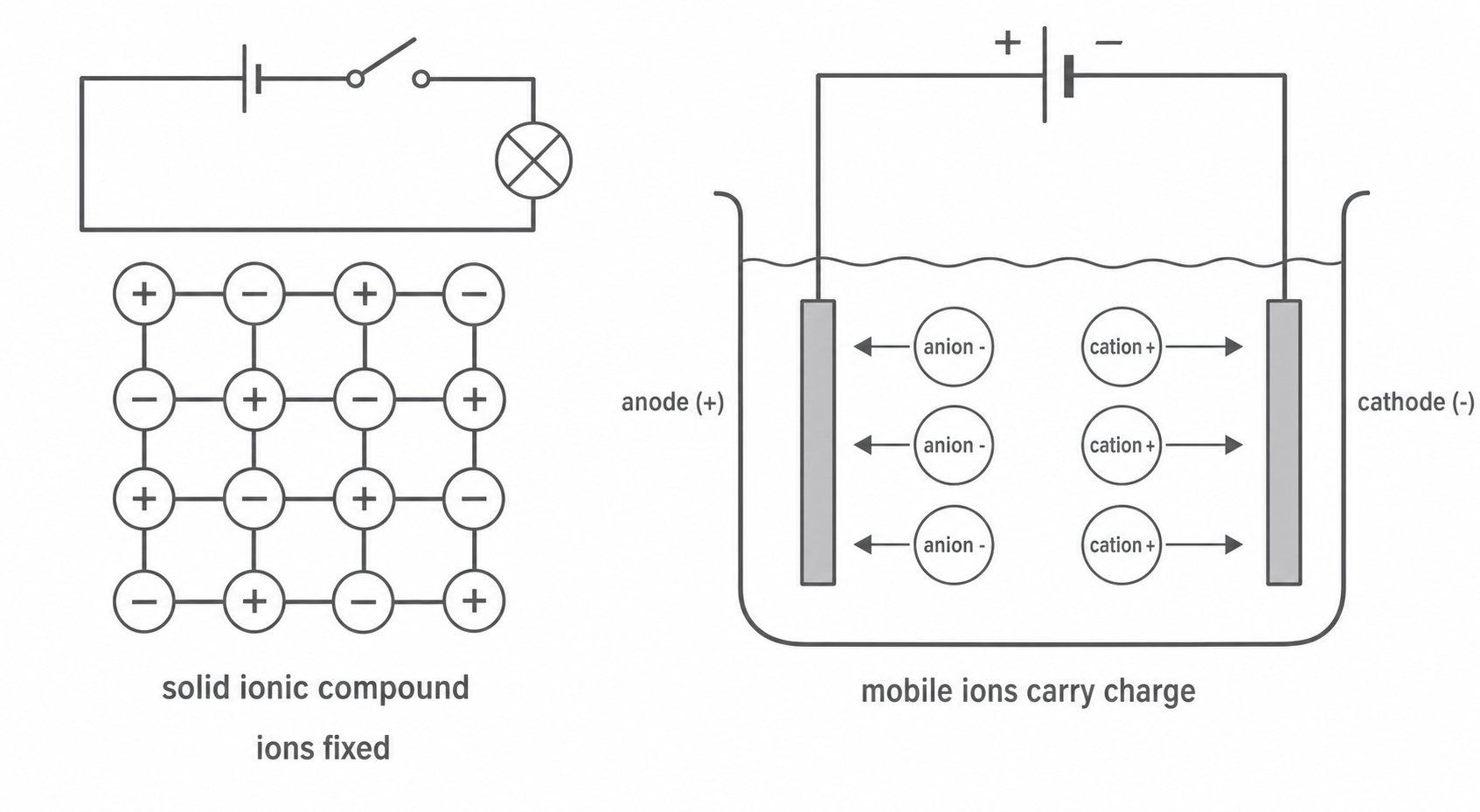
Ionic compounds conduct only when molten or aqueous because only then are the ions free to move and carry charge.
Ions and electrodes
Electrolysis needs a complete circuit, a direct current power supply, two electrodes, and an electrolyte. The electrodes are conductors dipped into the electrolyte. In this cluster, the electrodes are inert, so they conduct electricity without reacting with the electrolyte or the products.
Cation and anion
A cation is a positive ion. An anion is a negative ion.
In electrolysis, the negative electrode is called the cathode and the positive electrode is called the anode.
- cations move to the cathode because positive ions are attracted to the negative electrode
- anions move to the anode because negative ions are attracted to the positive electrode
When ions reach an electrode, atoms or molecules can form there. This is why the products of electrolysis are found at the electrodes rather than mixed evenly through the solution.
The names can feel close together, so anchor them to charge and movement: cations are positive and move to the cathode; anions are negative and move to the anode. The product at the cathode is usually a metal or hydrogen. The product at the anode is usually a non-metal such as oxygen, chlorine, or bromine.
Molten lead(II) bromide
Molten electrolysis is the simpler case because only the ions from the ionic compound are present. Molten lead(II) bromide contains Pb2+ ions and Br- ions.
To investigate it, lead(II) bromide is heated in a crucible until it melts. Inert graphite electrodes are dipped into the molten compound and connected to a DC power supply. This demonstration must be carried out in a fume cupboard because bromine is toxic and corrosive.
Solid lead(II) bromide does not conduct because its ions are fixed. Once it melts, the ions become mobile and the current can pass through the molten electrolyte.
At the negative cathode, positive lead ions form lead. At the positive anode, negative bromide ions form bromine. In observations, lead appears as a grey or silvery metal, often as a small molten bead, and bromine appears as brown fumes at the positive electrode.
For a molten binary ionic compound, the metal forms at the cathode and the non-metal forms at the anode.
Continue this lesson.
You’re previewing NovaLearn without an account. Create a free account to read the rest.
Create free account