2.39-2.40C, 2.42 - Preparing soluble salts
Many salts dissolve in water, so making a pure, dry solid sample is not as simple as filtering out a precipitate. In this lesson, the key skill is choosing the right reactants, making a salt solution without excess reactants, then using crystallisation to obtain crystals. The named Pearson practical is the preparation of hydrated copper(II) sulfate crystals from copper(II) oxide.
Choosing reactants
A salt is made when the hydrogen ions from an acid are replaced by metal ions or ammonium ions. The acid usually tells you the second part of the salt name.
| Acid used | Salt type formed | Example salt |
|---|---|---|
| hydrochloric acid | chloride | sodium chloride |
| sulfuric acid | sulfate | copper(II) sulfate |
| nitric acid | nitrate | zinc nitrate |
For an insoluble-reactant preparation, the solid reactant supplies the metal ion. Suitable insoluble reactants include many metal oxides, metal hydroxides and metal carbonates. The product salt must be soluble, otherwise this lesson's crystallisation route is not the right method.
Common salt-making reactions
For example, to make copper(II) sulfate, choose sulfuric acid because a sulfate is needed, and choose a copper(II) compound such as copper(II) oxide because copper(II) ions are needed.
The acid-alkali route is different. Both reactants are soluble, so there is no excess solid to filter away. That means a titration-style method is needed to find exactly the volumes that neutralise each other.
Insoluble-reactant method
When the starting reactant is insoluble, the safest exam method is to use that insoluble solid in excess. Excess means more solid is added than the acid can react with. This is useful because unreacted solid can be removed by filtration, while excess acid would stay dissolved and contaminate the crystals.
[DIAGRAM: asset_name: Preparing soluble salts - diagram 01; asset_slug: c35_preparing_soluble_salts__diagram_01; recommended_method: image_gen; description: Monochrome three-stage schematic of preparing a soluble salt from an insoluble reactant: warm acid in a beaker, add excess insoluble solid with stirring, filter off unreacted solid to collect salt solution, then gently evaporate and cool to form crystals.]
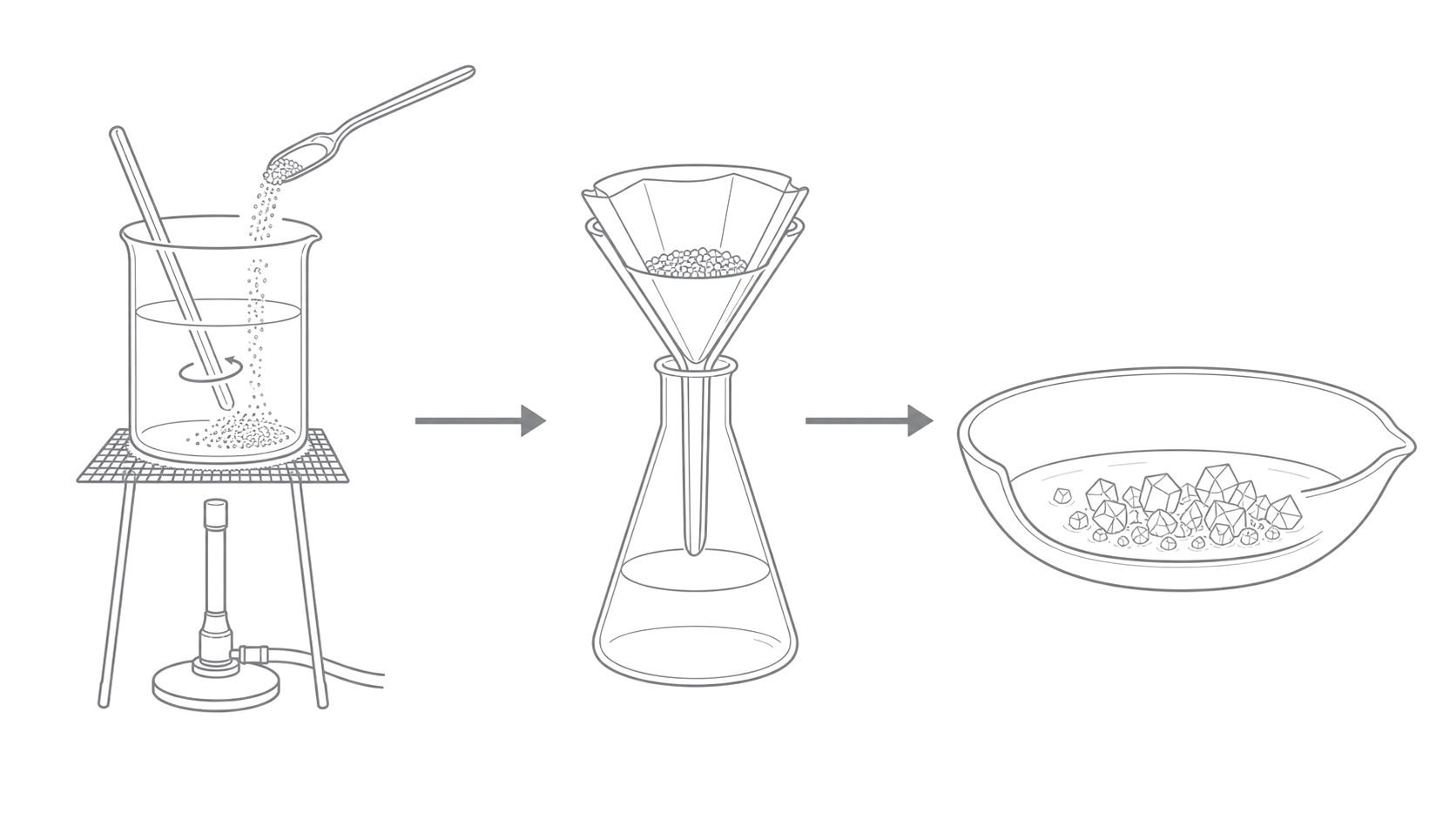
A suitable method is:
- Measure a known volume of dilute acid into a beaker.
- Warm the acid gently if the reaction is slow.
- Add the insoluble reactant a little at a time, stirring after each addition.
- Continue adding solid until some remains unreacted after stirring, or until fizzing stops for a carbonate and excess solid is present.
- Filter the mixture to remove the excess insoluble solid.
- Heat the filtrate gently to evaporate some water until the solution is concentrated or hot saturated.
- Leave the solution to cool so crystals form.
- Filter off the crystals and dry them between filter papers, on a warm surface, or in a warm oven if suitable.
Filtrate
The filtrate is the liquid or solution that passes through the filter paper.
Do not heat the solution to complete dryness. Crystallisation needs a concentrated solution that is then allowed to cool. If all the water is boiled away, soluble impurities can be left mixed with the salt, and some hydrated salts may lose water from their crystals.
Copper sulfate practical
The Pearson core practical uses copper(II) oxide and dilute sulfuric acid to make hydrated copper(II) sulfate crystals. Copper(II) oxide is an insoluble base, so it reacts with acid to form a soluble salt and water.
The real laboratory observations help you track the reaction: copper(II) oxide is a black solid, and copper(II) sulfate solution and hydrated copper(II) sulfate crystals are blue. NovaLearn diagrams stay monochrome, so the colour is described in the text rather than shown as a coloured asset.
[DIAGRAM: asset_name: Preparing soluble salts - diagram 02; asset_slug: c35_preparing_soluble_salts__diagram_02; recommended_method: image_gen; description: Monochrome apparatus sequence for the hydrated copper(II) sulfate practical: a hot water bath warming dilute sulfuric acid in a beaker or boiling tube, copper(II) oxide added with a spatula and stirred, filtration of excess copper(II) oxide, and gentle evaporation/cooling to crystallise hydrated copper(II) sulfate.]
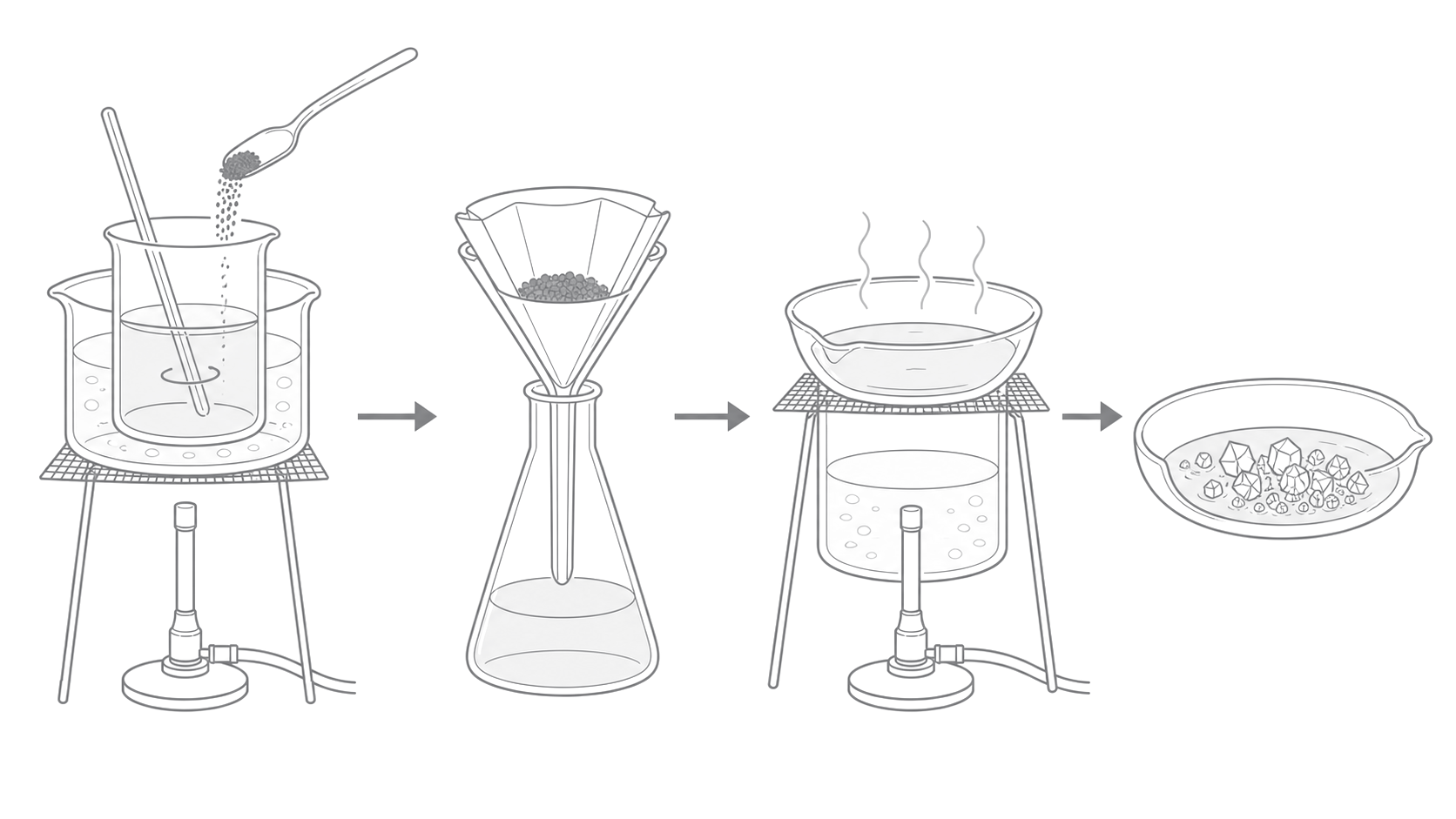
A full method is:
- Place dilute sulfuric acid in a beaker or boiling tube and warm it using a hot water bath.
- Add copper(II) oxide in small spatula portions, stirring after each addition.
- Keep adding copper(II) oxide until some black solid remains after stirring. This shows the acid has been used up.
- Filter the warm mixture to remove excess copper(II) oxide. The filtrate is copper(II) sulfate solution.
- Gently heat the filtrate to evaporate some water until a hot saturated solution is formed.
- Allow the solution to cool so hydrated copper(II) sulfate crystals form.
- Filter off the crystals and dry them with filter paper or in a warm place.
Continue this lesson.
You’re previewing NovaLearn without an account. Create a free account to read the rest.
Create free account