3.20C-3.22C - Changing equilibrium conditions
Some reversible reactions do not go fully to reactants or fully to products. Once dynamic equilibrium has been reached, the important question is what happens if a condition changes. This lesson shows how catalysts, temperature and pressure affect the equilibrium mixture, using only the direction rules required for Edexcel International GCSE Chemistry.
Dynamic equilibrium
A reversible reaction at dynamic equilibrium is still reacting in both directions. It only looks steady because the two rates are balanced.
Dynamic equilibrium
Dynamic equilibrium is reached when the forward and reverse reactions occur at the same rate, so the concentrations of reactants and products remain constant.
Dynamic equilibrium can only be maintained in a closed or sealed system, because substances must not escape. If gas leaves the container, the mixture is no longer fixed and the forward and reverse reactions cannot settle into a steady balance.
[DIAGRAM: asset_name: Changing Equilibrium Conditions - diagram 01; asset_slug: c47_changing_equilibrium_conditions__diagram_01; recommended_method: image_gen; description: Monochrome sealed-container diagram for dynamic equilibrium. It shows reactant particles and product particles in one closed container, equal-sized forward and reverse arrows, and steady concentration indicators to emphasise that the forward and reverse reactions happen at the same rate while reactant and product concentrations remain constant.]
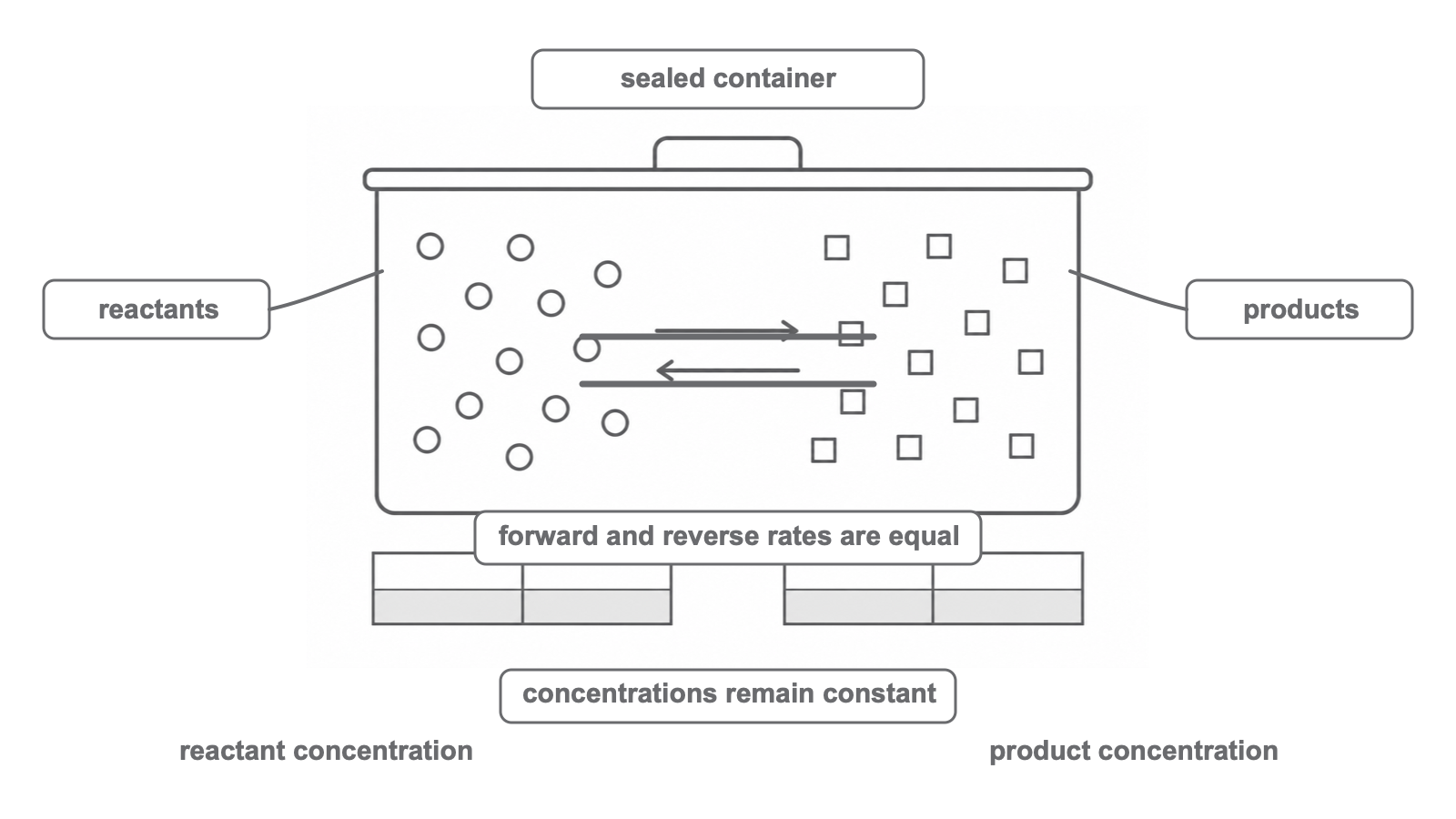
"Constant concentration" does not mean "equal concentration". At equilibrium, there might be more reactants than products, more products than reactants, or similar amounts of each. The key idea is that the concentrations stop changing because every forward change is matched by a reverse change.
For a reaction written as:
dynamic equilibrium means:
- particles of are still forming
- particles of are still forming
- the two rates are equal
- the concentrations of and stay constant
Catalysts and equilibrium position
A catalyst increases the rate of a reaction. In a reversible reaction, the catalyst provides a faster route for both directions.
At equilibrium, the forward and reverse rates must be equal. A catalyst speeds up the forward reaction and the reverse reaction equally, so it does not favour one side over the other. This means a catalyst does not change the position of equilibrium.
[DIAGRAM: asset_name: Changing Equilibrium Conditions - diagram 02; asset_slug: c47_changing_equilibrium_conditions__diagram_02; recommended_method: deterministic_drawing; description: Monochrome line graph of product concentration against time. A dashed curve labelled with catalyst reaches the equilibrium plateau sooner than a solid curve labelled no catalyst, but both curves finish at the same plateau to show that a catalyst changes rate, not equilibrium position.]
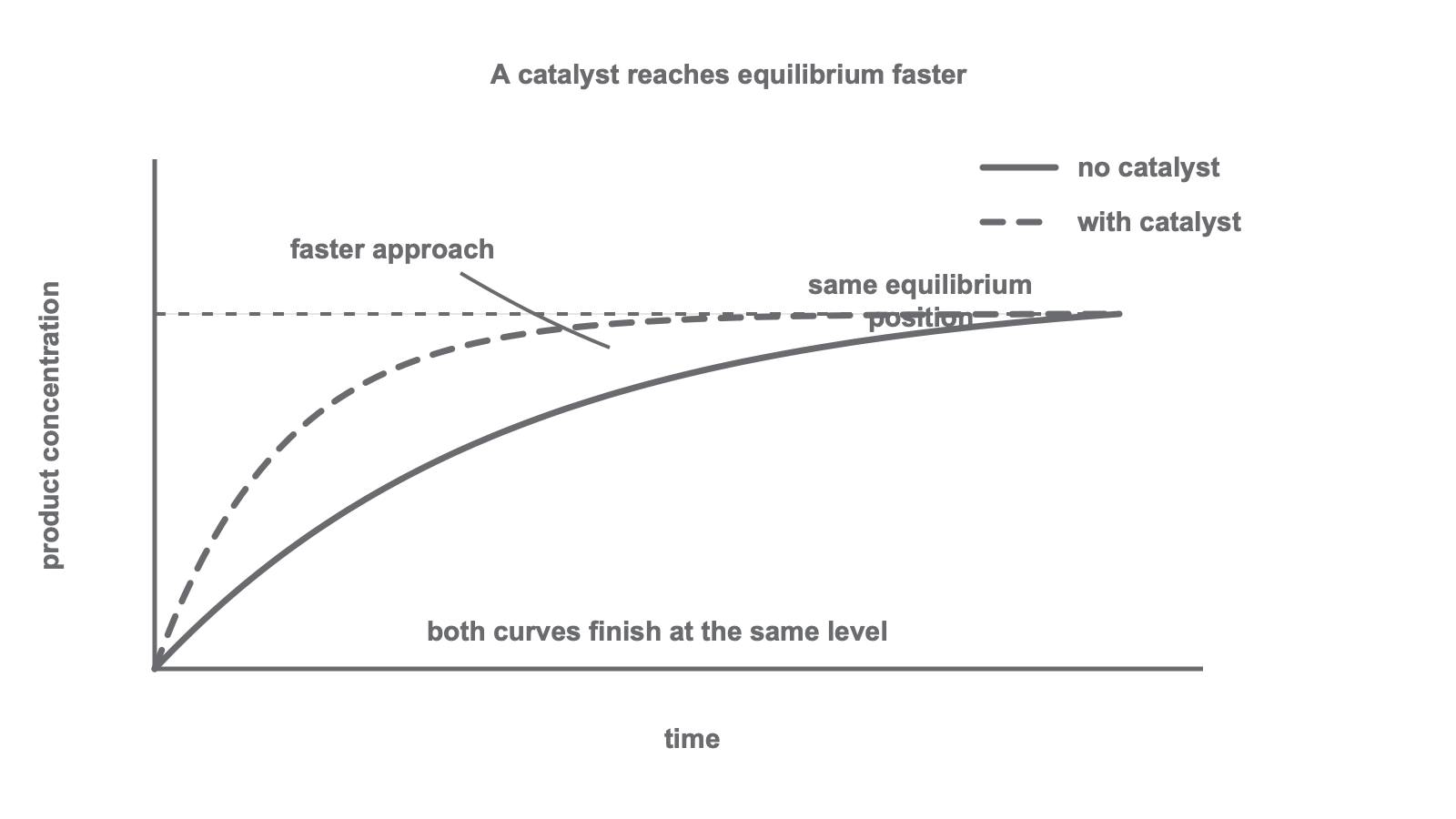
The position of equilibrium means the relative amounts of reactants and products in the equilibrium mixture. If the position shifts towards the products, the yield of products increases. If it shifts towards the reactants, the yield of products decreases.
A catalyst can be useful industrially because it helps the mixture reach equilibrium faster. It does not increase the final equilibrium yield.
Changing temperature
Every reversible reaction has one endothermic direction and one exothermic direction. If the forward reaction is endothermic, the reverse reaction is exothermic. If the forward reaction is exothermic, the reverse reaction is endothermic.
Temperature changes shift the position of equilibrium according to this rule:
| Change in temperature | Equilibrium shifts in the direction of... |
|---|---|
| Increase temperature | the endothermic reaction |
| Decrease temperature | the exothermic reaction |
Use the enthalpy change sign to decide which direction is endothermic. For the forward reaction:
- is positive: forward reaction is endothermic
- is negative: forward reaction is exothermic
For example:
The forward reaction is endothermic. Increasing the temperature shifts equilibrium to the right, towards . Decreasing the temperature shifts equilibrium to the left, towards , because the reverse direction is exothermic.
Continue this lesson.
You’re previewing NovaLearn without an account. Create a free account to read the rest.
Create free account