4.27-4.28 - Alkene reactions and the bromine test
Alkenes react with bromine because they contain a carbon-carbon double bond. This reaction is also useful as a simple chemical test: bromine water distinguishes an alkene from an alkane by its colour change. The key exam skill is to connect the observation to the type of hydrocarbon and to describe the product as a dibromoalkane.
Why alkenes react
An alkene contains the functional group >C=C<. This means two carbon atoms are joined by a carbon-carbon double bond. For this lesson, the important idea is that the double bond is the part of the molecule that reacts with bromine.
Alkenes are described as unsaturated hydrocarbons. They are hydrocarbons because they contain carbon and hydrogen only. They are unsaturated because they contain at least one carbon-carbon double bond.
When bromine reacts with an alkene, the reaction is an addition reaction. The alkene does not lose an atom from the molecule. Instead, atoms from another molecule are added across the carbon-carbon double bond.
Addition reaction
An addition reaction is a reaction in which atoms are added to an unsaturated molecule, so one product molecule is formed.
This cluster does not require the reaction mechanism. You only need to describe what reacts, what is formed, and how the bromine-water test distinguishes alkenes from alkanes.
Forming dibromoalkanes
Bromine is written as Br2 because a molecule of bromine contains two bromine atoms. When bromine reacts with an alkene, the carbon-carbon double bond changes to a carbon-carbon single bond and one bromine atom becomes attached to each of the two carbon atoms that used to be double bonded.
The product is a dibromoalkane:
- di means two
- bromo means bromine atoms are present
- alkane shows that the carbon-carbon double bond has become a carbon-carbon single bond
[DIAGRAM: asset_name: Alkene reactions and the bromine test - diagram 01; asset_slug: c56_alkene_reactions_and_the_bromine_test__diagram_01; recommended_method: image_gen; description: Monochrome reaction scheme showing ethene reacting with bromine: H2C=CH2 plus Br2 gives BrCH2-CH2Br, labelled ethene, bromine and 1,2-dibromoethane. The diagram emphasises that the C=C bond becomes a C-C bond and one Br atom is added to each carbon.]
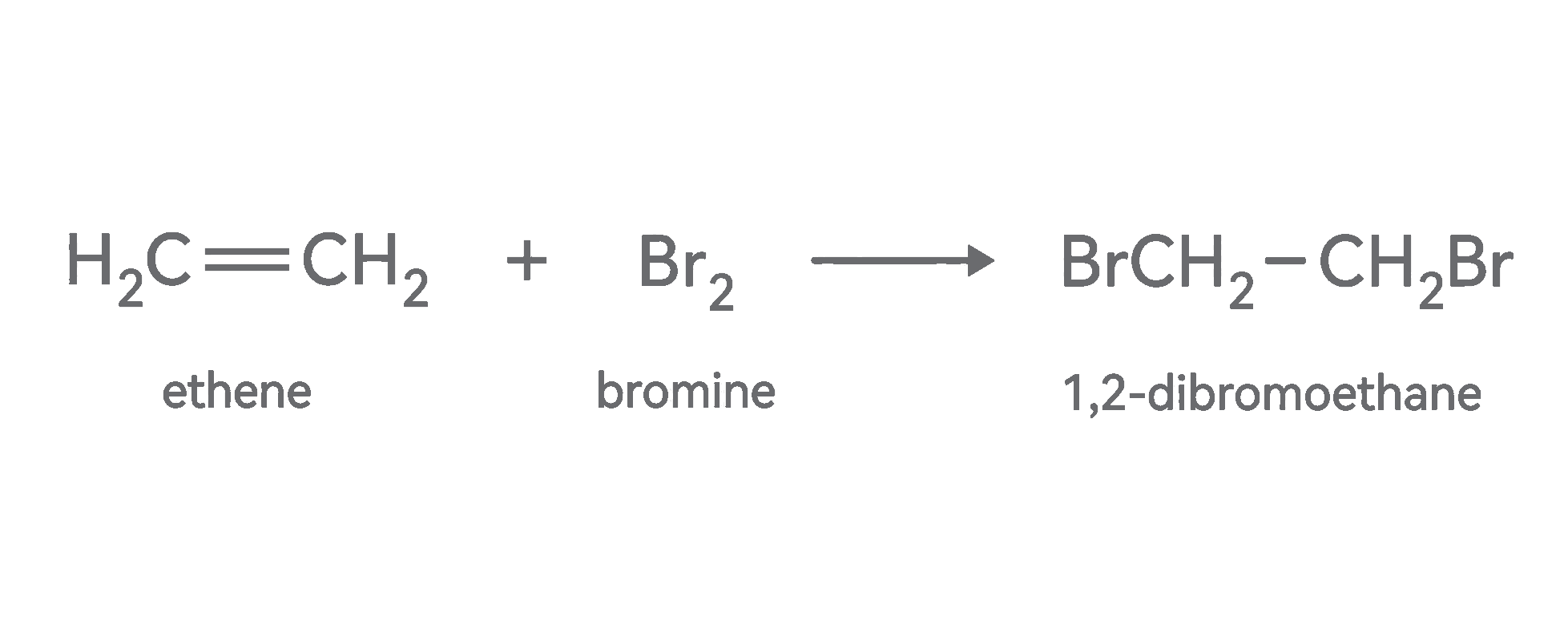
For ethene:
CH2=CH2 + Br2 -> CH2Br-CH2Br
The same reaction can also be written using molecular formulae:
C2H4 + Br2 -> C2H4Br2
For propene:
CH3CH=CH2 + Br2 -> CH3CHBrCH2Br
You do not need to use curly arrows, charges, bromonium ions, or stereochemistry for this specification point. A strong IGCSE description is: "bromine adds across the carbon-carbon double bond to form a dibromoalkane."
Using bromine water
Bromine water is a solution of bromine in water. It is used to test for an alkene because alkenes react with bromine water at room temperature. In exam answers, write bromine water or a solution of bromine, not just "bromine", unless the question itself has already made the solution clear.
The observation for an alkene is that bromine water is decolourised. The safest colour-change wording is:
orange/yellow to colourless
An alkane does not decolourise bromine water in this test. Its observation is:
stays orange/yellow or no colour change
[DIAGRAM: asset_name: Alkene reactions and the bromine test - diagram 02; asset_slug: c56_alkene_reactions_and_the_bromine_test__diagram_02; recommended_method: image_gen; description: Monochrome comparison of the bromine-water test. One sequence shows alkane plus bromine water giving no change. The other shows alkene plus bromine water giving a decolourised final sample. No real colours are used; colour observations are taught in the lesson text.]
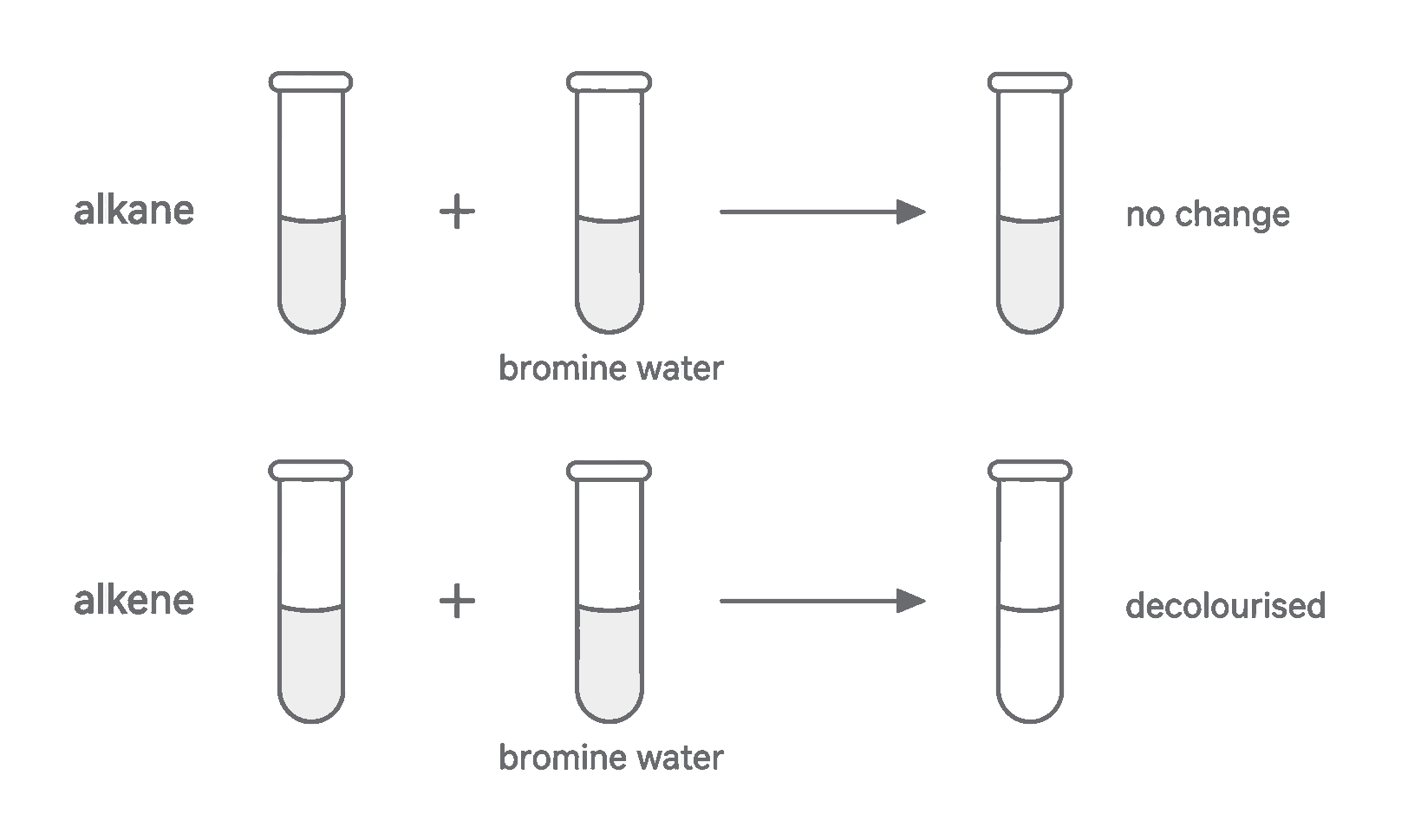
The test works as a comparison:
Continue this lesson.
You’re previewing NovaLearn without an account. Create a free account to read the rest.
Create free account