4.23-4.26 - Alkene functional group, formulae and structures
Alkenes are hydrocarbons with a carbon-carbon double bond. In this lesson, the double bond is the centre of the story: it decides the functional group, the general formula, why alkenes are unsaturated, and how their structures are drawn and named. Reactions of alkenes are taught in the next cluster, so keep your focus here on formulae, structures and names.
The alkene functional group
An alkene is a hydrocarbon that contains the functional group >C=C<. A hydrocarbon contains carbon and hydrogen atoms only. A functional group is the part of a molecule responsible for the characteristic reactions of that homologous series.
Alkene
An alkene is a hydrocarbon containing the carbon-carbon double bond functional group >C=C<.
The C=C part means two carbon atoms are joined by a double bond. The > and < symbols in the specification show that each double-bonded carbon also has other bonds to atoms or groups. In a displayed formula, count the double bond as two bonds: each carbon should still have four bonds in total.
[DIAGRAM: asset_name: Alkene functional group, formulae and structures - diagram 01; asset_slug: c55_alkene_functional_group_formulae_and_structures__diagram_01; recommended_method: image_gen; description: Monochrome line diagram of the alkene functional group showing a central C=C double bond, two further bonds from each carbon to H or R groups, and labels for the functional group and unsaturated hydrocarbon.]
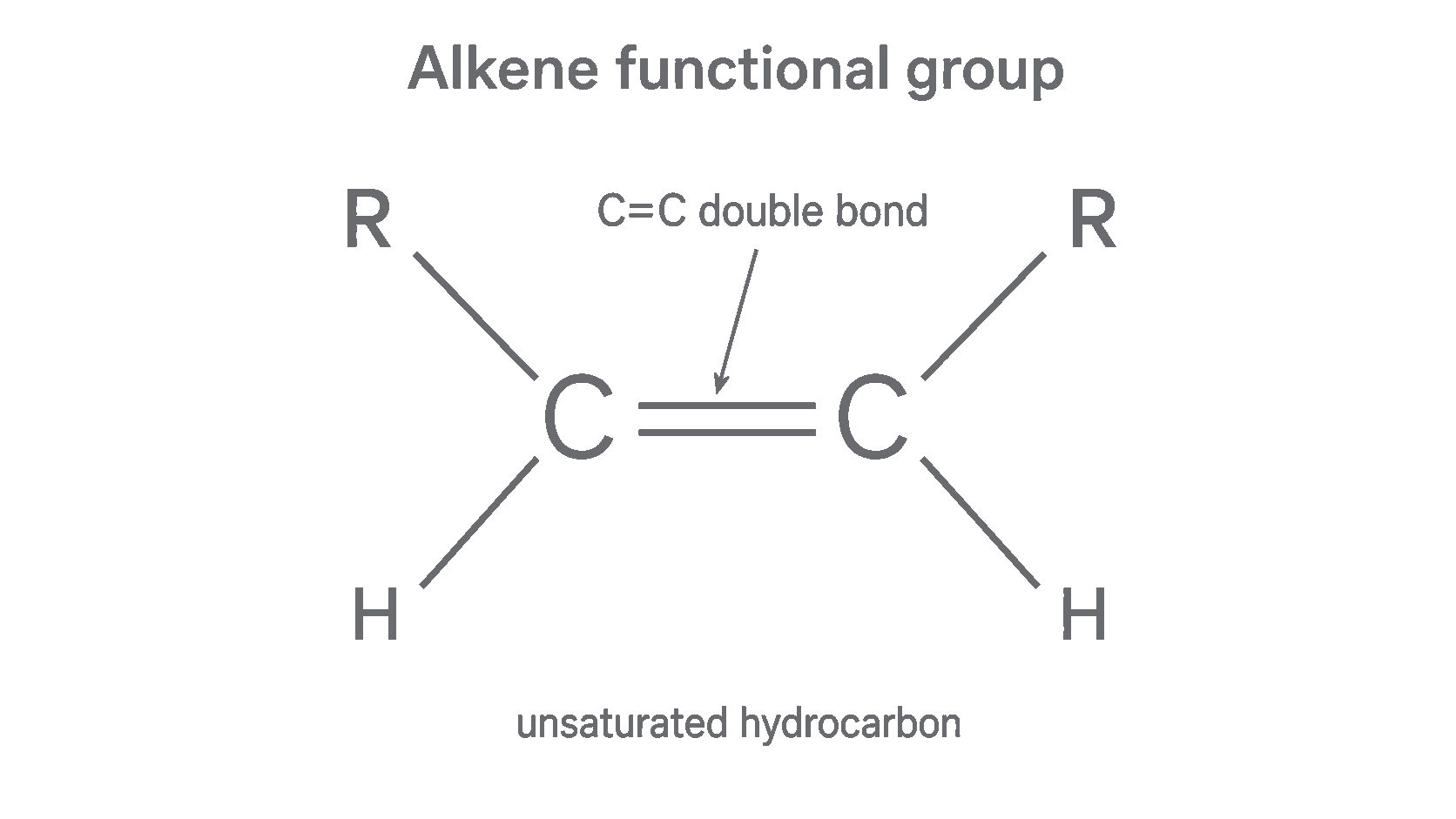
Do not think that an alkene contains only double bonds. Most alkenes also contain single C-C and C-H bonds. What makes it an alkene is the presence of at least one carbon-carbon double bond.
The general formula
The general formula for alkenes in this specification is:
General formula for alkenes
The n stands for the number of carbon atoms in the molecule. The formula means that an alkene has twice as many hydrogen atoms as carbon atoms.
Number of carbon atoms, n | Molecular formula |
|---|---|
| 2 | C2H4 |
| 3 | C3H6 |
| 4 | C4H8 |
There is no one-carbon alkene in this series, because a carbon-carbon double bond needs two carbon atoms. That is why the first alkene is ethene, C2H4, not "methene".
Use the general formula as a quick check when drawing structures. If you draw an alkene with four carbon atoms, the molecular formula should be C4H8. If your structure gives C4H10, you have drawn an alkane instead. If it gives C4H9 or C4H7, a hydrogen or bond count is wrong.
Why alkenes are unsaturated hydrocarbons
Alkenes are described as unsaturated hydrocarbons. This phrase has two separate credit points in exam answers:
| Word | Meaning in this lesson |
|---|---|
| hydrocarbon | made from carbon and hydrogen atoms only |
| unsaturated | contains a carbon-carbon double bond |
An unsaturated molecule does not have the maximum possible number of hydrogen atoms for that carbon chain. The double bond is the reason: two carbon atoms are already joined by two shared pairs of electrons, so fewer C-H bonds are needed than in the corresponding alkane.
For example, propane is C3H8, but propene is C3H6. The alkene has two fewer hydrogen atoms because it contains a C=C bond.
The safest Edexcel-style explanation is direct: alkenes are hydrocarbons because they contain carbon and hydrogen only, and they are unsaturated because they contain a carbon-carbon double bond.
Continue this lesson.
You’re previewing NovaLearn without an account. Create a free account to read the rest.
Create free account