4.1-4.3 - Organic formulae and homologous series
Organic chemistry uses several kinds of formula because each one answers a different question. In this lesson, you will learn how to recognise hydrocarbon formulae, how empirical, molecular, general, structural and displayed formulae differ, and how Pearson uses the terms homologous series, functional group and isomerism.
Hydrocarbons
A hydrocarbon is a compound made from hydrogen and carbon only. The word only is the trap: a compound can be organic without being a hydrocarbon if it also contains another element.
Hydrocarbon
A hydrocarbon is a compound of hydrogen and carbon only.
For example, C3H8 is a hydrocarbon because it contains carbon and hydrogen atoms and no other elements. CH3OH is not a hydrocarbon because it contains oxygen as well as carbon and hydrogen. C2H5Cl is not a hydrocarbon because it contains chlorine.
When a Pearson question asks whether a substance is a hydrocarbon, inspect the elements in the formula rather than the size of the molecule or whether it looks carbon-based.
Five formula types
The same organic molecule can be represented in different ways. Each type of formula hides some information and shows other information clearly.
Empirical formula
An empirical formula gives the simplest whole-number ratio of atoms of each element in a compound.
Use an empirical formula when the ratio is the point, not the actual size of the molecule.
Molecular formula
A molecular formula gives the actual number of atoms of each element in one molecule.
Use a molecular formula when you need the real atom count for one molecule.
General formula
A general formula uses a symbol such as n to represent the formula pattern for a homologous series.
[DIAGRAM: asset_name: Organic formulae and homologous series - diagram 01; asset_slug: c48_organic_formulae_and_homologous_series__diagram_01; recommended_method: image_gen; description: Monochrome comparison table showing empirical formula, molecular formula, general formula, structural formula and displayed formula for the same C2H4 molecule.]
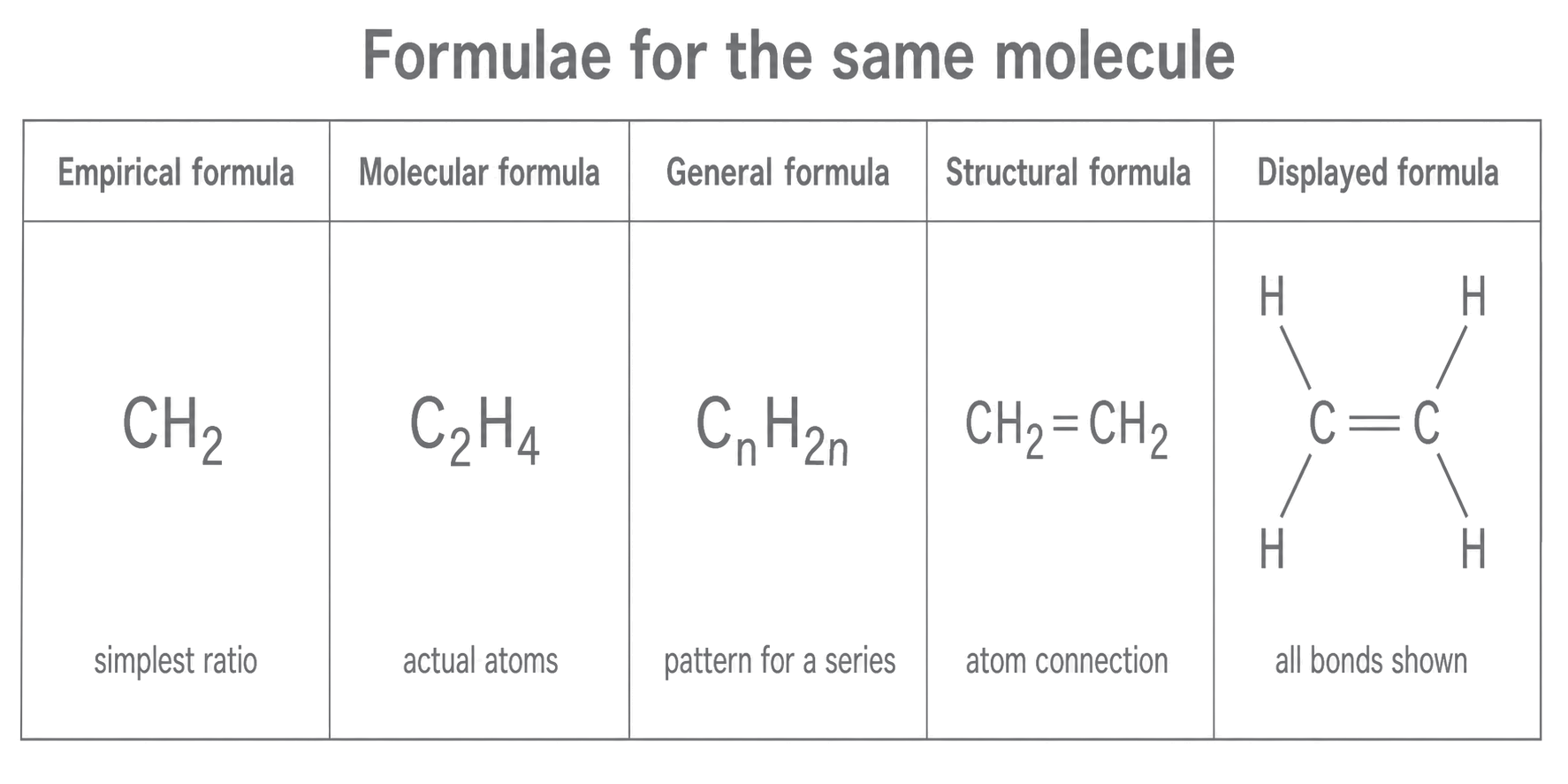
For a molecule with molecular formula C2H4, the empirical formula is CH2 because the ratio 2:4 simplifies to 1:2. The molecular formula stays as C2H4 because that is the actual number of carbon and hydrogen atoms in one molecule.
A general formula does not represent one particular molecule until a value of n is chosen. If a question gives the general formula and says n = 3, the molecular formula is C3H6. In this cluster, the key skill is understanding what a general formula does; later lessons teach the named homologous series that use particular general formulae.
Structural and displayed formulae
Structural formulae and displayed formulae both show how atoms are connected. The difference is how much bond detail they show.
Structural formula
A structural formula shows how the atoms in a molecule are arranged or connected. It is usually written in a condensed form, such as CH3CH2CH3.
A structural formula is compact, so it is useful when the connectivity matters more than drawing every single bond.
Displayed formula
A displayed formula shows all the atoms and all the bonds in a molecule.
Pearson exam diagrams use displayed formulae when every bond matters. A displayed formula must show bonds from carbon to hydrogen as well as bonds between carbon atoms. If a displayed formula is missing hydrogens or gives a carbon three or five bonds, it is chemically wrong.
A structural formula is more compact. For example, CH3CH2CH3 shows three carbon atoms connected in a chain without drawing every C-H bond. Branches may be written with brackets or drawn as a short side branch, but the important idea is the same: a structural formula tells you the atom connectivity.
When converting between these two forms, use carbon's usual four bonds as a check. A carbon in a displayed formula should have four bond lines around it, counting a double bond as two.
Continue this lesson.
You’re previewing NovaLearn without an account. Create a free account to read the rest.
Create free account