4.48C-4.50C - Condensation polymers and biopolyesters
Condensation polymerisation is another way to make very long molecules from smaller monomers. In this lesson, the monomers are a dicarboxylic acid and a diol, the polymer is a polyester, and water is formed as a small molecule alongside the polymer. You also need to recognise the repeat unit for the polyester made from ethanedioic acid and ethanediol.
What condensation polymerisation makes
A polyester can be made when two types of monomer react:
- a dicarboxylic acid, which has two
-COOHgroups - a diol, which has two
-OHgroups
The word di means two. The two functional groups are important because each monomer can react at both ends, so the molecules can join again and again to make a long chain.
Condensation polymerisation
Condensation polymerisation is polymerisation in which monomers join together and a small molecule is eliminated.
For the polyester reactions in this specification, the small molecule eliminated is water.
Polyester formation
dicarboxylic acid + diol -> polyester + water
This is different from simply joining monomers with no other product. In condensation polymerisation, the exam point is not just that a polymer forms; it is that water forms too.
When a dicarboxylic acid reacts with a diol, condensation polymerisation produces a polyester and water.
Use the check below to keep all three required words together: the process, the polymer, and the small molecule.
Forming an ester link
The link between the monomers in a polyester is an ester link. It forms when a carboxylic acid group reacts with an alcohol group.
[DIAGRAM: asset_name: Condensation polymers and biopolyesters - diagram 01; asset_slug: c63_condensation_polymers_and_biopolyesters__diagram_01; recommended_method: deterministic_drawing; description: Monochrome reaction diagram showing a carboxylic acid end and alcohol end forming an ester link, with OH and H eliminated as water.]
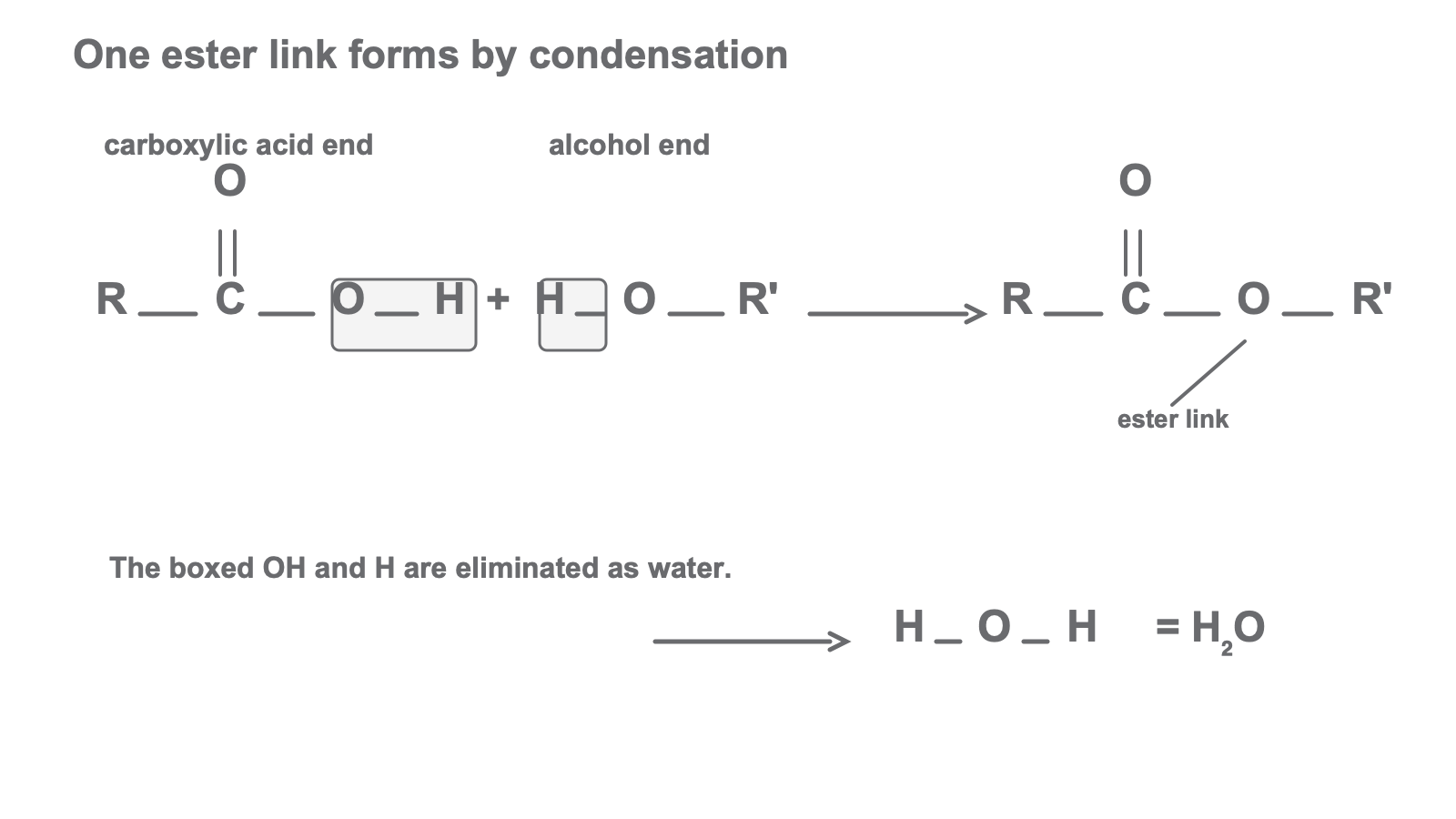
The useful pattern is:
Ester link formation
-COOH + HO- -> -COO- + H2O
The -COO- part is the ester link. In a polyester, this ester link appears many times along the chain because each monomer has two reactive ends.
A common mistake is to leave the acid as -COOH inside the polymer. In the polymer chain, the OH from the acid group and an H from the alcohol group are no longer attached in the same way; they have been eliminated as water.
Ethanedioic acid and ethanediol
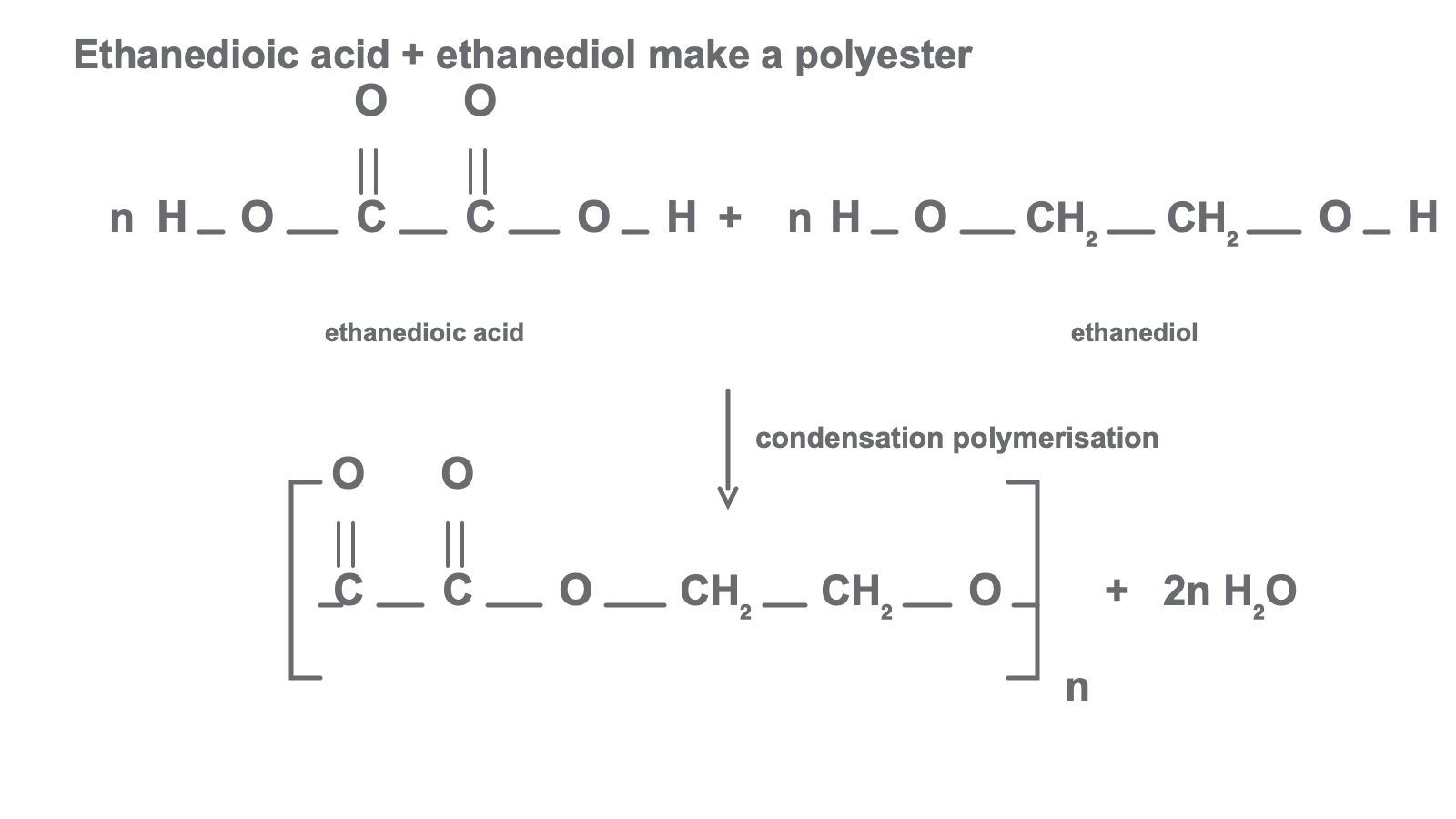
The required example is the reaction between ethanedioic acid and ethanediol.
Ethanedioic acid is a dicarboxylic acid. Its structural formula is HOOC-COOH. It has a carboxylic acid group at each end.
Ethanediol is a diol. Its structural formula is HOCH2CH2OH. It has an alcohol group at each end.
When these monomers react, ester links form between the acid and alcohol groups. Because the reaction continues at both ends, the product is a polyester.
[DIAGRAM: asset_name: Condensation polymers and biopolyesters - diagram 02; asset_slug: c63_condensation_polymers_and_biopolyesters__diagram_02; recommended_method: deterministic_drawing; description: Monochrome displayed reaction scheme for n ethanedioic acid plus n ethanediol forming the polyester repeat unit and 2n water, matching the Pearson specification structure.]
Continue this lesson.
You’re previewing NovaLearn without an account. Create a free account to read the rest.
Create free account