4.32C-4.33C - Ethanol production
Ethanol can be made in two very different ways: by reacting ethene with steam, or by fermenting glucose using yeast. The exam usually tests the conditions for each route, the balanced equations, and why fermentation needs no air and an optimum temperature. Keep the comparison precise: one route is a high-pressure catalytic reaction, the other is an enzyme-controlled biological reaction.
Two routes to ethanol
Ethanol is an alcohol with the formula C2H5OH. In this lesson, you do not need to redraw its displayed formula; the important idea is how ethanol is manufactured.
There are two specification routes:
| Route | Starting material | Main idea |
|---|---|---|
| Hydration of ethene | ethene and steam | add water across the C=C double bond in ethene |
| Fermentation of glucose | glucose solution and yeast | yeast enzymes convert glucose into ethanol and carbon dioxide |
Both routes make ethanol, but they are not interchangeable in exam answers. If the question asks for hydration, name ethene, steam, phosphoric acid catalyst, about 300 °C, and 60-70 atm. If it asks for fermentation, name glucose, absence of air, yeast enzymes, and an optimum temperature of about 30 °C.
The two useful equations are:
Hydration of ethene
This first equation shows one molecule of ethene reacting with one molecule of water to make one molecule of ethanol.
Fermentation of glucose
Do not confuse the catalysts. Phosphoric acid is the catalyst for hydration. Enzymes in yeast are the biological catalysts for fermentation.
Hydration of ethene
In hydration, ethene reacts with steam to form ethanol. The word hydration means adding water. Here the water is steam, and it is added to ethene.
[DIAGRAM: asset_name: Ethanol production - diagram 01; asset_slug: c58_ethanol_production__diagram_01; recommended_method: image_gen; description: Monochrome process diagram for ethanol manufacture by hydration, showing ethene and steam entering a reactor containing a phosphoric acid catalyst, with conditions about 300 °C and 60-70 atm, ethanol leaving, and the equation C2H4 + H2O -> C2H5OH.]
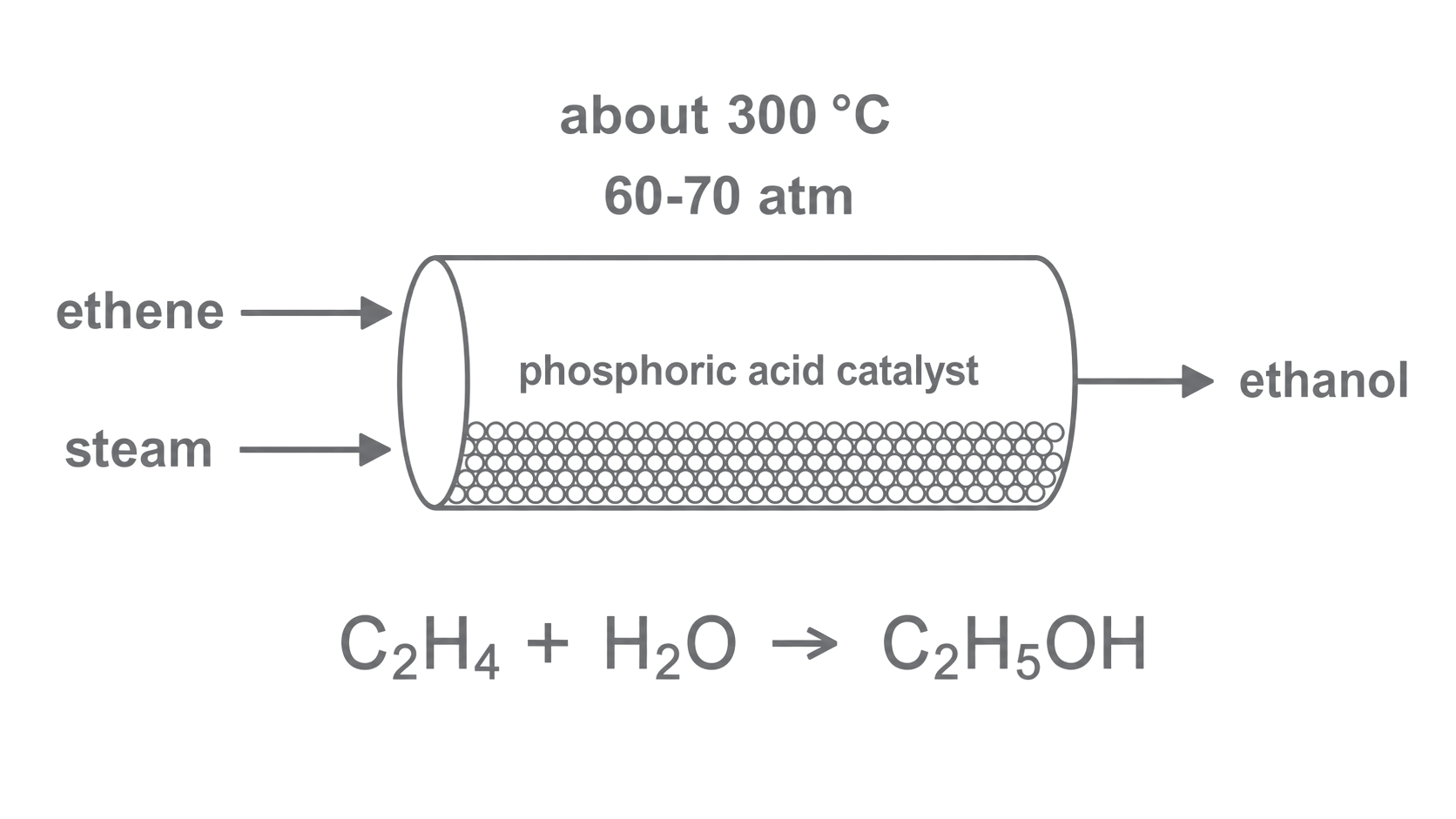
The required conditions are:
| Feature | Hydration condition |
|---|---|
| Reactants | ethene and steam |
| Catalyst | phosphoric acid |
| Temperature | about 300 °C |
| Pressure | about 60-70 atm |
This is often described as a continuous industrial process. Reactants can be passed over the catalyst and ethanol can be separated from the mixture. For this cluster, keep the explanation at the level of reactants, catalyst, temperature and pressure. Detailed equilibrium arguments are not needed unless a question gives extra information.
The hydration equation can also be written using the structural formula for ethanol:
Both C2H5OH and CH3CH2OH show ethanol. CH3CH2OH is useful because it makes the alcohol group visible.
Fermentation of glucose
In fermentation, glucose is converted into ethanol and carbon dioxide using the enzymes in yeast. The glucose is usually in aqueous solution, and the mixture is kept without air.
[DIAGRAM: asset_name: Ethanol production - diagram 02; asset_slug: c58_ethanol_production__diagram_02; recommended_method: image_gen; description: Monochrome fermentation apparatus diagram showing glucose solution plus yeast in a sealed vessel, an airlock or delivery tube for carbon dioxide, absence of air, about 30 °C, enzymes in yeast, and the equation C6H12O6 -> 2C2H5OH + 2CO2.]
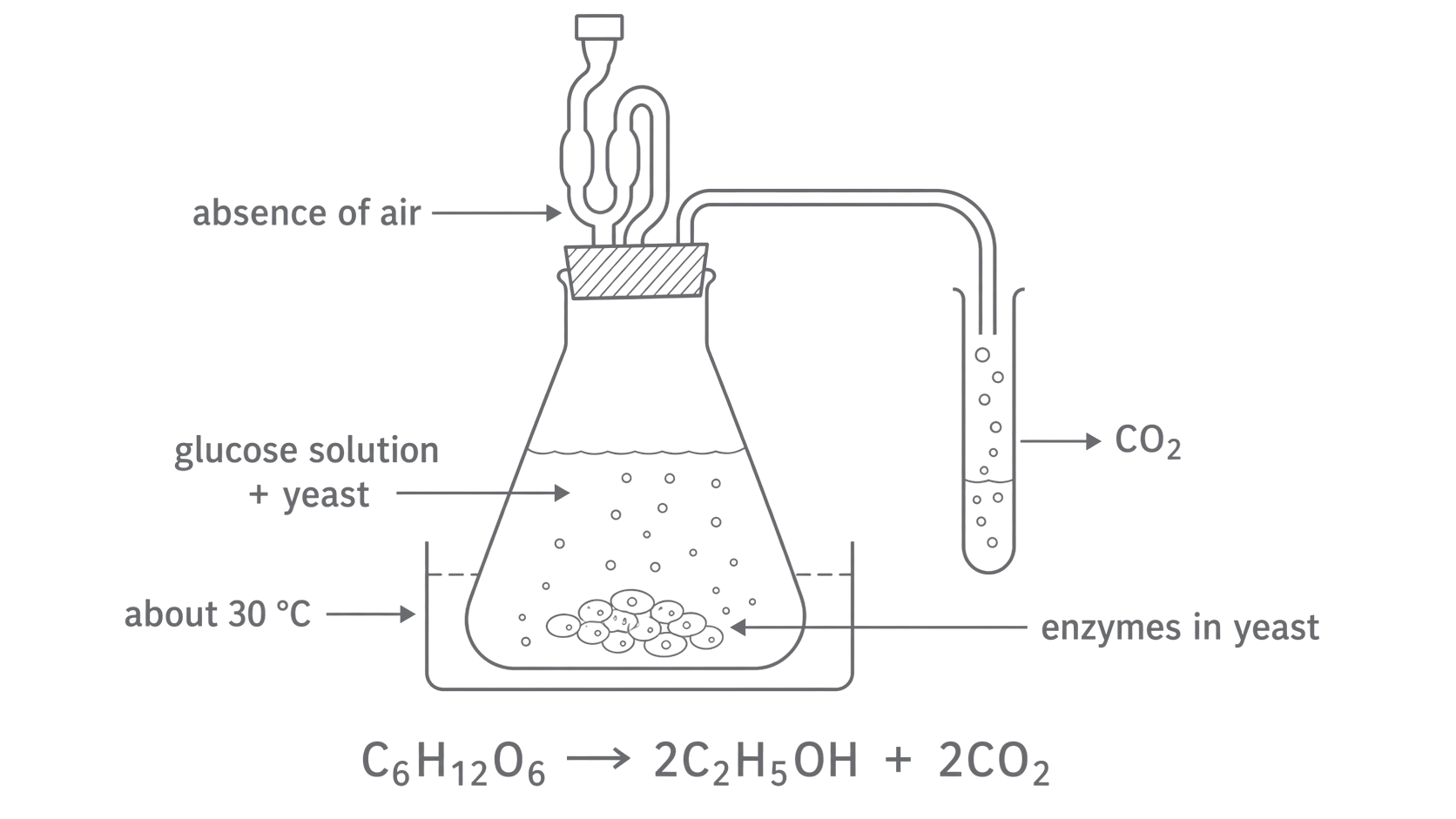
The balanced equation is:
Continue this lesson.
You’re previewing NovaLearn without an account. Create a free account to read the rest.
Create free account